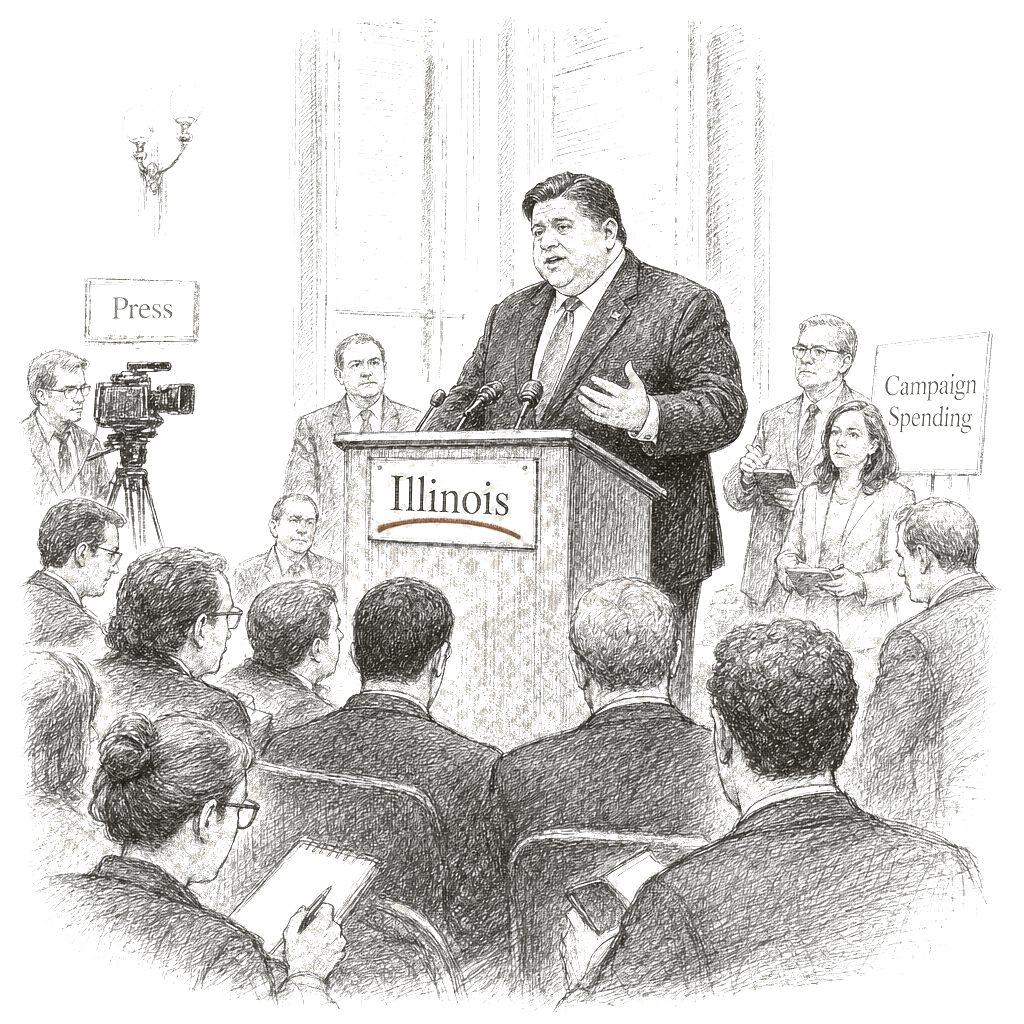
Pritzker condemns AIPAC spending, says group aligned with Trump
Illinois Gov. J.B. Pritzker on Wednesday criticized special-interest money that flowed into the state ahead of this week’s Democratic primary, including spending by the pro-Israel political group AIPAC. Pritzker, who is Jewish and who said he also contributed to efforts to influence races Tuesday, pointed to the scale of outside spending and to what he described as a shift in AIPAC’s political focus.
Pritzker said he previously supported AIPAC but left the group more than a decade ago, and he told The Associated Press that AIPAC no longer resembles the bipartisan Middle East-peace effort he remembered. He said AIPAC has become “an organization that was supporting Donald Trump and people who follow Donald Trump,” adding, “AIPAC really is not an organization that I think today I would want any part of.”
The governor called the influx of money “interference,” and said outside groups—including AIPAC—funneled roughly $70 million into six open U.S. House and Senate races in Illinois on Tuesday. A message left Wednesday for an AIPAC spokesperson was not immediately returned.
Primary contests highlight Democratic debate over Israel and the Middle East
Pritzker’s comments landed as multiple Illinois primary contests served as a proving ground for large national issues, with super PACs and other outside groups pouring millions into races across the state. The Democratic Senate primary for the open seat in particular reflected debates over questions about U.S. involvement in the Israel-Hamas war and, in recent days, the Iran war.
AIPAC’s involvement triggered some of the primary’s sharpest attacks, but its results were mixed in the Democratic nominations for House districts. In a 10-candidate primary for a U.S. House district that includes parts of Chicago’s South Side, AIPAC backed Cook County Commissioner Donna Miller, who won the Democratic nod Tuesday. In a separate Democratic primary in a heavily Jewish district north of Chicago, AIPAC supported Evanston Mayor Daniel Biss’s preferred candidate, but that candidate lost.
Pritzker spends millions supporting Stratton
While AIPAC’s role varied across House races, Pritzker’s own spending centered on helping his lieutenant governor, Juliana Stratton, in her bid for the Democratic U.S. Senate nomination. The governor said he himself put at least $5 million into helping Stratton, who won the Democratic nomination over U.S. Rep. Raja Krishnamoorthi, according to the AP report.
The AP report also said outside groups spent more than $16 million to support Stratton’s campaign and $11 million to support opposition to her. Pritzker said Stratton won on her own merits rather than because of his involvement, telling the AP, “She stood on her own two feet, and people saw that she’s real and she’s going to be a fighter for us in Washington.”
Other voters told the AP that Pritzker’s involvement mattered. Matthew Crain, 54, of downstate Chatham, said Pritzker’s endorsement influenced him to shift his vote from Krishnamoorthi to Stratton, saying that because of potential interest in Pritzker’s future White House ambitions, “I thought having one of his allies in would be a good thing.” Brooke Morgan, 39, of Springfield, said she gained confidence from the governor’s backing, adding, “The governor is doing a pretty good job in Illinois, and I think that his backing, his support of her certainly gave me some confidence as well.”
November matchup and Pritzker’s political horizon
Looking ahead, Pritzker said he will face Republican Darren Bailey in November. Bailey, a former state lawmaker who backs President Donald Trump’s agenda, received Trump’s endorsement four years ago and told supporters Tuesday that he does not agree with Trump on everything while vowing to include Democrats who feel left out, according to the AP report. Pritzker’s team characterized Bailey in a campaign ad posted Wednesday as “still too extreme for Illinois.”
The general-election matchup is a rematch: Pritzker defeated Bailey in 2022. Asked about higher office, Pritzker told the AP he is not planning anything beyond his 2026 bid for a third term, saying, “That is not something I’m thinking.”