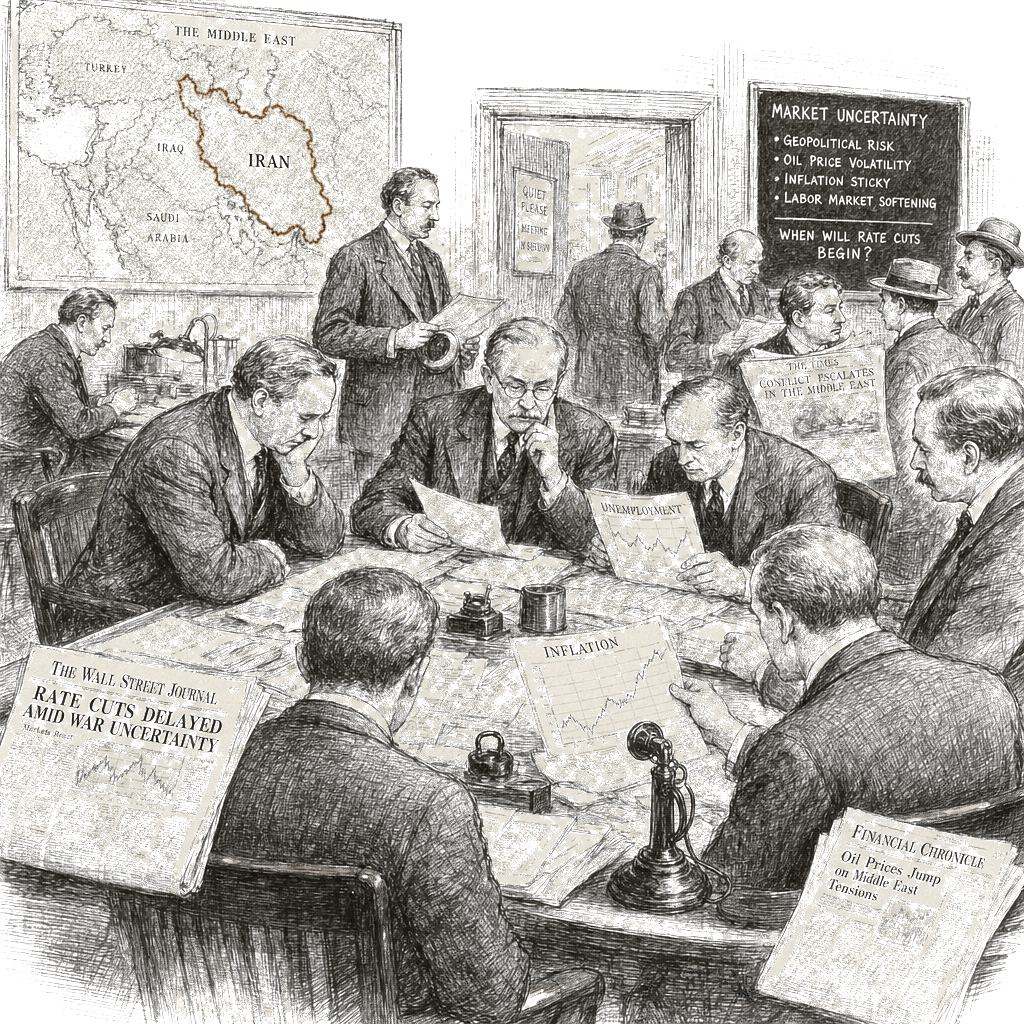
The Iran war has complicated the Fed’s decision on interest rates, with higher energy costs raising inflation risk while also threatening weaker economic growth and employment, the AP reported ahead of the Federal Reserve’s March policy meeting. The central bank’s 12-member rate-setting committee is expected to keep rates unchanged on Wednesday, and some economists said the conflict could keep the Fed on pause through later meetings.
For policymakers, the immediate problem is the energy-price jump linked to the conflict. Costlier gas can raise inflation in the short run, a factor that normally leads the Fed to either increase borrowing costs or hold them steady to dampen price pressures. But if the shock lasts long enough or is large enough, it can also strain the broader economy and push unemployment higher—an outcome that would typically lead the Fed to move in the opposite direction and cut rates.
The Fed’s path through that tradeoff, according to the AP reporting, is for now to “stand pat and wait to see which way the economy goes.” In that scenario, the Fed would not only keep rates unchanged on Wednesday, but may also remain on pause at meetings in late April and June. Many economists, the report said, expect the first rate cut this year to come no earlier than September or later.
Complicating the outlook further is the Fed’s quarterly economic projections, which require the committee to balance what it expects about inflation against how it sees growth and jobs evolving. In December, the committee forecast inflation would cool to 2.6% by the end of the year, and it projected core inflation would fall to 2.5%, excluding food and energy. But the report said those figures had already been moving in the wrong direction before the Iran war, with core prices rising 3.1% in January from a year earlier—the biggest increase in more than two years.
The AP also noted disagreement among economists over how the Fed should treat core inflation in its projections. Tim Duy, chief economist at SGH Macro, argued the Fed should raise its forecast for core inflation to at least 2.8% by the end of this year. He said that an increase of that magnitude would make it harder to justify any cuts during the year, and he also warned against what he characterized as the possibility that the Fed’s projections might still call for a cut.
Another pressure point highlighted in the report is that the Fed cut three times last year before pausing in January, and the committee is now deciding whether it can maintain a forecast that includes at least one rate cut. The AP said whether the Fed continues to show a single rate cut in its projections or instead pulls back to project no cuts was considered by many economists a close call, with several Fed officials reluctant to give up on the idea of reducing rates.
The conflict has also intersected with other Fed considerations. The AP said mortgage rates have already risen in the wake of the fighting, in part because markets appear to expect higher inflation will prevent the Fed from cutting anytime soon. The report cited the average 30-year mortgage rate jumping to 6.1% last week from 6%, while still remaining below nearly 6.7% from a year ago. Derek Tang, an economist at Macro Policy Analytics, said Fed officials are “a little scarred” from the backlash tied to the word “transitory,” which was used during the earlier inflation surge.
Beyond rates, the report said the Fed also faces a major leadership transition. Powell’s term ends May 15, and President Donald Trump has nominated Kevin Warsh to replace him. The nomination, the AP reported, has been delayed in the Senate because Republican senators have objected to a Justice Department investigation of Powell tied to his testimony about a building renovation. A judge threw out two subpoenas issued by the Justice Department last Friday, dealing a blow to the investigation, though the AP said U.S. Attorney Jeannine Pirro said she would appeal the ruling.
Still, the AP described a possible counter-scenario that would keep policy steady even if energy prices spike. It said the Fed has in the past often looked through supply shocks after they end, and if the latest disruption proves temporary, inflation could eventually drop without the Fed needing to hike rates further—leaving the committee to consider unchanged rates or even future cuts if employment weakens. With inflation still elevated after the pandemic-era surge—and after Powell’s earlier “transitory” framing did not play out—the Fed’s projections, and the timing of any cuts, remain at the center of the debate.