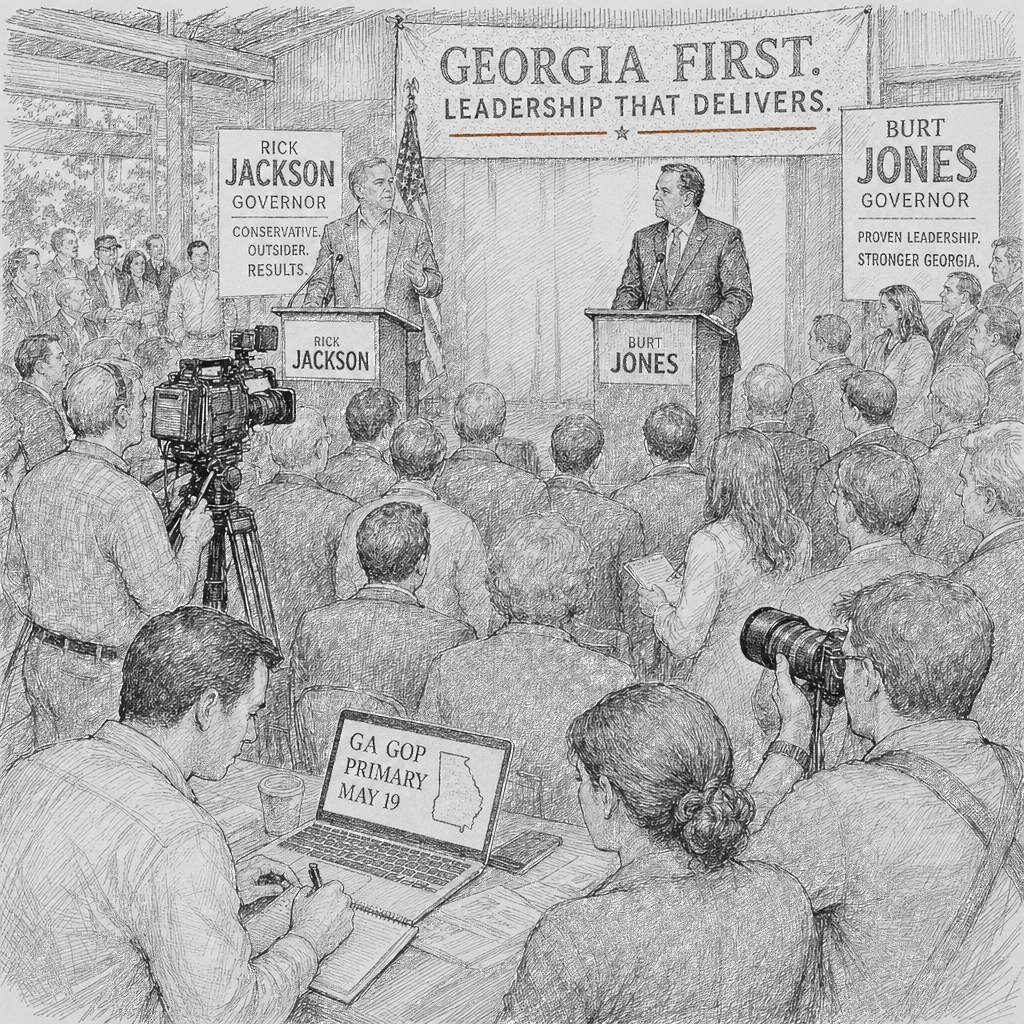
Trump-backed Jones faces influx of money from Rick Jackson
Burt Jones, Georgia’s lieutenant governor and a leading Republican contender for governor, has found his previously assumed path to the GOP nomination complicated by the entry of health care entrepreneur Rick Jackson, whose self-funded campaign has shifted the race’s momentum. The Associated Press reported that Jackson entered the contest in February after what the story described as an abrupt, financially forceful arrival that undercut the idea that Jones was the inevitable nominee.
Jackson began running television ads funded by more than $30 million of his own money, with more than two months before the May 19 election. The AP described the surge as an election “turned upside down,” with Jackson’s advertising blitz and campaign tactics contrasting with Jones’s reliance on Trump’s support.
While the article characterized Jones as leaning on Trump’s endorsement, Trump publicly reaffirmed his connection to Jones. The AP reported that Trump said Feb. 19 at an event in Rome, Georgia, “Burt Jones has been here and been with you and been with me right from the beginning.”
Court fight, lawsuits and a fast escalation of attacks
The Jackson campaign also moved the contest into legal and ad-to-ad confrontation. The AP reported that Jackson filed a lawsuit claiming Jones was defaming him, and that Jones responded the next day with a negative ad barrage.
The race also includes outside pressure on Jones. Before Jackson’s entry, the AP said a mystery dark money group began spending $19 million on ads that accused Jones of using his office to enrich himself. The story reported that there is little evidence to support the most serious claims, including an allegation that Jones used his lieutenant governor role to promote a data center development his family partly owns. Jackson has repeatedly denied bankrolling the ads that began in November.
Alongside the ad war, the AP described how a federal court ruling temporarily constrained a fundraising mechanism tied to Jones. The story said a federal judge ruled a leadership committee structure illegal because contributions from others remain subject to Georgia’s $8,400 limit. It said Jones was ordered not to spend from the committee, but that a judge froze that order Friday to allow Jones to appeal. The AP added that while Jones has increased spending from other sources, political consultants said Jackson had already bought so many television spots that he may crowd out competitors.
“No template” for Jackson’s approach, Morgan says
Former Georgia state Republican Party executive director Jay Morgan told the AP that there is “no template” for what Jackson is doing in Georgia, and that the campaign is on a “different playing field.” Morgan said, “We’re on a different playing field,” adding, “It’s like going from Little League to major leagues.” The AP reported that Morgan viewed the shift as dramatic, saying, “The landscape that we were looking at 30 days ago looks radically different today.”
Political analysts in the AP story also framed the Trump-endorsement question as a test of whether a nominee can rely on the president’s backing alone. University of Georgia political scientist Charles Bullock said, “The Trump endorsement is still valuable to get, but it can’t be the be-all and end-all.” Bullock added: “I guess $50 million or whatever Rick Jackson is spending will be a real test of that.”
Jones counters Jackson’s Trump credibility
The AP described Jones’s effort to counter Jackson by challenging Jackson’s political alignment and fundraising background. It said Jones tried to question Jackson’s “Make America Great Again” bona fides, including citing Jackson’s history of giving to Republicans other than Trump. The story also said Jones pointed to Jackson’s health care staffing company assisting Planned Parenthood and gender-affirming care.
Jackson’s campaign responded with its own messaging. The AP reported that on Feb. 4, Jackson launched his candidacy at a faux Italian office park he custom-built for Jackson Healthcare in suburban Alpharetta. The story said Jackson described himself as a businessman entering politics and told supporters he would be “Trump’s favorite governor.”
Jackson also attacked Jones directly at the launch, saying of Jones, “I saw a so-called front-runner who was as weak as can be and as lazy as the day is long,” and adding, “Really, he wants the title of governor, but not the job.”
The self-funder’s background and political ties
The AP portrayed Jackson as a former foster child who now calls himself a billionaire, describing his fortune as stemming from Jackson Healthcare. The story said Jackson Healthcare recruits medical workers and leases them as well-credentialed temp workers, and reported that the state of Georgia has been among its biggest clients. It said Jackson Healthcare companies have collected nearly $1 billion from state government in recent years, including providing medical workers during the pandemic.
Beyond business, the AP described Jackson’s long-running role in Georgia politics as a Republican megadonor and policy advocate. It reported that he has supported and advocated over the years on issues including medical malpractice and foster care, and that he helped back efforts that increased support for foster children. The story also said Jackson has run ads pledging to cut taxes, deport immigrants and block gender-affirming care to minors, while noting that some people described him as motivated by Christian faith and concern for others.
The AP included a testimonial from a Republican operative who has worked for Jackson, Eric Tanenblatt, who said, “He’s a rock-solid conservative and just a terrific guy.” Tanenblatt also said, “He’s obviously a successful business person, but also someone with just a genuinely kind heart.”
Trump influence and the GOP party’s positioning
The AP reported that Jackson’s emergence presented additional trouble for Trump’s influence in a battleground state, recalling that Trump’s kingmaker record in Georgia had been described as shaky in past races. It also said Trump has backed Jones in the current contest after other endorsements and political efforts in Georgia in prior election cycles.
The AP also described how Republican officials previously sought to shape party strategy in the primary before Jackson entered the race. It said Josh McKoon, Georgia Republican Party chairman, and the state’s two Republican National Committee members sought to waive a party rule about taking sides in primaries so the party could back Jones, but that local party groups condemned the move and the national party later said it would not wade in. The AP reported that Joe Gruters, the RNC chairman, told WSB-AM on Feb. 19, “We’re not spending any money in that race.”
Even so, the AP reported that large self-funding does not guarantee success. It said that of 65 candidates who spent more than $1 million of their own seeking federal office in 2024, only 10 won, according to OpenSecrets.
Critics question Jackson’s MAGA ties
The AP reported that Jones’s attacks have focused on whether Jackson is a “never Trumper,” citing Jackson’s earlier political friendships and giving. It also said Jackson has tried to offset that history, writing a $1 million check to Trump’s MAGA Inc. PAC on Dec. 10, and said Jones supporters were not persuaded.
Debbie Dooley, a pro-Jones Republican activist, told the AP, “My Chihuahua Izzy is closer to being MAGA than Rick Jackson is.”
For now, the AP described how Jackson’s financial force has made his message feel inescapable and has complicated Jones’s position as the Trump-backed front-runner heading into the May 19 contest.