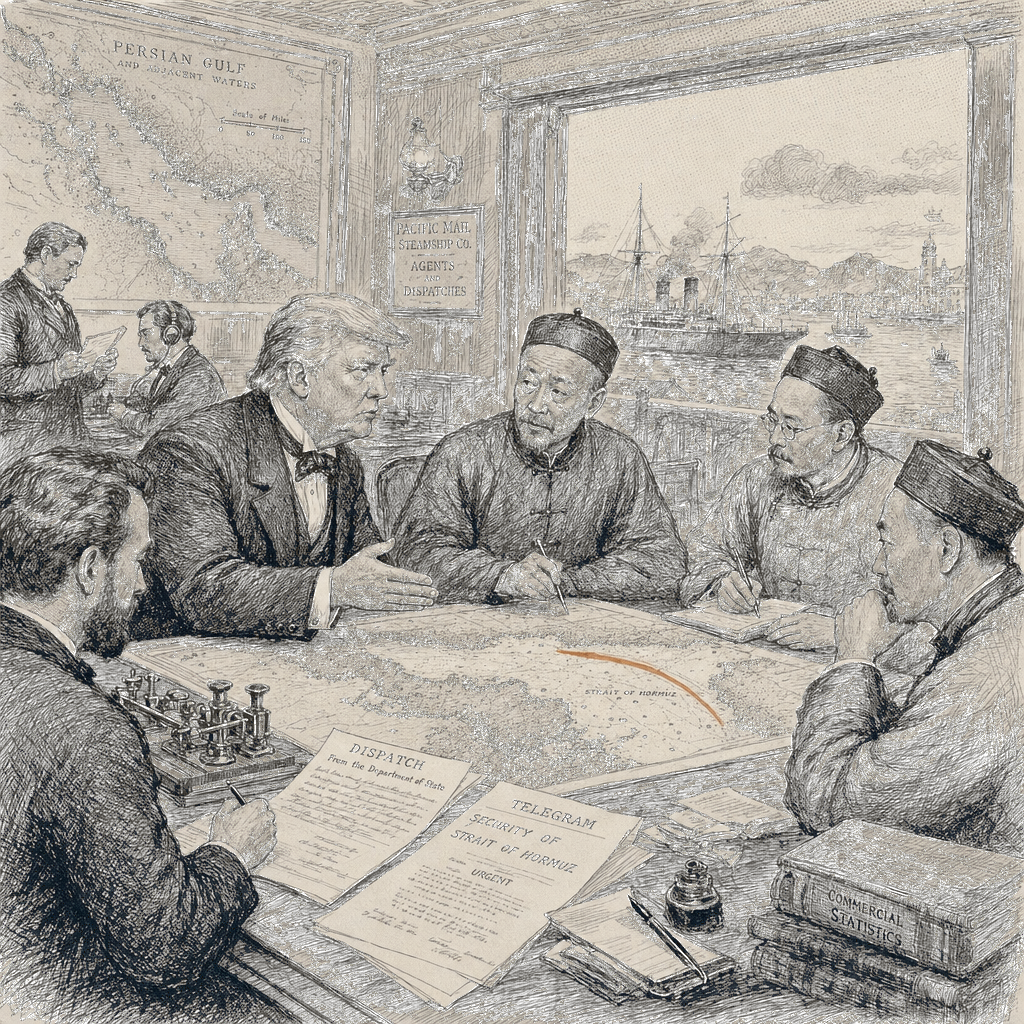
After launching strikes on Iran with Israel, President Donald Trump is turning to a broader diplomatic push centered on the Strait of Hormuz, a key shipping route linking the Persian Gulf to the Gulf of Oman. Speaking at the White House on Monday, Trump said he has asked a half-dozen or more countries to send warships to reopen the strait and said he wants them to “come and help us with the strait.”
Trump also tied the request to his plans for a late-March trip to China, suggesting he could condition the timing of the visit on whether Beijing will take part in efforts to secure tanker traffic. “We’d like to know” whether China will help secure the strait, Trump said in a Sunday interview with the Financial Times, and he added that the trip “We may delay.” An afternoon event in the Oval Office then described Trump saying he has asked China to delay the visit “a month or so,” while also saying he feels “I have to be here” because of the war.
In explaining the administration’s pressure campaign, the White House argued that other governments stand to benefit from U.S. efforts aimed at Iran. White House press secretary Karoline Leavitt told reporters on Monday that the initiative is “something not just the United States but the entire Western world has agreed with for many, many years,” and she said it reflects a goal to disarm the Iranian regime. Trump’s framing has also included the argument that countries relying on the strait more than the United States should contribute because, as he put it, “we strongly encourage other nations whose economies depend on the strait far more than ours … we want them to come and help us with the strait.”
Treasury Secretary Scott Bessent sought to lower the market implications of any shifting timeline with Beijing, saying in a CNBC interview Monday that rescheduling would not be tied to the strait dispute. Bessent said that if the meeting were delayed, it “would be rescheduled because of logistics,” and he urged investors not to react negatively if Trump postpones the trip. Trump’s own comments about delaying face-to-face talks with Chinese President Xi Jinping come as relations between the world’s two largest economies remain strained over tariffs and other issues.
Trump’s requests have met resistance so far from several governments that say they are not ready to expand their role in the conflict. In Britain, Prime Minister Keir Starmer said Monday that Britain is working with allies on a plan to reopen the Strait of Hormuz, but “will not be drawn into the wider war,” and he said Britain is discussing with the United States and allies the possibility of using mine-hunting drones. Starmer also signaled the United Kingdom is unlikely to dispatch a warship, and other countries described similar limits: Australia’s Transport Minister Catherine King said “we won’t be sending a ship to the Strait of Hormuz,” Italy’s Antonio Tajani said EU naval missions supporting the Red Sea could not readily be expanded to the Strait of Hormuz, and the report said France was “a maybe” when “circumstances permit.”
As the administration weighs options, it has faced a mismatch between its call for international participation and other nations’ willingness to take on risk at sea. The AP report said Trump has argued early on that the United States did not need help because it had access to oil, but he has pressed for external assistance as oil prices rose and the Middle East remained volatile. The continuing pressure campaign came after Trump initially downplayed threats from Iran and said U.S. Navy vessels would escort tankers, and amid growing calls for a coalition rather than a solely American approach.
Trump also confronted questions about economic fallout from the war, including how long gas prices might stay elevated. At the White House on Monday, Trump dismissed the question when asked about what aides had told him about gas prices, saying, “I don’t need advisers to tell me that. I know what it is.” Bessent, speaking from Paris while meeting with Chinese Vice Premier He Lifeng for trade talks, similarly downplayed the impact on oil prices, accusing the media of “trying to make it into some crisis that it’s not,” and saying prices would come down after the conflict ends.
China, in response to the administration’s request, was described as noncommittal. A Foreign Ministry spokesperson in Beijing, Lin Jian, did not respond directly to questions about Trump’s call for outside help in the strait, instead highlighting the impact on goods and energy trade and repeating China’s call for an end to the fighting. The AP report described Trump’s view that this reluctance reinforces his suspicions about relying on other countries, including by drawing on earlier statements about alliance weakness—an argument he made Monday by comparing how he said NATO members might act “in need.”
As a result, Trump’s effort to broaden the coalition around Hormuz is unfolding alongside uncertainty over the next step in the broader U.S.-China diplomatic calendar. While Trump signaled he may delay his late-March visit unless China helps secure the strait, Bessent said any postponement would be logistical, and Britain and other governments have indicated they are working on reopening the route without directly joining what Trump calls a wider effort to secure it during the Iran war.