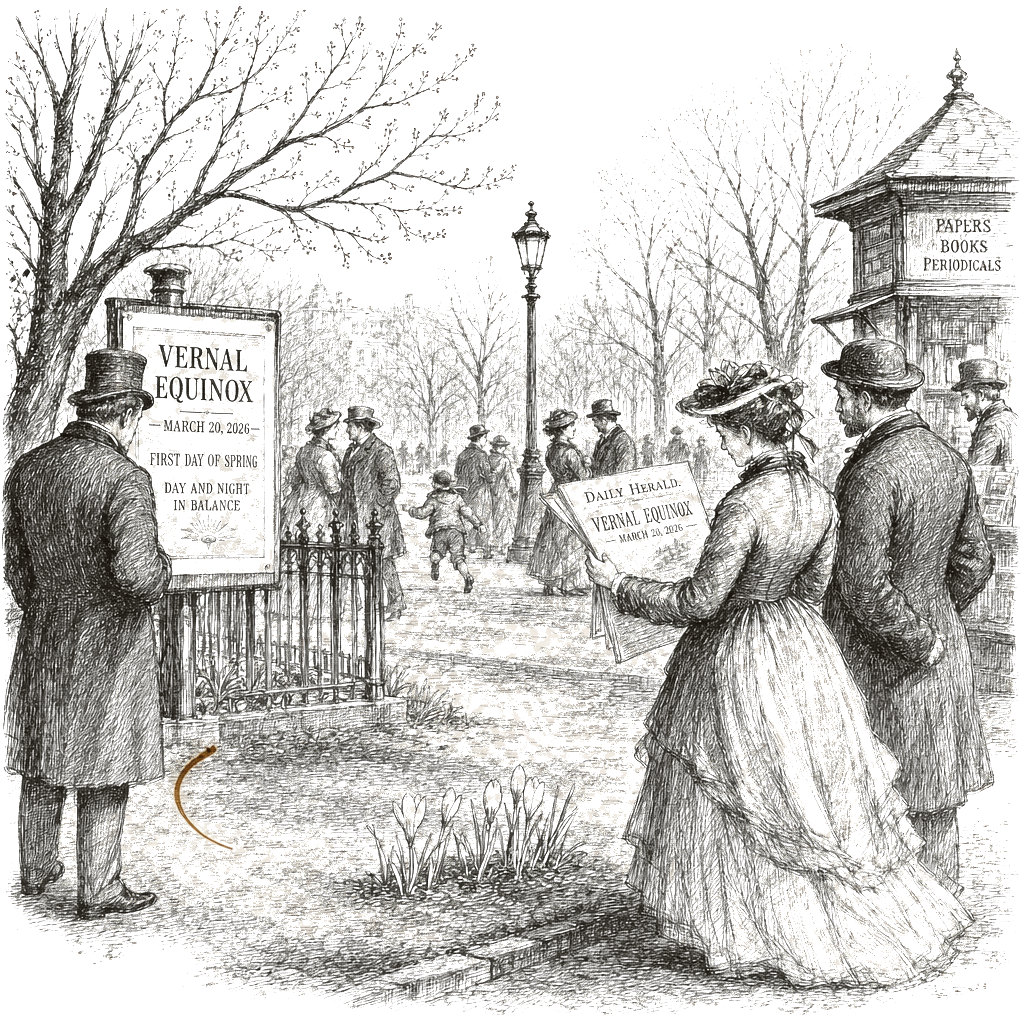
The vernal equinox arrives Friday, March 20, 2026, marking the start of spring in the Northern Hemisphere and the start of fall in the Southern Hemisphere. While local weather may not immediately feel like spring, the astronomical transition is tied to Earth’s position in its orbit around the sun.
The equinox occurs at the moment the sun is directly overhead at the equator. On the equator, the sun will be directly overhead at noon on the equinox.
During the equinox, Earth’s tilt is neither toward the sun nor away from the sun, so both the northern and southern hemispheres receive an equal amount of sunlight. The AP explains that, as a result, the sun rises almost exactly due east and sets almost exactly due west.
The term “equinox” comes from two Latin words meaning equal and night. On the equinox, day and night last almost the same amount of time, though one may get a few extra minutes depending on where you are on the planet.
In the Northern Hemisphere, the fall—or autumnal—equinox can land between Sept. 21 and 24, depending on the year, while the spring—or vernal—equinox can land between March 19 and 21. For 2026, AP reports the exact time is Friday, March 20 at 10:46 a.m. EST.
From that point, days will get a little longer every day in the Northern Hemisphere until the solstice in June, when day length reaches its seasonal extremes.
The solstices, by contrast, mark when Earth’s tilt is tipped most extremely either toward or away from the sun. At the Northern Hemisphere’s summer solstice, Earth’s upper half is leaning toward the sun, creating the longest day and shortest night of the year; AP says this year’s summer solstice falls on June 21, within a window of June 20 to June 22.
The winter solstice follows the opposite pattern. At the Northern Hemisphere’s winter solstice, Earth’s upper half leans the furthest away from the sun, leading to the shortest day and longest night of the year, with the winter solstice falling between Dec. 20 and 23.
The AP story also distinguishes astronomical seasons from meteorological seasons. Astronomical seasons depend on how Earth moves around the sun, while meteorologists define three-month seasons based on annual temperature cycles. Under the meteorological calendar, spring starts on March 1, summer on June 1, fall on Sept. 1, and winter on Dec. 1.
Equinoxes have been marked and celebrated around the world for centuries. AP reports that Japan observes “Vernal Equinox Day” as a public holiday, and that at the Mayan site Chichen Itza in Mexico, people gather during the equinox to watch the sun create a shadow pattern resembling a serpent descending a pyramid called El Castillo.