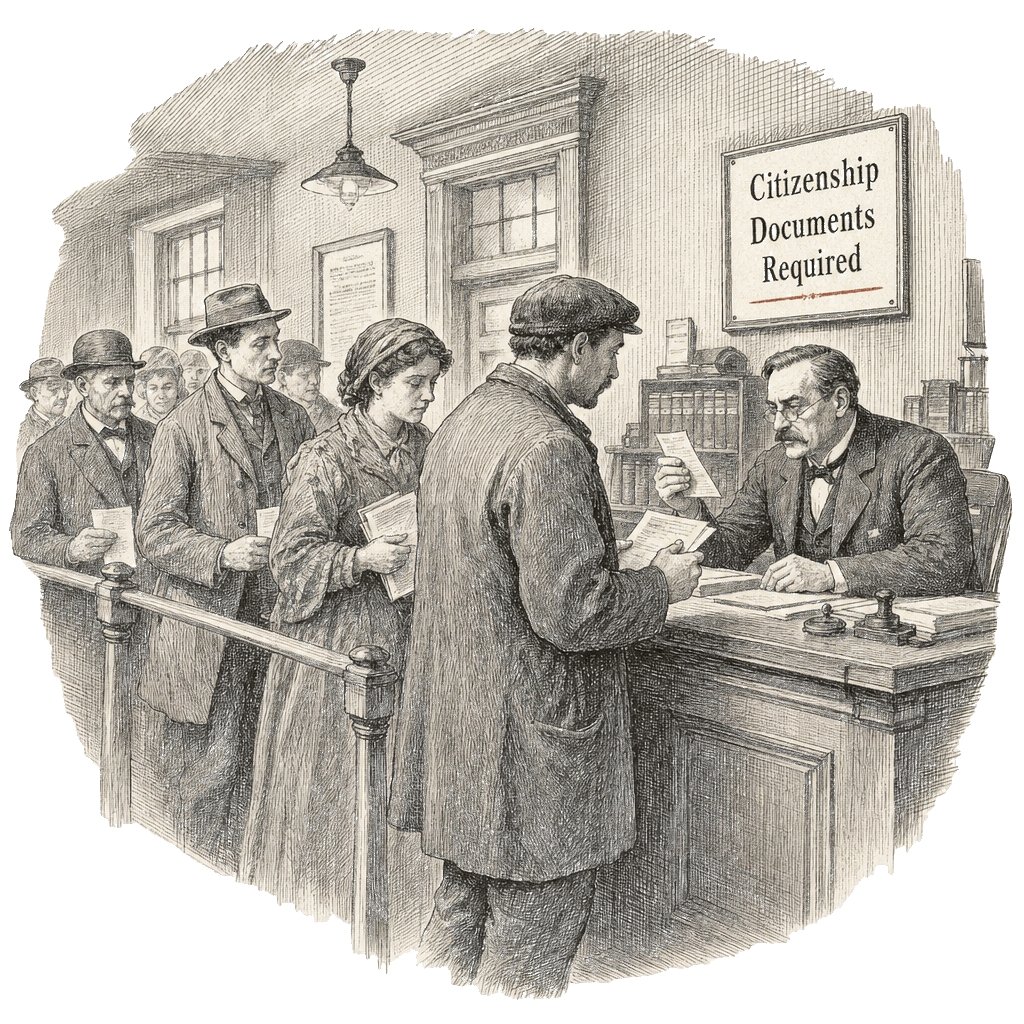
The House has cleared the Republican-backed SAVE America Act, a measure that would require voters to provide documentary proof of U.S. citizenship to register for federal elections, setting up a potential change that critics say could affect millions of eligible Americans.
The bill cleared the U.S. House last month on a mostly party-line basis. Republicans argue the requirements would improve election integrity, and President Donald Trump has described the bill’s safeguards as common sense. The measure is scheduled to come up in the U.S. Senate next week for voting and debate.
While the bill’s messaging has often emphasized a photo ID requirement, the documentary proof-of-citizenship mandate is expected to carry the broadest impact. Under current rules, noncitizens are already prohibited from voting in federal elections, and the article said noncitizen voting is not allowed by any state. Cases where it occurs, the article reported, are rare.
Opponents point to the possibility that the documentary standard could create new barriers for voters who do not readily have qualifying documents. The Fair Elections Center’s Rebekah Caruthers said the legislation’s strict documentation requirements could move the U.S. “in the opposite direction” of representative democracy, in an email. She also said the bill would deny millions of eligible Americans their fundamental freedom to vote and argued that the impact would extend to communities including married women, people of color, and voters in rural areas.
The article described a “long list” of qualifying documents in the SAVE Act, but said many include qualifiers. For example, a REAL ID-compliant driver’s license would need to indicate that “the applicant is a citizen,” but the article said only five states—Michigan, Minnesota, New York, Vermont and Washington—offer that enhanced type of REAL ID. By contrast, standard driver’s licenses typically do not indicate citizenship, and the article noted some states, including Ohio, have added citizenship indicators more recently.
The article also described additional documentation constraints. It said that while military ID cards are listed, they would not be sufficient on their own and would need a military “record of service” indicating the person’s U.S. birthplace. It added that a DD214 does not fulfill that requirement, citing the Pentagon’s position that the form does not list where someone was born.
Beyond what counts as proof, the timing and access to documents are central to the debate. The article reported that the SAVE Act contains no phase-in period in its description, meaning a documentary proof-of-citizenship mandate could apply immediately if Congress passes the bill and Trump signs it, potentially affecting the next election cycle. The piece cited a 2025 University of Maryland study estimating that 21.3 million Americans eligible to vote lack or have no easy access to documents proving their citizenship, including nearly 10% of Democrats, 7% of Republicans, and 14% of people unaffiliated with either major party.
A passport, the article noted, would most effectively meet the requirement, but it reported that about half of American adults have one, citing the State Department. It also said the bill requires passports to be current and that expired passports would not count. The article said the State Department website estimates passport processing time at four to six weeks excluding mailing time, with expedited options of two to three weeks for additional fees. It reported that a new passport costs $165 for adults while renewals cost $130, plus photo costs of $10 or $20 more, and that fully expedited processing would cost at least $257.
The practical hurdles extend to birth certificates as well. The article said the SAVE Act would require certified birth certificates issued by state, local government or tribal government, and that it would not appear to include the certificate signed by a doctor that new parents receive in the hospital. It also described delays for certified copies in at least some states, and said people whose birth certificates do not match current IDs—such as women who change last names after marriage—would likely need additional documentation to register under the bill.
The article also highlighted that the SAVE Act, as described, would not provide money to help states and local election offices implement or promote the changes. It pointed to a recent example from New Hampshire involving Joshua Bogdan, a 31-year-old resident who said he ran into trouble voting after arriving at his polling place in Portsmouth. Bogdan said the poll worker told him that under the state’s proof-of-citizenship law, which took effect for the first time during town elections in 2025, he would need a passport or his birth certificate because he had moved and needed to reregister.
Bogdan said he did not expect the change when he entered the polling place, saying, “I didn’t know that anything had officially changed walking in there.” He added that being told to provide documents he had not previously needed was “frustrating,” saying, “And then being told that I had to provide a passport that I’ve never had or a birth certificate that’s usually tucked away somewhere safe just to cast my vote — which I’ve done before — it was frustrating.”
In the article, Bogdan said he was eventually able to cast his ballot because he had recently retrieved his birth certificate from his parents’ house more than an hour away. He also said he believed government notices to voters could help prevent possible disenfranchisement, adding that young voters do not always carry documents like birth certificates and Social Security cards. He said, “Young voters like myself don’t always carry around our birth certificate, Social Security card, all that important stuff, because it’s not used ever or very often.” He said, “And so all those young kids who are going to go out and try and vote will be held back from that.”