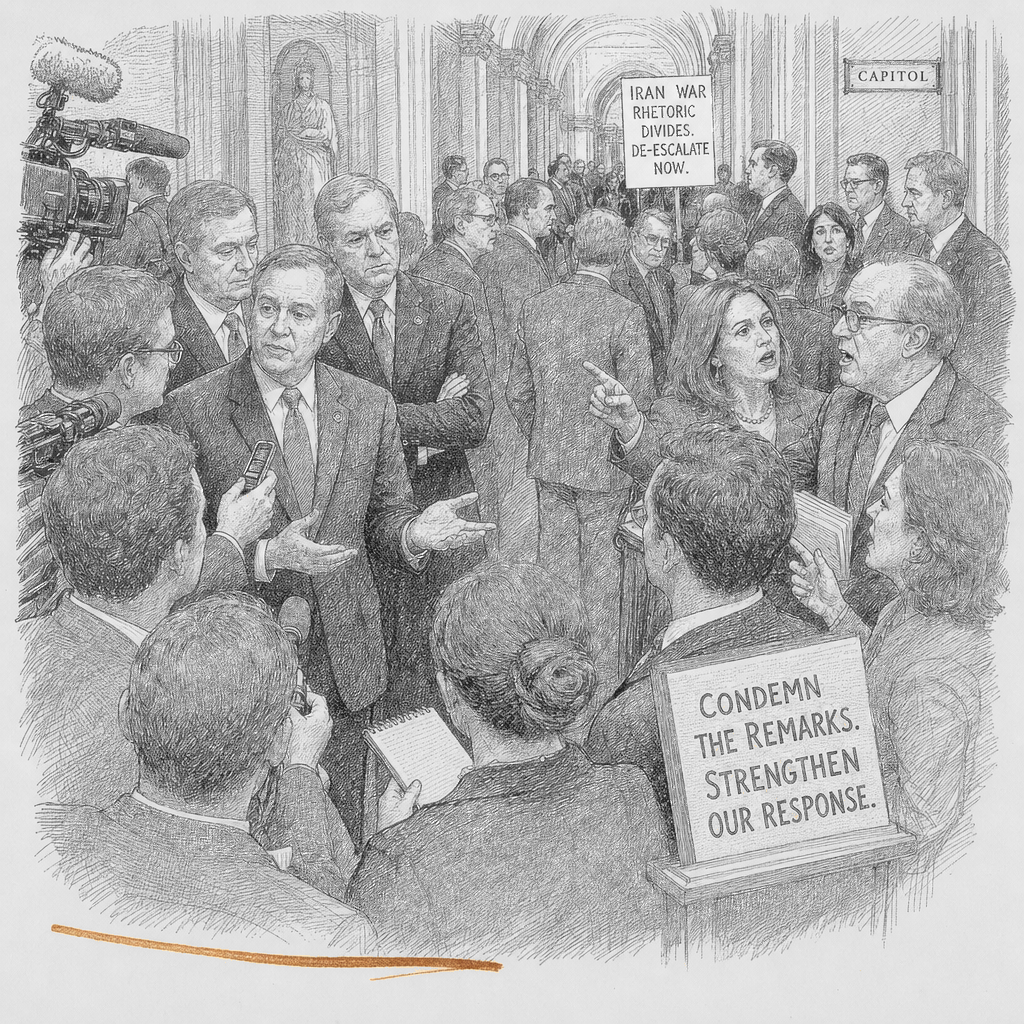
Anti-Muslim rhetoric from some Republicans in Congress intensified this week as the Iran war escalated political tension and lawmakers responded to attacks that targeted Muslim communities, according to reporting by the Associated Press.
The rhetoric sharpened after criticism from Democrats for comments that singled out Muslims and tied them to security fears, even as Democratic leaders said Republican control of messaging should have produced firmer pushback. In several cases, party leaders acknowledged that the tone and language were an issue, while offering limited condemnation of the remarks themselves.
Alabama Sen. Tommy Tuberville became a focal point after he posted about New York Mayor Zohran Mamdani during an iftar dinner at New York City Hall. Tuberville wrote Thursday, “The enemy is inside our gates,” accompanying the post with a photo of Mamdani sitting on the ground juxtaposed with an image of the Sept. 11 attacks, according to the Associated Press account.
Hours later, Tuberville doubled down, saying, “To be clear, I didn’t ‘suggest’ Islamists are the enemy. I said it plainly.” Democrats condemned the comments and used the remarks to argue that GOP leaders were not doing enough to prevent anti-Muslim messaging, the report said.
The broader surge also followed other incidents that Republicans framed through a national-security lens. Federal officials identified a man who rammed his vehicle into a hallway at Temple Israel in West Bloomfield Township, Michigan, as a naturalized citizen born in Lebanon, according to Associated Press reporting. The AP account said officials described the man as having lost four family members in an Israeli airstrike in Lebanon last week, just after sunset as worshippers were having their fast-breaking meal during Ramadan.
In Virginia, the Associated Press report said Mohamed Bailor Jalloh opened fire in a classroom at Old Dominion University before ROTC students subdued and killed him. Court documents described in the reporting said Jalloh had previously served time for attempting to aid the Islamic State and was released less than two years ago.
As Democrats condemned the tone of GOP responses, Republican lawmakers also pushed proposals that tied immigration and citizenship status to counterterrorism objectives. Minnesota Rep. Tom Emmer, the House GOP whip, said the “security of our nation hinges on our ability to denaturalize and deport terrorists,” and West Virginia Rep. Riley Moore said he would introduce legislation to denaturalize and deport a naturalized citizen who “commits an act of terrorism, plots to commit an act of terrorism, joins a terrorist organization or otherwise aids and abets terrorism against the American people,” according to the Associated Press account.
Republican rhetoric targeting Muslims also spread online, the report said, including from Tennessee Rep. Andy Ogles. The Associated Press report said Ogles wrote in a social media post that “Muslims don’t belong in the United States,” and that after criticism mounted he later wrote that “paperwork doesn’t magically make you American” and that “Muslims are unable to assimilate; they all have to go back.”
When asked about Ogles’ post, House Speaker Mike Johnson said he had spoken with members “about our tone and our message and what we say.” Johnson added that Ogles used “different language than I would use,” but he said he believes the issue raised by the comments is “serious,” according to the Associated Press account. Johnson also said, “There’s a lot of energy in the country, and a lot of popular sentiment that the demand to impose Sharia law in America is a serious problem,” and that “That’s what animates this.”
During the same period, Democrats framed the rhetoric as anti-Muslim hostility rather than legitimate policy debate. Senate Democratic leader Chuck Schumer condemned Tuberville’s post, calling it “mindless hate” in comments cited by the Associated Press. Zohran Mamdani also responded directly to Tuberville’s “enemy inside our gates” framing by saying: “Let there be as much outrage from politicians in Washington when kids go hungry as there is when I break bread with New Yorkers.”
Iman Awad, national director for policy and advocacy at the Muslim American advocacy group Emgage Action, told the Associated Press that the comments have consequences beyond words. “When members of Congress speak, it’s not just words,” Awad said. “It shapes public perception. It legitimizes prejudice.”
The Associated Press report also placed the current rhetoric within an earlier pattern of hostility in the years after the Sept. 11 attacks and the wars in Afghanistan and Iraq. For many Muslims, the report said, the moment carries echoes of that era, when the hostility was accompanied by discrimination and racist violence.
The reporting noted that Republican leaders’ limited condemnation contrasts with comments from earlier Republican administrations. The Associated Press account said that after the Sept. 11 attacks in 2001, then-President George W. Bush visited the Islamic Center of Washington, D.C., and said, “America counts millions of Muslims amongst our citizens, and Muslims make an incredibly valuable contribution to our country,” adding: “They need to be treated with respect. In our anger and emotion, our fellow Americans must treat each other with respect.” Bush also warned that “Those who feel like they can intimidate our fellow citizens to take out their anger don’t represent the best of America, they