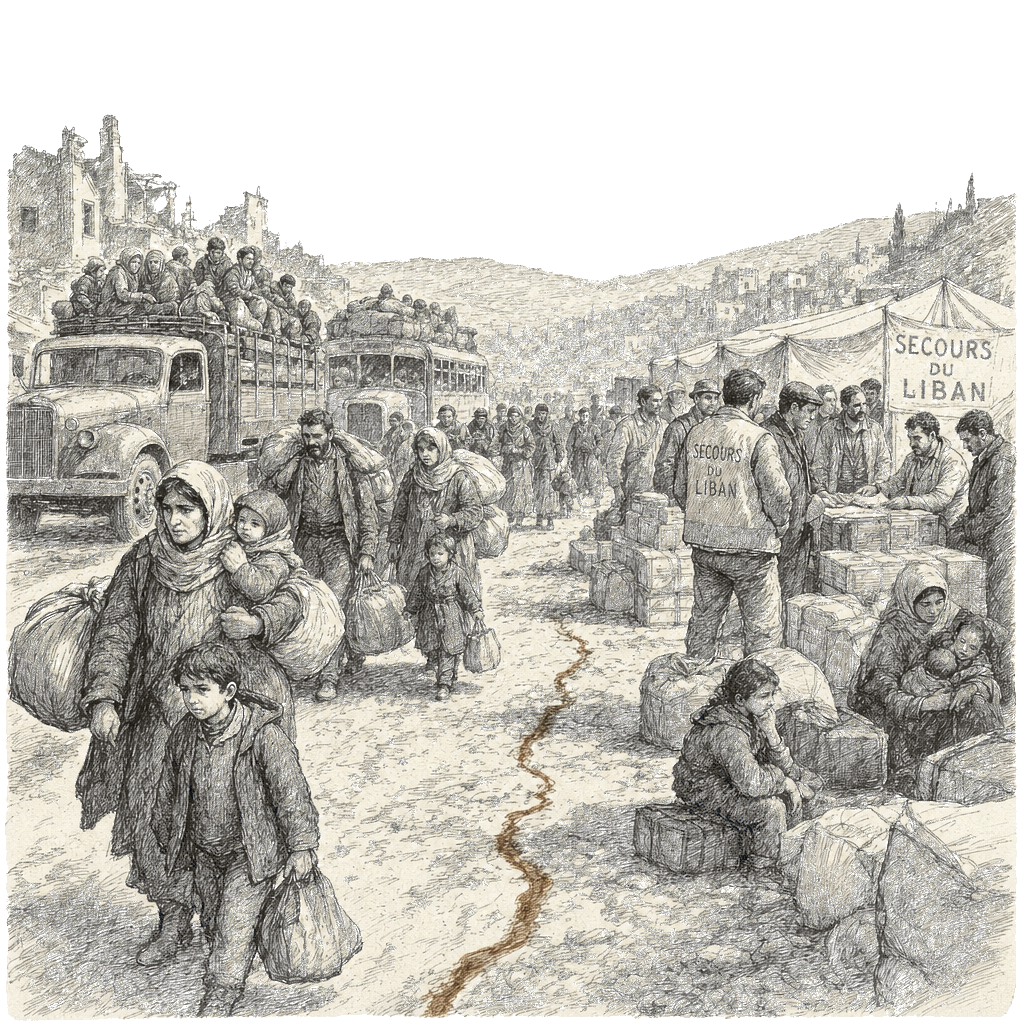
War has displaced nearly a million Lebanese, aid groups and officials said, warning that the scale and speed of departures are outpacing shelter capacity and humanitarian response.
Fatima Nazha slept on the street for two days after she and her family fled their home in Beirut’s southern suburbs following what the article described as an Israeli mass evacuation order. With schools that the government had converted into shelters already full, Nazha said the family could not afford a hotel or an apartment, and she and her husband moved into a tent in the country’s biggest stadium while their children and grandchildren found shelter near the southern coastal city of Sidon.
The article said the displacement has surged in just 10 days, reaching more than 800,000 people in Lebanon. It added that the Norwegian Refugee Council described the figure as about one in every seven people in the small country and noted that the current uprooting has occurred just over a year after the previous conflict displaced over a million Lebanese.
Nazha, who uses a wheelchair, said leaving home this time has been harder than during the last war, more than a year ago. She said, “The strikes used to target a specific area, but now they’re hitting all the areas,” describing how the intensity and unpredictability of attacks, and the abruptness of the evacuation order, left her unable to gather all her belongings.
Lebanon’s Health Ministry said Friday that more than 700 people, including 103 children, have died in the war, according to the report. In the same account, Nazha said that the limited support available to displaced people is not enough, telling reporters, “It’s not enough that they bring us food. … A tin of sardines or a loaf of bread or a gallon of water, that’s not enough.”
Humanitarian groups, the article said, are struggling to keep up after years of underfunding. Mathieu Luciano, the head of the International Organization for Migration in Lebanon, said during a recent press briefing, “The needs are escalating much faster than our capacity to respond.”
The government has used Lebanon’s largest sports stadium as a makeshift shelter, with Nazha and her husband among more than 800 people sleeping in semiopen corridors under the stands, the report said. It described the stadium setup as having toilets and sinks but no showers and only sporadic electricity.
The article described conditions and logistics as a time-sensitive scramble, quoting Naji Hammoud, who oversees sporting facilities for the Lebanese Youth and Sports Ministry, saying, “It’s a race against time” as aid workers and volunteers pitched tents.
It also detailed how the government’s sheltering efforts and the evacuation warnings unfolded quickly, with what the report said would be described as major roads into Beirut becoming gridlocked as people tried to find safe places. According to the account, Israel first called on dozens of villages south of the Litani River to flee north and later warned residents to evacuate Dahiyeh, an area of predominantly Shiite suburbs on Beirut’s southern edge.
In displacement accounts from residents, the report said Seganish Gogamo, a worker from Ethiopia who fled Nabatieh, described being trapped on the road before finding a shelter spot in a Beirut church hosting migrant workers. Gogamo said, “We were on the road for two days until we found this place here that accepted us,” and the article said she fled in the middle of the night after intense airstrikes.
The report said uncertainty about the war’s duration remains high, pointing to fears that a ground invasion could follow. It reported that some 100,000 Israeli troops had amassed along the U.N.-mandated Blue Line, where many residents who remained in border areas during the first days of fighting later chose to leave after attacks killed people nearby.
Joe Sayyah, who the report said was among residents who stayed in the border village of Alma al-Shaab during the initial days, described how the brief relief of reaching shelter turned into worry. He said, “This time around, there’s a huge possibility we may not be able to go back to our village.”