Aid groups warn of a humanitarian crisis as evacuations swell displacement in Lebanon
War has already displaced nearly a million Lebanese, and families are struggling to find shelter as Israel’s strikes and evacuation orders scatter people across the country, according to the Norwegian Refugee Council and aid officials in Lebanon.
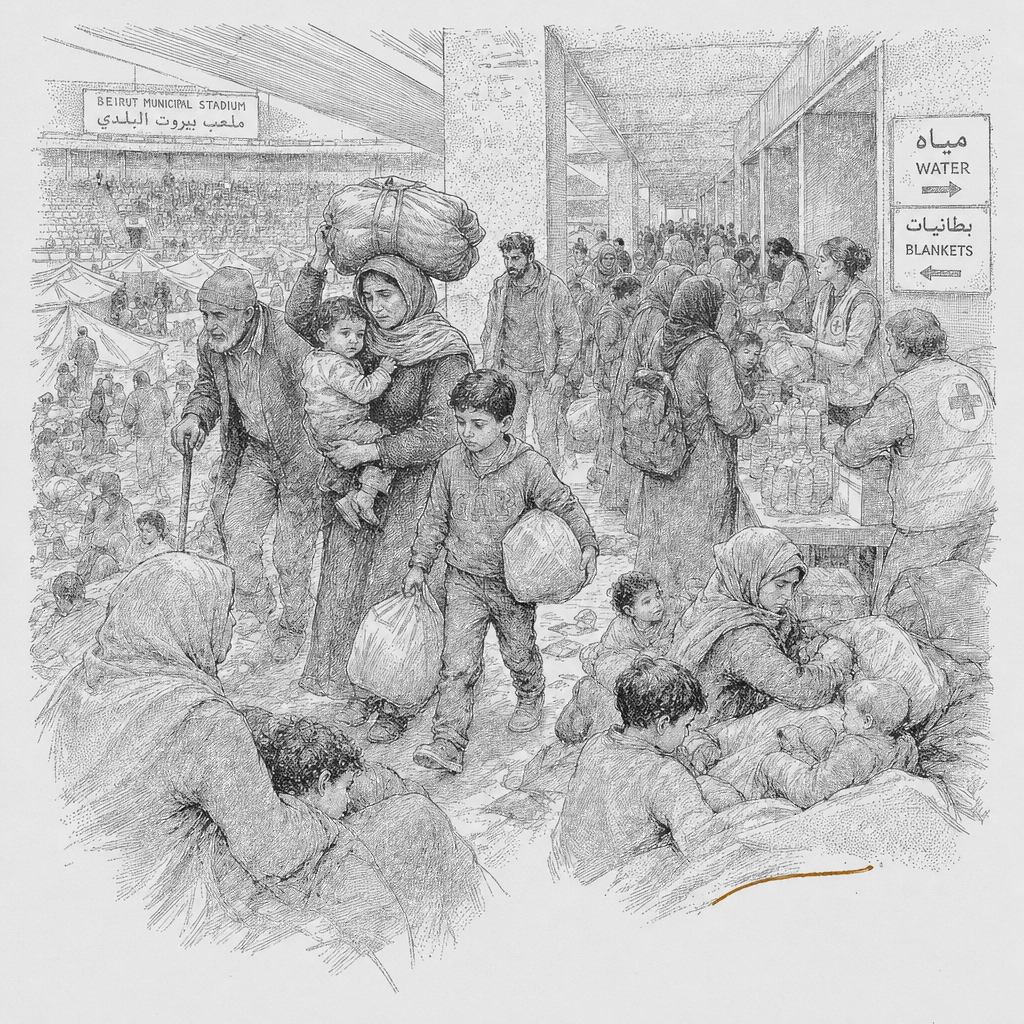
Fatima Nazha fled her home in Beirut’s southern suburbs after what the report described as an Israeli mass evacuation order. She slept on the street for two days because schools converted into shelters were full and the family could not afford a hotel or an apartment. The family later moved into a tent in Lebanon’s biggest stadium while their children and grandchildren found space near the southern coastal city of Sidon, the Associated Press reported.
In just 10 days, more than 800,000 people in Lebanon were displaced by war, according to the Norwegian Refugee Council, which said the total amounts to about one in seven people in the tiny country. Many families still lack a place to stay, and the cash-strapped government has been able to accommodate only roughly 120,000 people as it scrambles to open shelters and bring in more supplies, the report said.
Nazha, who uses a wheelchair, described the latest displacement as worse than the last time Israel and Hezbollah fought more than a year ago. She said the strikes targeting Hezbollah have grown more intense and unpredictable, and that the evacuation order came abruptly, leaving her unable to gather all her belongings. “The strikes used to target a specific area, but now they’re hitting all the areas,” Nazha said.
The war’s toll is also rising, according to Lebanon’s Health Ministry, which said Friday that more than 700 people—including 103 children—have died in the conflict. The report said the crisis is unfolding across a country already divided by simmering resentments tied to Hezbollah’s regional role and the way the fighting has spread.
Israel ramped up its strikes after Hezbollah fired rockets into Israel following the killing of Iran’s Supreme Leader Ali Khamenei, the report said. In Lebanon, the Associated Press described growing resentment toward Hezbollah and its backers as internal tensions continue, including after Israel’s attacks on Hezbollah in Lebanon in 2023 linked to Hezbollah’s support for Hamas.
Housing and services in Beirut have also tightened as displacement rises. The report said landlords have been hiking apartment rents to deter new tenants and that hotels have been vetting guests more strictly after Israeli strikes hit two hotel rooms, which Israel said were targeting Iranian Revolutionary Guard members operating in Beirut. People without family networks or money have instead slept on streets or in cars around central Beirut, trading comfort for safety.
Humanitarian groups, the report said, are struggling to keep pace after years of underfunding. Mathieu Luciano, head of the International Organization for Migration in Lebanon, said during a recent press briefing that “The needs are escalating much faster than our capacity to respond,” according to the Associated Press.
In Beirut, the report described the scale of the sheltering effort as the government uses the country’s largest sports stadium as a makeshift facility. Nazha said she and her husband slept in semiopen corridors under the stands, while more than 800 other people also stayed there. She said the site has toilets and sinks but no showers and only sporadic electricity, and she criticized the level of assistance as inadequate, saying: “It’s not enough that they bring us food. … A tin of sardines or a loaf of bread or a gallon of water, that’s not enough.”
Residents and aid workers also described the speed of the evacuation process and how quickly it overwhelmed daily life. The report said Israel first called on dozens of villages south of the Litani River to flee north, then later warned residents to evacuate Dahiyeh, a densely populated Shiite suburb on Beirut’s southern edge. The report said main roads to the capital became gridlocked as people tried to find safety.
While some families left only after attacks made staying impossible, others have described the uncertainty of whether they will be able to return. Joe Sayyah, who remained in the border village of Alma al-Shaab during the first days hoping to avoid leaving, told the Associated Press that he and others decided to go after a friend was killed by an Israeli drone strike while watering plants. He said they rang the church bell one last time before leaving in a convoy escorted by United Nations peacekeepers, but later after holding a funeral Mass in a church in the northern outskirts of Beirut, he said relief at finding shelter quickly turned into concern. “This time around, there’s a huge possibility we may not be able to go back to our village,” Sayyah said.
With about 100,000 Israeli troops amassed along the U.N.-mandated Blue Line, many residents fear the conflict could continue beyond the Iran war, the report said, as the displacement crisis deepens and the pressure on shelters and aid capacity intensifies.