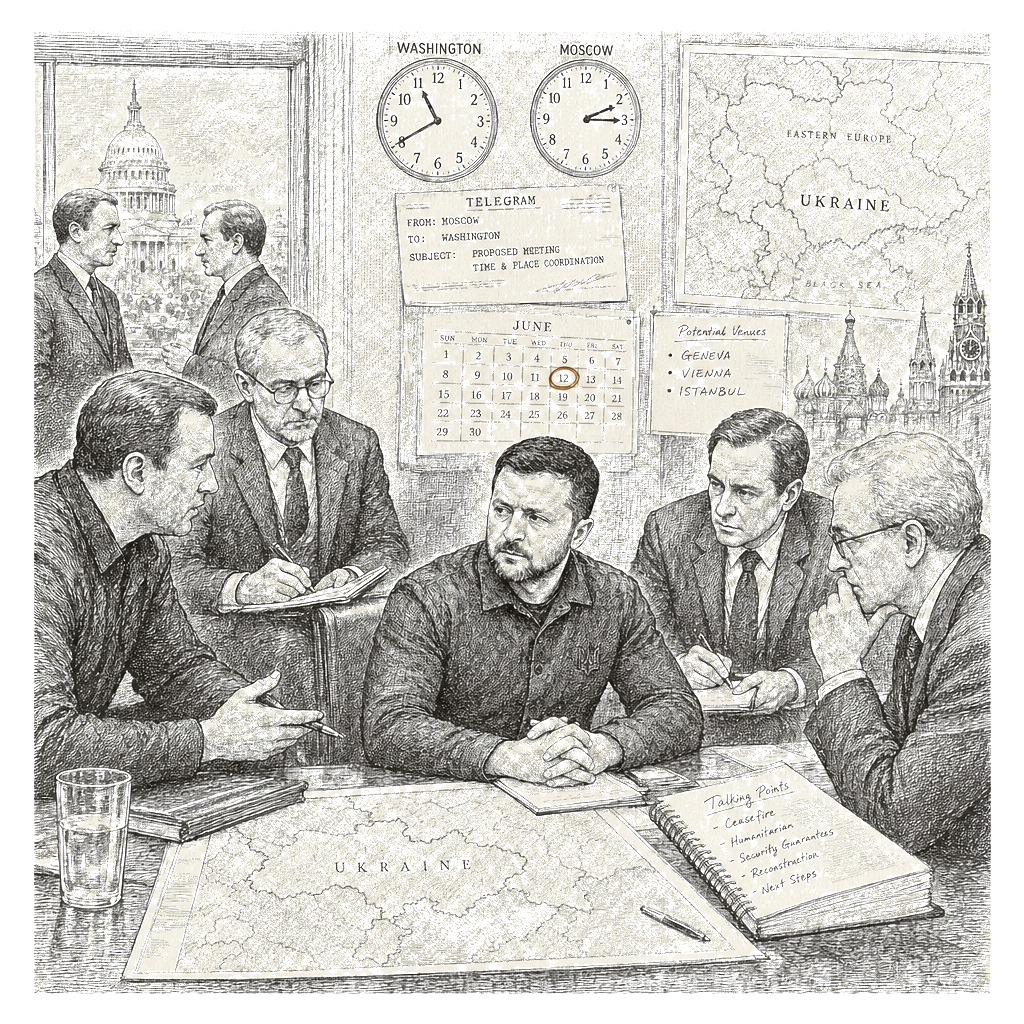
Zelenskyy said Ukraine was prepared to move to the next stage of trilateral talks to end Russia’s more than four-year invasion, while placing the responsibility for the next step on the United States and Russia to align on the meeting’s logistics. In comments released Sunday, the Ukrainian president said the U.S. had proposed a format that would host the next meeting with American, Ukrainian and Russian negotiating teams, but he said Moscow had not agreed to participate.
Zelenskyy said he was waiting for Washington to respond and said the parties needed to settle whether the meeting location would change or whether Russia would confirm the U.S. plan. He added in a media briefing Saturday that Ukraine was not blocking any initiatives and wanted a trilateral meeting to take place.
In the U.S.-proposed approach, Zelenskyy said, the negotiating teams would include U.S. envoys Steve Witkoff and Jared Kushner. He also said the U.S. had suggested the American side would host the next round, but that Moscow refused to send a delegation after the proposal.
Zelenskyy’s remarks also tied Ukraine’s diplomacy to the broader international attention shift he associated with the Middle East conflict. The comments said the U.S. postponed talks it was sponsoring between the two sides because of the war in the Middle East, which he described as having erupted on Feb. 28 after U.S.-Israeli strikes on Iran and spread across the region.
He told journalists that he warned of a “very high” risk that the Iran war could drain the air-defense stockpiles Ukraine relies on against Russian missile strikes. Zelenskyy said he did not have a clear picture of what air-defense stockpiles were available and said he discussed with French President Emmanuel Macron in Paris on Friday whether SAMP/T systems could serve as an alternative to U.S.-made Patriot batteries for intercepting ballistic missiles, and that Ukraine would be “first in line” to test any viable alternative.
Zelenskyy also addressed U.S. comments about drone support, pushing back against President Donald Trump’s assertion that Washington had no need for Ukrainian drone technology. Trump had said the U.S. did not need Ukrainian help on drone defense in a Fox News Radio interview aired Friday, and Zelenskyy said Washington had reached out to Ukraine “several times” requesting assistance for specific countries or support for Americans.
According to Zelenskyy, those requests were made through U.S. military institutions to Ukraine’s Ministry of Defense and other military leaders, and he said Ukraine’s institutions provided responses. Zelenskyy added that last year he offered Washington a defense cooperation deal worth $35 billion–$50 billion that would have given the U.S. administration access to technology from roughly 200 Ukrainian drone, AI and electronic warfare firms, with half of production earmarked for partners, primarily the U.S.
He said U.S. military officials had expressed strong interest in the proposal and that Trump himself had indicated he was receptive. Zelenskyy told reporters that he and others received a message from the U.S. and directly from Trump that the U.S. was interested, but he said Ukraine did not sign the document under Trump and that he did not have an explanation for why, adding that it might happen later but that he was not sure.
On energy transit, Zelenskyy warned against reopening the Druzhba pipeline for Russian oil transit through Ukraine while the EU continues to impose sanctions on Russian oil sales elsewhere. He said it raised a question of whether the U.S. and European partners would oppose lifting sanctions in one context while pressing Ukraine to resume pipeline transit at a political price that, he said, effectively pays for anti-European policies.
Zelenskyy said if conditions imposed on Ukraine in the dispute threatened weapons supplies, Kyiv would have no choice but to resume oil transit. He said he told EU partners that such a scenario would amount to “blackmail.” He said oil deliveries through Druzhba have been halted since Jan. 27 and that an escalating feud has followed between Hungary and Ukraine, with the Ukrainian government attributing the stoppage to Russian drone strike damage and Hungarian Prime Minister Viktor Orbán accusing Zelenskyy of deliberately holding up supplies.
Zelenskyy’s comments linked the feud to broader European policy and financing disputes, saying Orbán vetoed a new round of EU sanctions against Russia and blocked a major 90-billion euro ($106 billion) EU loan for Ukraine until oil flows resume.