The White House attacks CNN over Iranian leader’s remarks
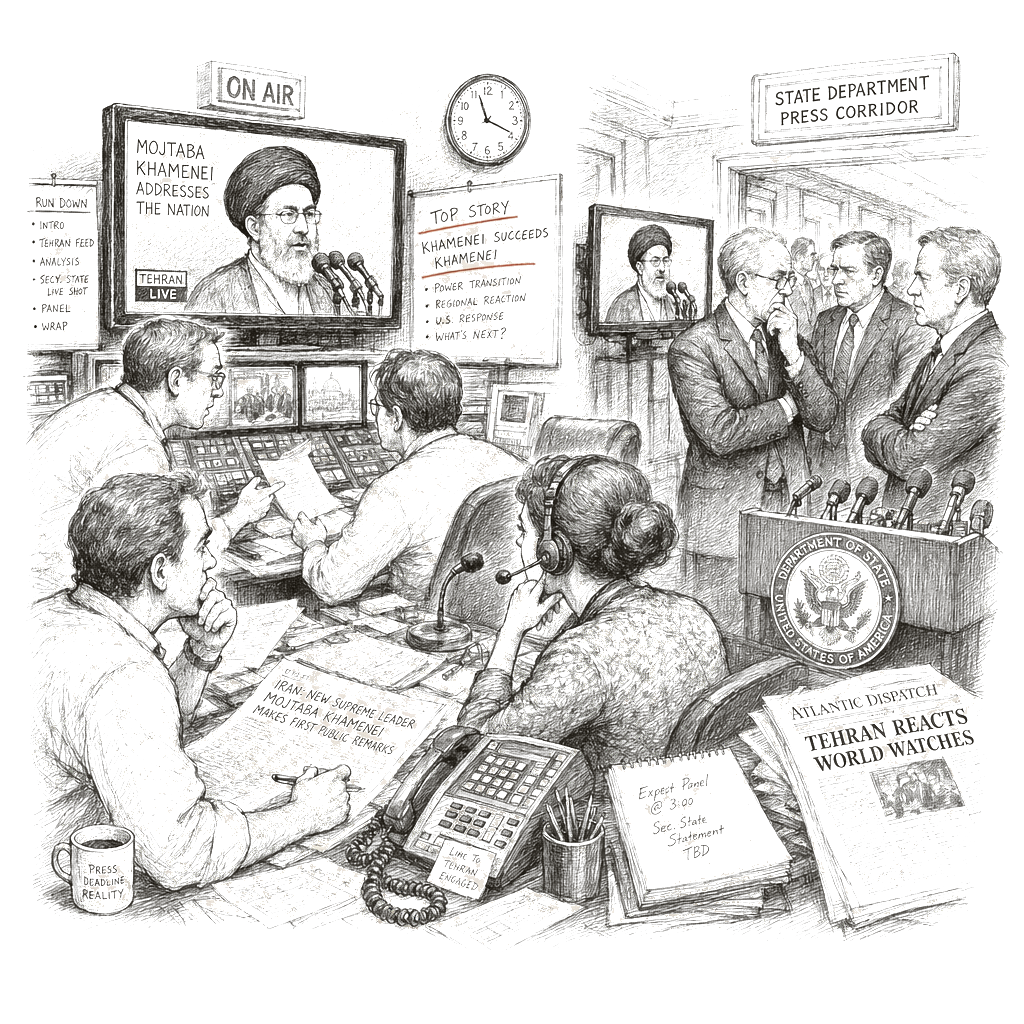
The Trump administration denounced CNN on Thursday for airing a portion of a public statement by Iran’s new supreme leader, Mojtaba Khamenei, the second time in three days that it targeted the network over how the regime was responding to American attacks.
In a social media post, the White House accused CNN of broadcasting Iranian state television “four straight minutes of uninterrupted” footage, and it characterized the outlet as part of what it described as a “psychotic and murderous regime” that, it said, “prided itself on brutally slaughtering Americans for 47 years.”
Previous clash: Steven Cheung challenges CNN coverage
The administration’s criticism follows an earlier exchange in which White House communications director Steven Cheung criticized CNN after an interview on the network involving Hossein Mousavian, a former Iranian nuclear negotiator.
In that segment, CNN anchor Erin Burnett asked Mousavian what he had been hearing about the Iranian government’s interest in having talks with the United States, and Mousavian said there wasn’t much. Cheung then posted on X that CNN regurgitates quotes and unverified information from “Iranian terrorists,” and he called CNN “the murderous Iranian Regime’s version of Pravda.”
CNN did not respond to Cheung’s post, but it did reply to the White House’s Thursday attack.
CNN says other outlets aired the remarks and defends news value
CNN said it aired portions of Khamenei’s statement for their news value and argued that the remarks were not exclusive to CNN. The network said it was not the only outlet to show parts of the statement live, citing that CNN, Sky News and Al Jazeera also did.
“The world is watching with anticipation which direction this war will take,” CNN said, adding that “Purported remarks from Iran’s new supreme leader are a critical component in helping audiences understand where this conflict is heading and were aired for their obvious news value.”
Khamenei’s message widely reported elsewhere
The Associated Press and other outlets issued alerts about what Khamenei said after he succeeded his father, who was killed in an Israeli airstrike. Reporting highlighted that Khamenei pledged to keep up attacks on other Arab countries in the region, and included plans described in coverage as aimed at choking off the world’s oil supply.
The dispute came as CNN aired selected text rather than the statement in full. After the speech, CNN correspondent Nick Paton Walsh debriefed anchor Kate Bolduan, focusing in part on the leader’s absence on camera. Walsh said, “We were waiting to see the face of the man to have proof of his health and survival,” and added, “and they’ve not met that moment.” He said instead it was “a handwritten message, it seems,” that “mostly reiterates things we kind of already knew.”
Accounts for the Iranian point of view on X
Beyond mainstream media, the fight over which messages to circulate is playing out on social platforms as well. The Tech Transparency Project has reported that several Iranian leaders and institutions maintain verified accounts on X, which is owned by Trump ally Elon Musk, and CNBC said Thursday that Khamenei has one of those accounts.
An X account using Khamenei’s portrait posted the text of his remarks in Farsi and in an English translation. Although X is officially blocked in Iran, the AP reported that users there often bypass restrictions via a virtual private network, and that a message sent to the platform on Thursday was not immediately returned.
The AP also reported that even though Khamenei’s father is dead, an account with his portrait was active on Thursday and was mainly reposting messages from his son, including one that referenced the “revenge we have in mind” and the obligation to respond to the killing of members of the nation.
Journalists and historians weigh in on what’s “newsworthy”
Some media and journalism experts told the AP that the White House challenge was misplaced. Jane Ferguson, a veteran international correspondent and founder of the journalism platform Noosphere, said the remarks were “absolutely newsworthy and legitimate” for CNN to air, and argued that it is not for government leaders to “pick apart” what CNN reports.
Douglas Brinkley of Rice University said it was unfair for CNN to be singled out, while adding that journalists must be careful. He said, “You have to be leery of being used as a propaganda tool by the Iranian regime,” and he said knowing what the enemy is saying—and looking for signs of “a peace offering or a nuance”—is important.
CNN’s vulnerability to criticism has also been part of the broader context, the AP reported, noting that Trump has targeted the network since his first term. It also cited Paramount Global’s agreement to purchase CNN’s parent company, Warner Bros. Discovery, as raising questions about CNN’s editorial independence.