Body
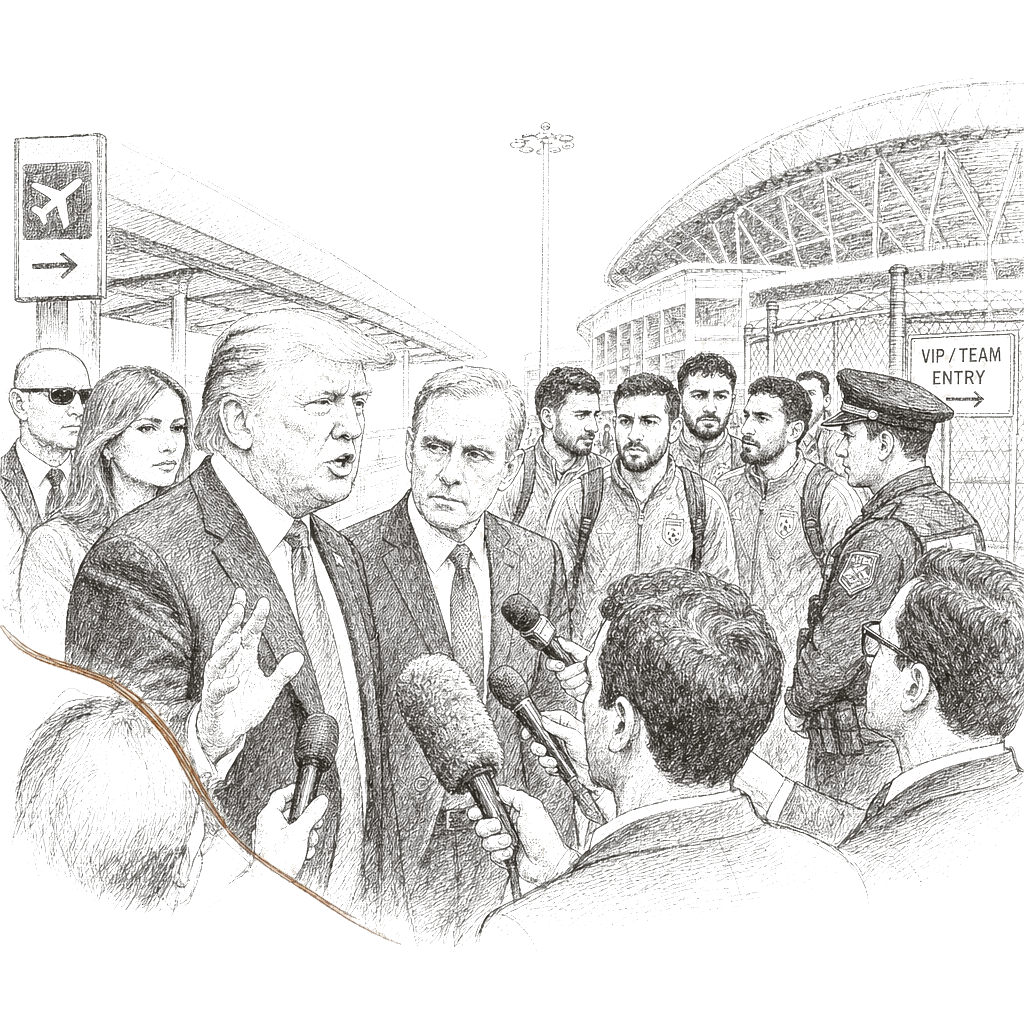
President Donald Trump said Thursday that he does not believe it is “appropriate” for Iran’s national soccer team to attend this year’s World Cup, citing the safety of the players and coaches amid ongoing war between the United States and Iran. Trump made the remarks as the tournament is co-hosted by the United States, Canada and Mexico and with Iran included among the 48 teams in the competition.
In a post on his social media site, Trump wrote that “The Iran National Soccer Team is welcome to The World Cup,” but added that he “really don’t believe it is appropriate that they be there, for their own life and safety.” The Associated Press reported that Trump’s message discourages the Iranian team from taking part.
Iranian leaders said earlier this week that it is “not possible” for the country to participate in the World Cup. The AP reported that Trump’s Thursday language appeared to depart from what the Republican president conveyed Tuesday at the White House to FIFA President Gianni Infantino, whom Infantino later said Trump assured him the Iranian players and coaches would be welcome to attend.
A White House official, who requested anonymity to discuss private conversations, confirmed to AP that Trump delivered the message to Infantino about Iran’s participation. On Thursday, the White House did not immediately clarify what Trump meant by “their own life and safety,” including whether he anticipated threats against the team while they would be in the United States.
Iran is scheduled to play group matches at multiple U.S. locations, including a June 15 match in Inglewood, California, against New Zealand, and a June 21 match there against Belgium. Iran is also set to finish group play on June 26 in Seattle against Egypt.
Iran’s soccer federation has planned to move the team in June to a tournament base camp in Arizona, at the Kino Sports Complex in Tucson. The AP noted that since June Iran has been subject to a travel ban into the U.S. as part of the Trump administration’s immigration crackdown, but athletes and coaches from the targeted countries are exempt—meaning the team would be allowed to enter the United States.
Beyond entry rules, the AP reported that players and coaches may weigh other risks tied to the country’s conflict and personal circumstances. The report said there are likely fears among Iranian soccer players about playing in a tournament abroad where they could face attention from an anti-government diaspora while their families face threats back home.
The AP also connected the broader backdrop of Iranian athletes’ decisions to past examples around international competitions. It reported that the Iranian women’s team, which arrived in Australia to play in the Asian Cup before the U.S. and Israeli bombing attacks on Iran began Feb. 28, did not sing the Iranian national anthem before its first game—a gesture widely interpreted as protest or mourning—and that several members stayed in Australia afterward on humanitarian visas.
The AP cited that at the 2022 men’s World Cup in Qatar, Iran’s men’s team did not sing the anthem before a game against England and did not celebrate after scoring twice in a 6-2 loss. It also referenced Iran’s broader turmoil weeks after the death in police custody of 22-year-old Mahsa Amini in 2022, who was detained for allegedly violating a strict Islamic dress code.
The AP said FIFA’s own assessment of World Cup safety and security plans proposed by the U.S., Canada and Mexico federations was “low risk,” adding that the plans are guaranteed by their governments. It reported that FIFA’s in-house inspection team wrote that “All parties have experience of hosting major sports events on a regular basis and established arrangements are in place for managing security and safety at stadiums and for high-profile individuals.”
At the same time, the AP reported that Iranian athletes who previously defied Iran’s Islamic regime have left the country to continue their careers. It cited examples including taekwondo medalist Kimia Alizadeh and judo champion Saeid Mollaei, who the report said went into hiding and later obtained Mongolian citizenship after disputes with Iranian team officials.