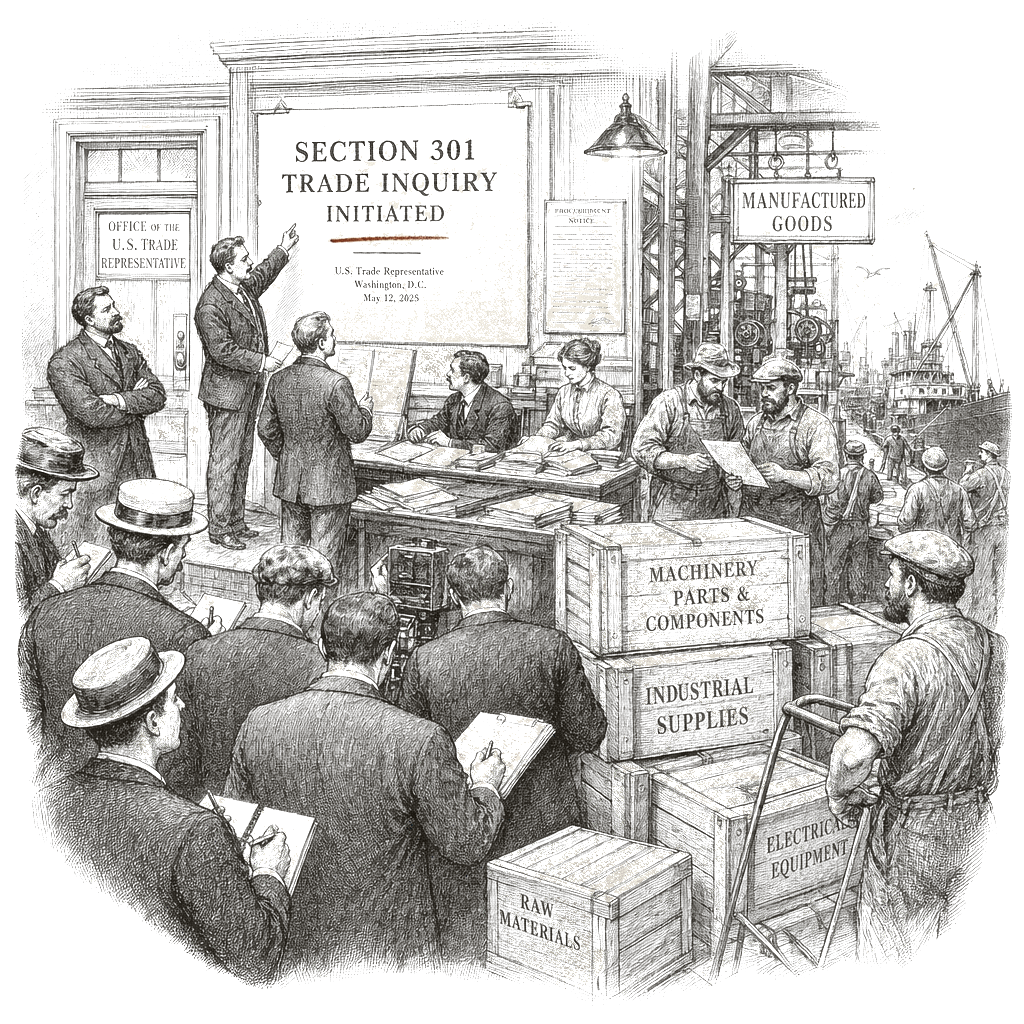
The Trump administration on Wednesday opened a new trade investigation into manufacturing in foreign countries as it moves to replace tariffs that the U.S. Supreme Court struck down after ruling that the previous tariff action relied on an economic emergency.
Trump and his team said they are seeking to replace the hundreds of billions of dollars in lost revenues following the Supreme Court’s February decision, according to a Wednesday briefing call with reporters by U.S. Trade Representative Jamieson Greer.
The new effort begins with investigations under Section 301 of the Trade Act of 1974, which could eventually lead to new import taxes. Greer said he did not want to prejudge the outcome of that process, and he framed the move as a continuation of the same overall policy aims while changing the legal tools used to pursue them.
“The policy remains the same — the tools may change depending on, you know, the vagaries of courts and other things,” Greer said, stressing that the goal was to protect American jobs. He also said the administration is seeking to bring potential options to Trump as soon as possible.
The start of the replacement process could bring back uncertainty for U.S. trade relationships. Greer described the administration’s earlier trade frameworks—announced last year and since overturned by the Supreme Court—as standing on their own, separate from the new Section 301 manufacturing investigation. Still, he suggested those frameworks could matter as countries’ commitments intersect with what is demanded under the Section 301 proceedings.
Greer’s briefing described the manufacturing investigation as focused on excess industrial capacity and government backing that could give foreign companies an advantage over U.S. firms. He said the investigation would examine whether the backing is persistent and whether it includes policies such as subsidies and actions that suppress workers’ wages.
The entities under review include China, the European Union and Singapore, along with Switzerland, Norway, Indonesia, Malaysia, Cambodia, Thailand, South Korea, Vietnam, and the self-governing island of Taiwan. The list also includes Bangladesh, Mexico, Japan and India.
The administration is also rolling out a separate Section 301 investigation aimed at banning the importing of goods made by forced labor. Greer indicated that additional Section 301 investigations could follow on topics including digital service taxes, pharmaceutical drug pricing and ocean pollution.
Separate from those Section 301 efforts, the Commerce Department has trade investigations under Section 232 of the 1962 Trade Expansion Act, the briefing described.
The administration faces timing pressures because the 10% tariffs it has imposed under section 122 of the 1974 Trade Act expire after 150 days on July 24. Trump said he planned to raise the import tax to 15%, but the briefing said he has not yet done so.
Greer said the administration is “keying off” the new investigation based on the 150-day deadline, with the aim of producing “potential options” quickly. He said a core assumption in the process is that trading partners continue to want to work toward agreements, adding, “My sense is that these countries continue to want to deal, and President Trump continues to want the deal,” and that commitments could be considered as they “bump” against the demands of the Section 301 process.
The new tariff work is unfolding alongside other international and domestic political pressures, including a war in Iran and midterm election dynamics in which Democrats have emphasized the tariff refunds they say are owed after the Supreme Court decision.
AP writer Mae Anderson contributed to this report.