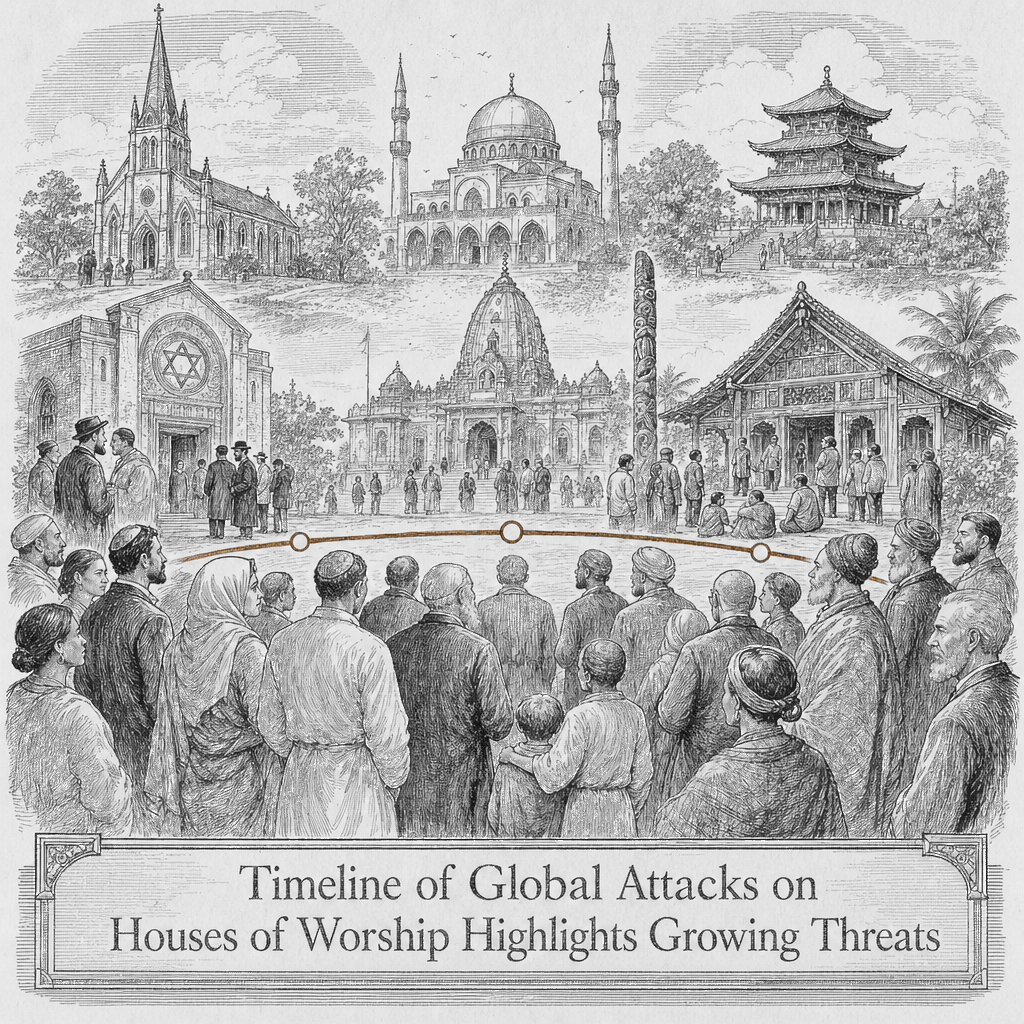
The Associated Press compiled a grim list of notable attacks on houses of worship over the past 15 years, spanning North America, Europe, Africa, the Middle East and Oceania. While weekly worship attendance remains one of the safest routine activities worldwide, the catalog records dozens of incidents in which armed assailants, bombers or suicide attackers have targeted synagogues, churches, mosques and temples, killing or wounding hundreds.
The timeline opens with the latest U.S. tragedy: on March 12, 2026, a rifle‑armed driver rammed his vehicle into a major reform synagogue in a Detroit suburb, igniting a fire inside the building’s hallway. Security forces fatally shot the attacker; no congregants were injured, but the incident revived fresh fears about the vulnerability of religious sites.
Earlier U.S. incidents include a September 29, 2025 attack on a Latter‑day Saints church in Michigan that left four dead and eight wounded, and an August 27, 2025 shooting during Mass at the Church of the Annunciation in Minneapolis that killed two children and injured several others. The timeline also recalls the October 27, 2018 massacre at Pittsburgh’s Tree of Life synagogue, where a white supremacist killed eleven worshippers, and the December 5, 2017 mass shooting at First Baptist Church in Sutherland Springs, Texas, that claimed 25 lives.
Outside the United States, the list documents a July 27, 2025 rebel raid on a Catholic church in Congo’s Ituri province that killed several dozen worshippers, a December 14, 2025 antisemitic massacre at a Hanukkah festival on Australia’s Bondi Beach that left 15 dead, and a June 22, 2025 suicide bombing inside a Greek‑Orthodox church near Damascus that killed more than 20. The 2019 Christchurch mosque shootings in New Zealand, which claimed 51 lives, remain a benchmark for the global shock such attacks can generate.
European attacks include a October 29, 2020 stabbing at a Catholic basilica in Nice, France, a July 26, 2016 slitting of a priest’s throat during Mass in Normandy, and a October 9, 2019 attempted mass shooting at a synagogue in Halle, Germany, where the gunman killed two passersby after failing to breach the building’s heavy doors. In the United Kingdom, a October 2, 2025 knife attack on a Manchester synagogue left two dead, while a June 19, 2017 van‑ramming near a London mosque killed one person and injured a dozen.
The timeline’s breadth demonstrates that extremist violence against faith communities is not isolated to any single region or religion. The attacks have been carried out by a range of actors—white supremacists, far‑right militants, Islamist extremists, and armed insurgents—often targeting the symbolic heart of a community. In many cases, the assailants were killed by police or later convicted, but the loss of life and the psychological impact on survivors and broader faith groups have been profound.
Security experts note that the clustering of attacks around high‑profile holidays and worship services, combined with the use of vehicles, firearms and explosives, points to a tactical shift that exploits the open, communal nature of religious gatherings. Governments in the United States, Australia, France and other nations have responded with heightened security protocols, increased funding for protective measures at houses of worship, and, in some cases, legislative action on gun control and hate‑crime statutes.
The growing catalog of attacks raises urgent questions for policymakers, faith leaders and security planners: How can congregations balance openness with protection? What role should law‑enforcement and intelligence agencies play in pre‑empting threats without infringing on religious freedom? And how can societies address the underlying extremist ideologies that fuel these violent acts?
As the world grapples with the resurgence of extremist violence, the AP timeline serves as a stark reminder that houses of worship—places traditionally regarded as sanctuaries—are increasingly becoming targets in a broader pattern of hate‑motivated terrorism.