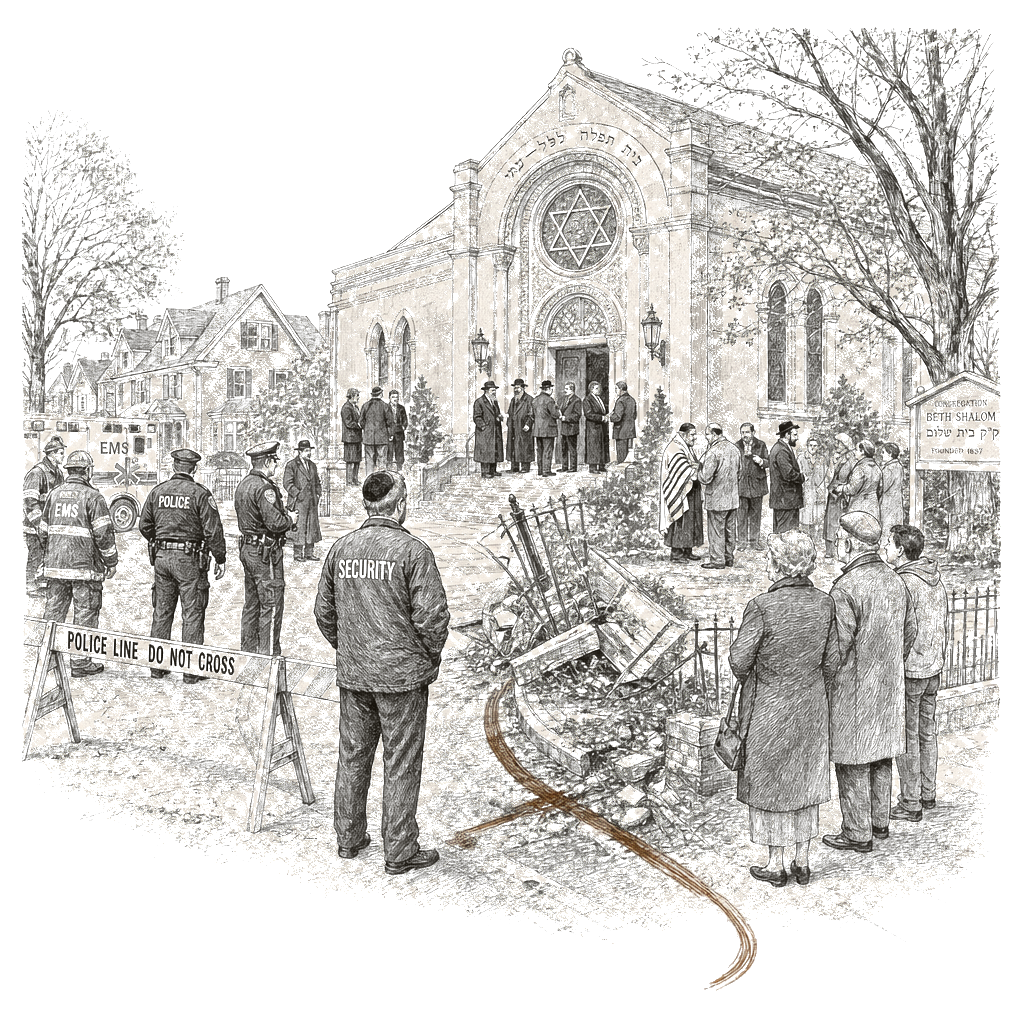
In the latest in a series of assaults on religious sites, a man armed with a rifle rammed a vehicle into a major reform synagogue in a Detroit suburb on March 12, 2026, according to a sheriff’s account cited by the Associated Press. The attacker was fatally shot by security, the report said, and the vehicle’s ignition sent smoke billowing from the synagogue. The attack took place in and around the building’s interior, and the Associated Press reported that no one was injured.
The Associated Press said the synagogue also houses an early childhood center, and that the attacker drove through a set of doors and into a hallway where something in the vehicle ignited. In the minutes after the attack, smoke billowed from the synagogue, the report said, as authorities responded quickly at the scene. Clergy and worshippers worldwide have been left facing renewed anxiety as recent incidents have intensified fear about safety at places of worship.
The Associated Press framing also noted that attending a weekly worship service is generally described as a remarkably safe activity, with global annual attendance totals in the billions and the number of people killed in attacks on individual houses of worship in any given year often in the hundreds or less. Still, it highlighted the emotional and communal impact of a sudden ambush at a highly populated religious facility, particularly one that was hosting regular activity and community life.
In the United States, the Associated Press cited multiple recent attacks, including one on Sept. 29, 2025, when an ex-Marine smashed a pickup truck into a Church of Jesus Christ of Latter-day Saints church in Michigan, opened fire, set the building ablaze during a crowded Sunday service, and was fatally shot by police. The report said that attack killed four people and wounded eight.
The Associated Press also cited an Aug. 27, 2025 shooting during Mass at the Church of the Annunciation in Minneapolis in which two children were killed and several others were injured. It said the shooter died from a self-inflicted gunshot and had been a former student at the parish’s school. Earlier U.S. examples in the Associated Press list included the Oct. 27, 2018 killing of 11 Jews at the Tree of Life synagogue in Pittsburgh by white supremacist Robert Bowers, and the Nov. 5, 2017 attack at First Baptist Church in Sutherland Springs that killed 25 people, including a pregnant woman.
The Associated Press report extended beyond the United States, describing attacks in multiple regions. In Australia, it cited a Dec. 14, 2025 attack in which a father and son fatally shot 15 people at a Hanukkah festival on Bondi Beach, and said Prime Minister Anthony Albanese called it an act of antisemitic terrorism. It also cited a Dec. 6, 2024 synagogue firebombing in Melbourne in a wave of antisemitic attacks and said Australian authorities accused Iran of directing the attack.
In Europe, the Associated Press cited an Oct. 2, 2025 stabbing attack on a synagogue in Manchester, England, that left two congregation members dead, and said police described it as carried out by a man who had pledged allegiance to the Islamic State group. In Britain, it cited a June 19, 2017 attack in London when a man drove a van at pedestrians near a mosque as worshippers were leaving after prayers; one man died and a dozen others were injured, and the attacker was sentenced to at least 43 years in prison after a judge said he had been radicalized by far-right and Islamophobic propaganda online.
The Associated Press also cited incidents in France, Germany and other countries. In France, it cited an Oct. 29, 2020 stabbing attack at a Catholic basilica in Nice in which three people were killed, and said a Tunisian man charged with the attack was later sentenced to life in prison without parole. In Germany, it cited an Oct. 9, 2019 attack in Halle on Yom Kippur in which a right-wing extremist attempted to shoot his way into a synagogue, broadcast the attack live on a gaming site, and after failing to open the heavy doors killed a woman in the street and a man at a nearby kebab shop; it said he was convicted of murder and sentenced to life in prison.
The Associated Press included other examples that underscored how violence and arson have struck different faith communities in different settings. In New Zealand, it cited March 15, 2019 when a white supremacist gunned down worshippers at two mosques in Christchurch during Friday prayers, killing 51 and prompting new laws and changes to social media protocols after the gunman livestreamed the attack on Facebook. In Norway, it cited Aug. 10, 2019 when Philip Manshaus killed his Chinese-born stepsister and then drove to a mosque in an Oslo suburb, firing rifle shots at the mosque’s glass door before being overpowered.
Outside Europe and North America, the Associated Press cited Egypt’s Nov. 2017 killing of more than 300 people in a militant attack on a mosque in northern Sinai frequented by Sufis, and April 9, 2017 attacks by suicide bombers on two Coptic churches that killed more than 40 people. It also cited July 27, 2025 in Congo’s Ituri province, when rebels stormed a Catholic church during a vigil and opened fire on worshippers, killing several dozen people, and Syria’s June 22, 2025 report that a suicide bomber opened fire and then detonated an explosive vest inside a Greek Orthodox church near Damascus, killing more than 20 and wounding dozens.
The Associated Press compilation stops short of a single explanation for why houses of worship have become recurring targets, but it underscores the reality that fear can spread across continents when an attack hits familiar religious spaces. After the March 12 incident in Michigan, the report pointed to how a new episode can deepen anxiety among clergy and worshippers, even as overall worship attendance remains common worldwide and comparatively low in the number of people killed in any given year.