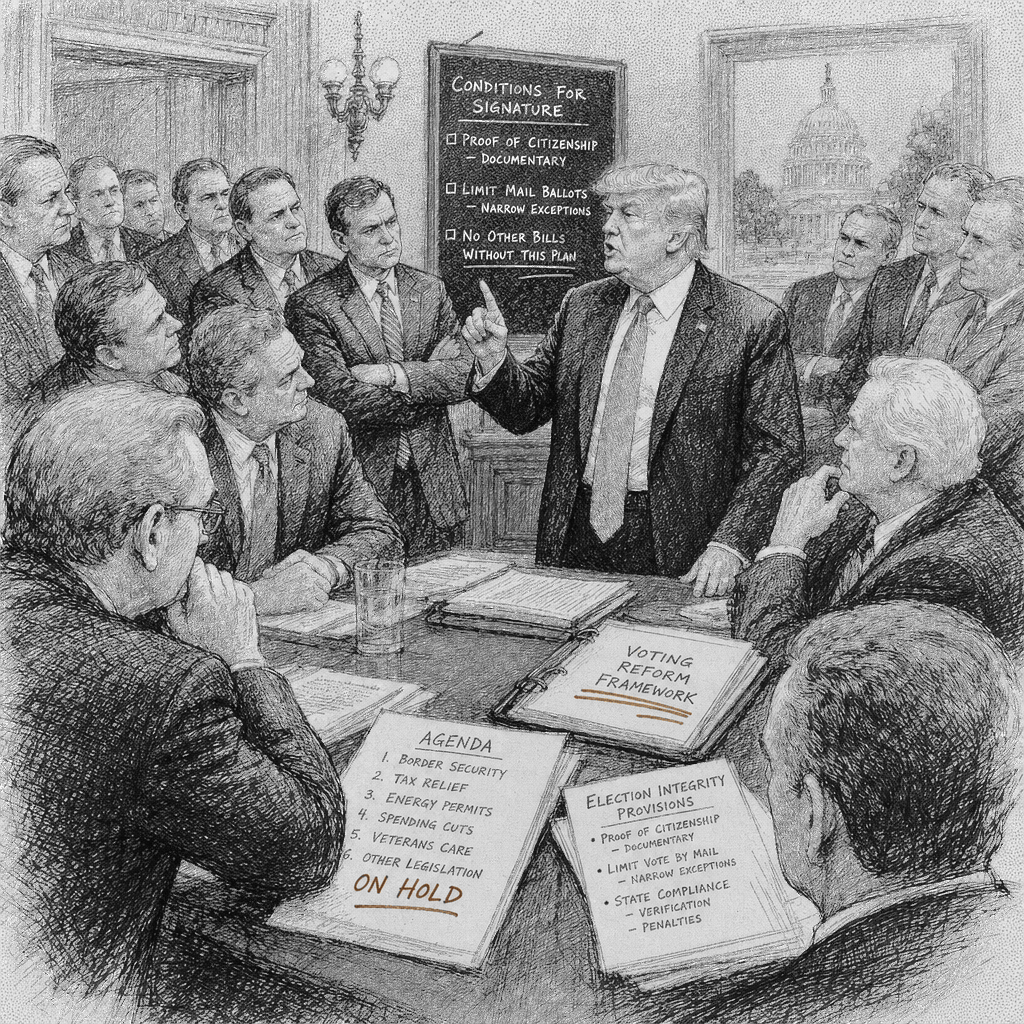
President Donald Trump said he will not sign any other legislation into law until Congress passes what he describes as a strict proof-of-citizenship voting bill that would also end Americans’ ability to vote by mail. Trump made the demand Monday to House Republicans during their annual retreat at his golf club in Florida, framing the voting proposal as his top priority months ahead of the midterm elections.
The president said he does not think Republicans will win elections unless voting laws are toughened up to prevent fraud, even as federal law already requires that voters in national elections be U.S. citizens. Voting experts cited by the Associated Press warned that changes along the lines of the administration’s proposal could disenfranchise some 20 million voters who do not have birth certificates or similar documents readily available, a figure that could grow if mail balloting is also curtailed.
Trump pressed House Republicans to support the SAVE America Act, which the House has already approved, and he urged the Senate to move past its filibuster rules to send the legislation to his desk. The president warned he would not accept delays on the broader legislative agenda, saying, “I’m not going to sign anything until this is approved,” and adding, “It’ll guarantee the midterms. If you don’t get it, big trouble.”
Democrats and voting-rights groups signaled alarm as the Trump administration reached into election procedures that states control under the Constitution. Senate Democratic leader Chuck Schumer, a Democrat from New York, said Trump’s approach would gridlock the chamber and described the effort using harsher language, calling Trump “a thug” and “a bully.”
House Speaker Mike Johnson, who has close ties with Trump, appeared on stage with Trump and other GOP leaders as they applauded the bill. Still, Senate Majority Leader John Thune said Senate Republicans have not found a clear historical example of major legislation being passed through a “talking filibuster” procedure, and he told reporters that the Senate has not identified a precedent “that’s been passed that way.”
The House-approved version of the SAVE America Act would require voters to present proof of citizenship—such as a passport or birth certificate—when registering to vote, and it would require photo identification when voters cast ballots, measures many states already use in some form. Trump wants to add a central change: a ban on mail-in ballots, though he has said the bill should include exceptions for voters who are disabled, serving in the military, or facing other qualifying circumstances.
In addition to the voting changes, Trump also said the legislation could be paired with other provisions tied to transgender-rights issues, including a proposal to bar those born as men from playing women’s sports and a proposal to block sex reassignment surgeries for some minors. Trump also raised the possibility of attaching an unrelated foreign surveillance bill—known as FISA—which is up for extension and is often difficult to navigate through Congress.
Trump’s comments echoed the broader political strategy of a Republican Party trying to hold narrow control of Congress as it faces multiple challenges going into the fall. Lawmakers have other pressing priorities, including funding for the Department of Homeland Security as some airport workers and others have faced pay delays amid fights in Congress over the agency’s immigration and deportation operations.
Republicans in the Senate, meanwhile, said they planned to discuss how to move forward on the voting bill in private meetings this week. AP reported that there was not yet consensus inside the party, with some senators open to using a “talking filibuster” while others opposed it, and Thune cautioned that allowing extended debate could open the floor to amendments that could shift the legislation in ways that divide Republicans.
Associated Press writers Mary Clare Jalonick and Steven Sloan in Doral, Florida, contributed to this report.