The 15th anniversary arrives as plant operator Tokyo Electric Power Holdings Company deploys micro-drones to examine melted fuel inside damaged reactors — work experts say could take decades — while independent monitors warn that government pressure to declare the region safe risks understating contamination that ongoing testing still detects.
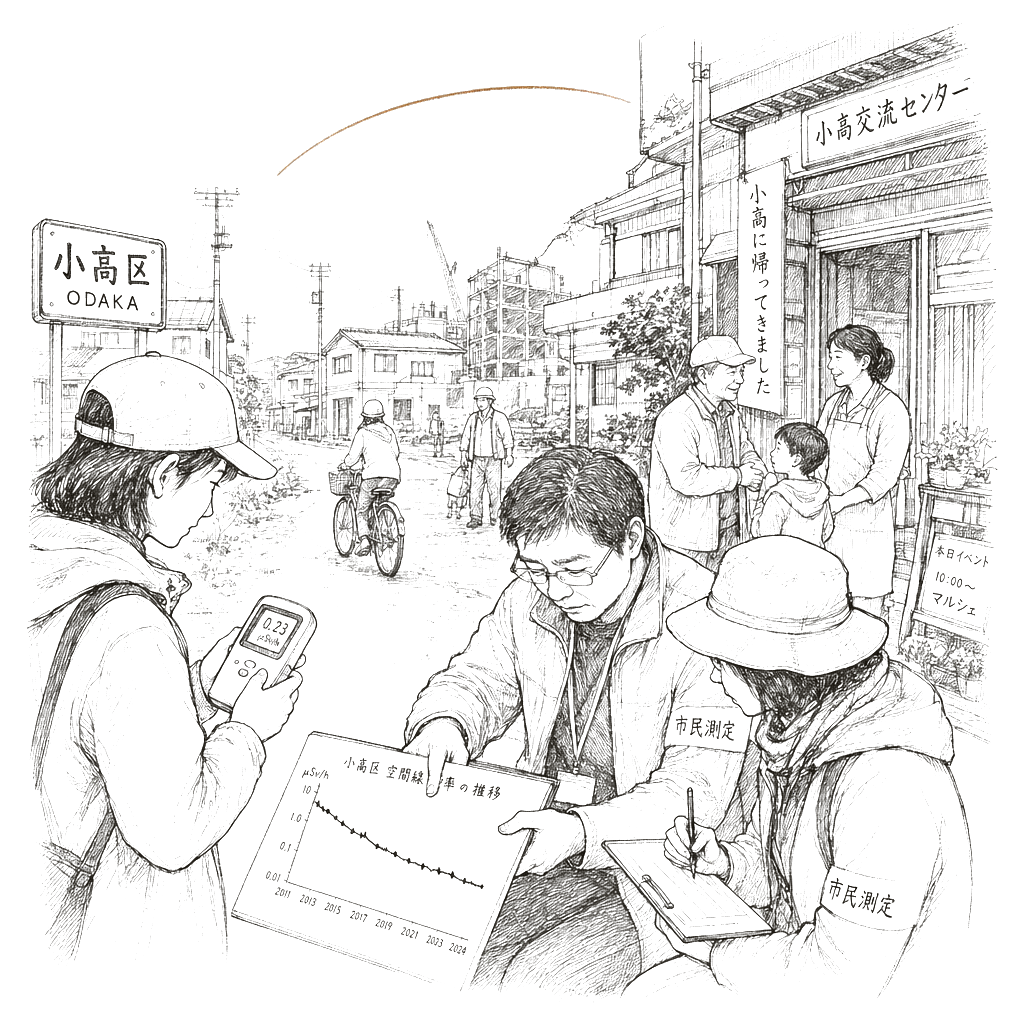
ODAKA, Japan — Fifteen years after a magnitude 9.0 earthquake and tsunami triggered meltdowns at three Fukushima Daiichi nuclear reactors, Tomoko Kobayashi greets guests at her family-run inn with color-coded radiation maps on the wall — data she and fellow citizen monitors collected themselves, twice a year, across hundreds of outdoor locations in this near-deserted corner of northeastern Fukushima.
Only about one-third of Odaka’s pre-disaster population of 13,000 have returned over the past decade, according to the Associated Press. The kindergarten Kobayashi attended as a child now serves as a museum, she said, because there are too few children.
“These empty lots used to be filled with shops,” Kobayashi said. “There used to be businesses, community activity and children playing. We used to live our ordinary daily lives here, and I hope to see that again.”
Monitoring where government leaves off
Kobayashi conducted her own radiation surveys before reopening the Futabaya Ryokan inn in 2016. She and her network of monitors now share air-quality readings from hundreds of locations and operate an adjacent lab to test locally produced food.
“We are not professional scientists, but we can measure and show the data,” she said. “What’s important is to keep measuring, because the government maintains that it’s safe, as if radiation no longer exists. But we know for a fact that it’s still there.”
Yukio Shirahige, 76, a former decontamination and radiation survey worker at Fukushima Daiichi who now assists the monitoring project, said testing of wild boar meat from the area showed it was more than 100 times over the safety limit.
As the government promotes the region’s safety and recovery, Shirahige said, “we are under growing pressure to be silent.”
Decades of decommissioning ahead
The plant’s physical appearance has changed since the disaster. For the first time since 2011, all of Fukushima Daiichi’s reactor buildings have their rooftops enclosed. Radiation levels have come down significantly, and the plant has built enhanced seawalls designed to withstand another large tsunami.
The three damaged reactors still contain at least 880 tons of melted fuel debris, however, with radiation levels still dangerously high and the debris composition largely unknown.
Akira Ono, head of decommissioning at Tokyo Electric Power Holdings Company, said remote-controlled robotics, careful planning, and practice are central to protecting workers. TEPCO successfully extracted tiny melted fuel samples last year from the Unit 2 reactor. Last week, workers deployed micro-drones inside the Unit 3 reactor — a technology Ono said was not realistic 15 years ago — to begin examining the melted fuel there.
TEPCO plans remote-controlled internal probes to further analyze the debris and is developing robots for additional fuel removal. Experts say the full cleanup could take decades more.
The disaster’s course
The earthquake struck at 2:46 p.m. on March 11, 2011. A tsunami followed roughly an hour later. A wave struck Fukushima Daiichi, destroying key cooling systems.
The No. 1 reactor building was damaged by a hydrogen explosion on March 12. The Unit 3 reactor building exploded two days later, followed by the No. 4 reactor building, releasing radioactive particles that caused hundreds of thousands of residents to flee. Some areas of Fukushima remain unlivable today.
Kobayashi’s family evacuated to a gymnasium in nearby Haramachi town, then traveled to Nagoya, where they stayed for a year. She and her husband returned to Fukushima in 2012 to begin measuring radiation while living in temporary housing near Odaka, which was then still off-limits.
Food safety and a policy reversal
Fukushima prefecture tests thousands of pre-distribution food samples annually and says all farm, fisheries, and dairy products in stores are safe, the Associated Press reported. Sale of some fruits, mushrooms, river fish, and other harvests in former no-go zones remains restricted.
In a major reversal after a decade of working to phase out nuclear technology, Japan in 2022 announced plans to accelerate reactor restarts and bolster nuclear power as a stable energy source.
Kobayashi said she understands that rebuilding takes time.
“The town was destroyed, and we need to rebuild it. It’s a time-consuming process that cannot be accomplished in just a couple of decades,” she said. “But I hope to see the progress, with new people and new development added to what this town used to be.”