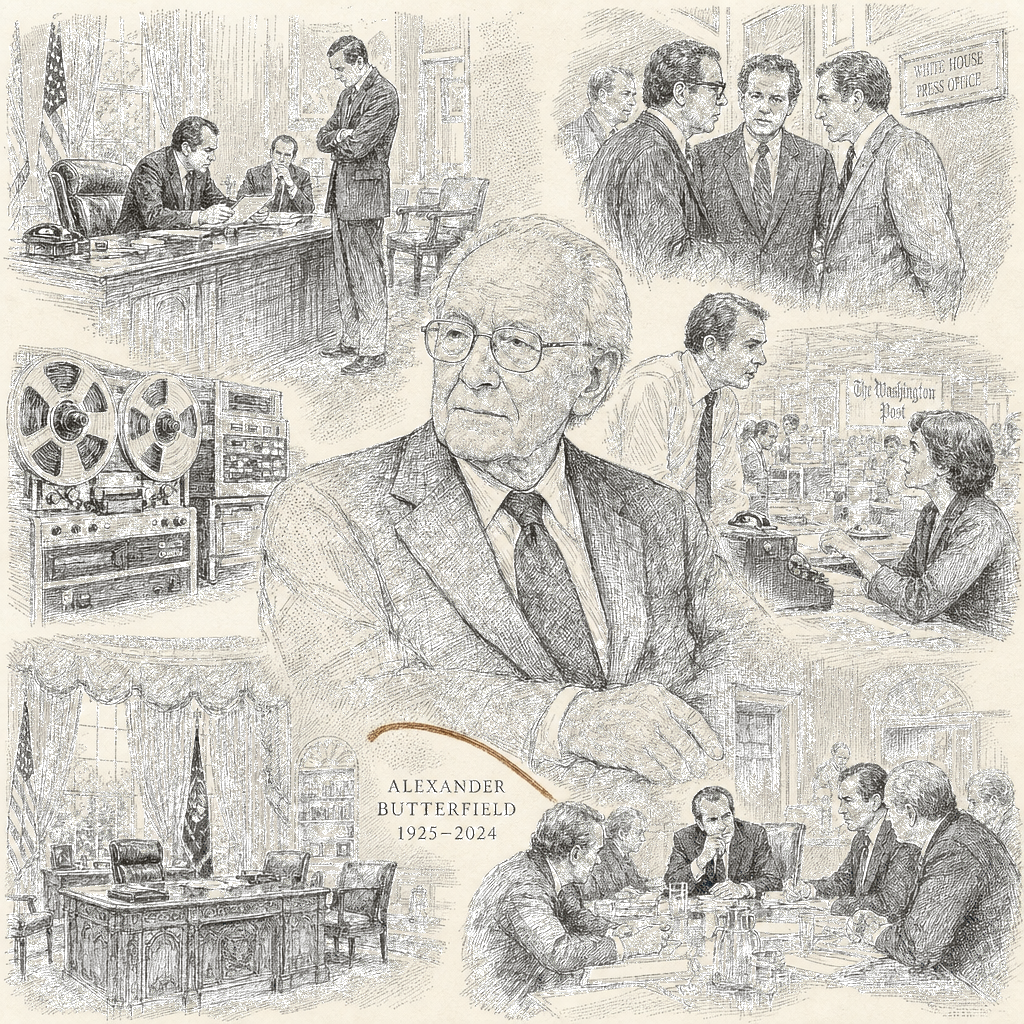
Alexander Butterfield, the Nixon-era White House aide whose testimony helped make the Watergate tapes a matter of public record, has died at 99, The Associated Press reported on March 9. His wife, Kim, and former White House counsel John Dean confirmed the death to the wire service.
Dean, who served as White House counsel during the Watergate investigation and later helped expose the scandal, said Butterfield carried “the heavy responsibility of revealing something he was sworn to secrecy on, which is the installation of the Nixon taping system,” and that “He stood up and told the truth.” Dean’s remarks underscored the dual nature of Butterfield’s role: the information he disclosed was central to the government’s case, but it came from a system tied to presidential confidentiality and clandestine surveillance.
Butterfield served as a deputy assistant to the president and oversaw a taping system connected to voice-activated listening devices that had been secretly placed in four locations, including the Oval Office in the Executive Office Building and the presidential retreat at Camp David. In testimony to Watergate investigators, he described how “Everything was taped … as long as the president was in attendance,” a detail that later fed investigators’ efforts to understand what Nixon knew and when.
The taping system, Butterfield said later, was known to only a small circle beyond himself and the president—he believed H.R. Haldeman, a Haldeman assistant, and a handful of Secret Service agents knew about it. Investigators’ pursuit of evidence about the president’s role in the aftermath of the 1972 Watergate break-in then gained momentum once the existence of the recording system became public.
According to the AP account, former White House counsel John Dean’s testimony that he believed a conversation he had had with Nixon may have been recorded set the stage for questions that Senate committee staffers put to Butterfield. When Butterfield acknowledged that such a taping system existed, he was brought before the Senate Select Committee on Presidential Campaign Activities, and the public revelation on July 16, 1973 “stunned Nixon friends and foes alike,” the report said. The tapes promised “a rich vein of evidence” for investigators working to determine what Nixon and others knew about the break-in.
As investigators sought access to the recordings, the dispute became a yearlong legal fight that ended in July 1974 when the Supreme Court ruled unanimously that Nixon had to turn over the tapes to the Watergate special prosecutor. Less than a month later, on Aug. 9, 1974, Nixon resigned, and the recordings later made public—now controlled by the National Archives—offered an often harsh window into Nixon’s language and views, according to the AP obituary.
Butterfield described to the Nixon Presidential Library and Museum in later years how he saw the stakes of his disclosure. In comments for a 2008 oral history, he said he had believed he “was, in a lot of ways,” a factor in the president’s fate, adding: “I didn’t like to be the cause of that, but I felt that I was, in a lot of ways,” the AP report said. In a separate statement to the library, Butterfield said, “I just thought, ‘When they hear those tapes …’ I mean, I knew what was on these tapes … they’re dynamite,” and he told the library he hadn’t foreseen impeachment or removal but believed “it would be a perilous few years for him.”
The AP account also said Butterfield later believed President Gerald Ford fired him as administrator of the Federal Aviation Administration in 1975 as part of an agreement between Nixon and Ford staff members, and that he had heard he was targeted after his testimony to the Senate committee. After leaving the FAA, he worked as a business executive in California and earned a master’s degree from the University of California, San Diego, in 1994.
Born Alexander Porter Butterfield on April 6, 1926, in Pensacola, Florida, Butterfield left UCLA to join the Navy and later earned degrees from the University of Maryland and George Washington University. The AP obituary said he joined the Air Force in 1948, served as an instructor near Las Vegas during the Korean War, held military posts in Germany, and later served in Washington as a military assistant and as a senior representative roles connected to Pacific Forces and Australia before retiring at the rank of colonel after 20 years.
In later years, Butterfield criticized Nixon, according to the AP account, describing his former boss as “not an honest man” and “a crook” and saying he believed Nixon knew about the Watergate break-in before it occurred and helped architect the cover-up. He also told the Nixon Library that he was “cheering … just cheering” the day Nixon resigned because “justice had prevailed,” saying he had not expected it to happen “for a while” and concluding: “This guy was the ringleader.”