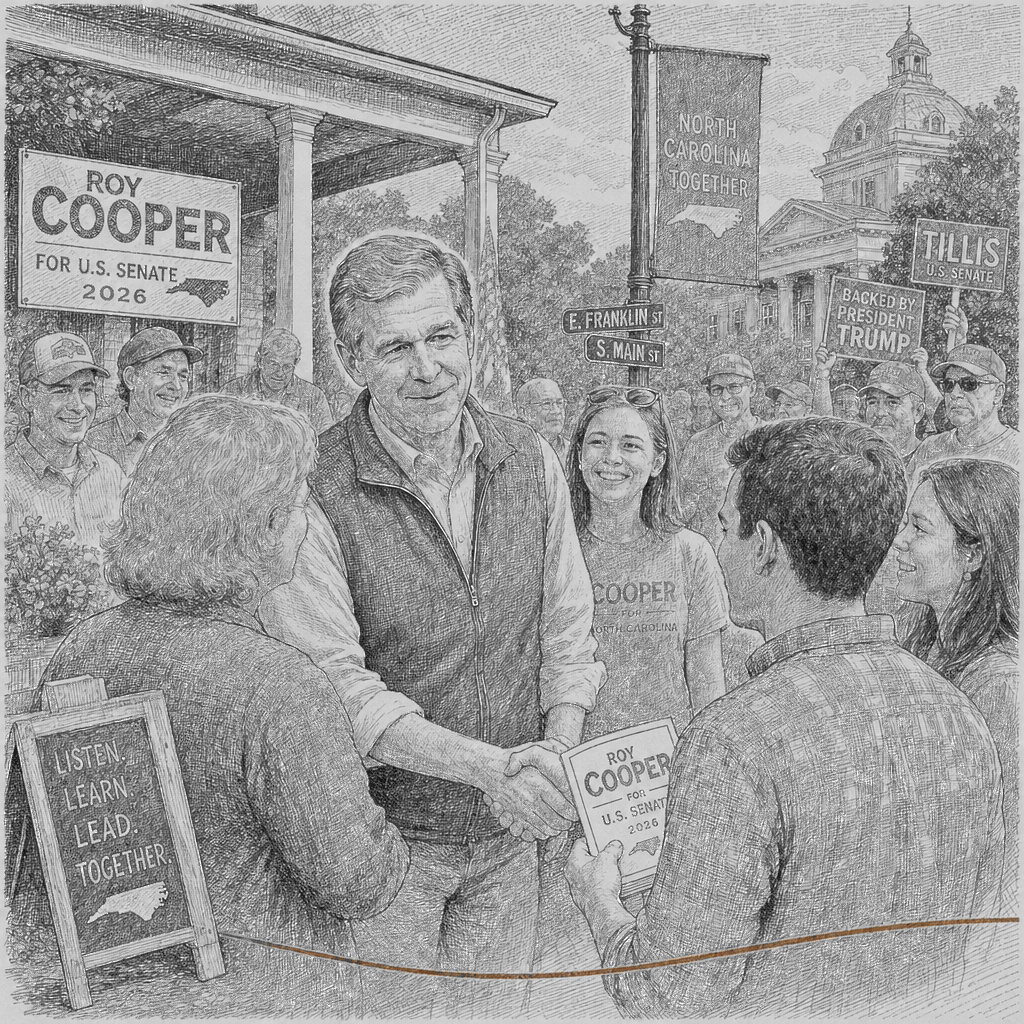
North Carolina’s 2026 U.S. Senate contest is setting up as a clash of political histories and national branding, with former President Donald Trump lending his weight behind the Republican nominee and former Gov. Roy Cooper leaning on decades of statewide campaigning. Cooper, a Democrat who led the state for two terms, is seeking to extend a winning streak that Republicans say they can disrupt by recasting him as out of step with the state’s Republican-leaning voters. Whatley, the Republican nominee, is trying to overcome what Democrats and some Republicans describe as lower name recognition by centering Trump’s support and his own party leadership credentials.
The primaries resolved the top-of-the-ticket matchup: both Cooper and Whatley won their party nominations this week, placing one of the year’s marquee Senate races on track for a general election that both parties expect to spend heavily on. The race is being viewed as critical to Democrats’ effort to pick up the four seats they say they need to win a Senate majority, and Republicans are approaching the contest as an opportunity to regain North Carolina’s Senate representation for their side.
Trump’s backing is a major through-line in Whatley’s campaign, and Whatley has positioned the contest as an extension of the Trump political project. In comments during his nomination acceptance, Whatley said: “His leadership has changed our country, and I am proud to stand with him in the fight to secure our border, to strengthen our economy and put America first.” The Associated Press report said Whatley previously served as the president’s chosen Republican National Committee chairman, a credential Republicans are using to present him as aligned with Trump’s priorities in Washington.
Cooper’s strategy emphasizes independence while engaging the president selectively, according to his remarks during the campaign. Speaking Wednesday, Cooper said, “Look, I’m going to be a strong, independent senator for North Carolina,” and he added that he would work with Trump when it made sense. Democrats close to the race see that framing as a way to counter Republicans’ efforts to nationalize the contest without undermining the coalition Cooper built through decades as a state lawmaker, attorney general and governor.
Republicans are testing whether they can link Cooper’s record to positions they argue are too liberal for North Carolina, according to the AP account. The report said Republicans want to portray Cooper as “too far left” for a state that Trump won three times, a framing that echoes tactics used in prior GOP victories against Democrats Republicans cast as aligned with liberal leadership. Republicans also plan to mix national political fights over issues such as immigration and transgender rights with state-specific matters, including crime and how Cooper managed hurricane responses and COVID-19 policy.
The GOP campaign focus also includes specific decisions tied to Cooper’s time as governor. In particular, Republicans pointed to Cooper’s veto of legislation that would have required sheriffs to cooperate with immigration agents seeking to pick up inmates believed to be in the country unlawfully. Whatley said during his nomination acceptance speech that Cooper chose “criminal illegal aliens over North Carolina communities,” describing it as a choice that reflects Cooper’s priorities rather than North Carolina’s.
In Democrats’ view, Cooper’s record provides an opening on health care even as Republicans attempt to drive the debate toward crime and immigration. The AP report said Cooper has argued he persuaded the Republican-controlled General Assembly to expand Medicaid coverage, and it noted that the issue is back in the spotlight after Republicans refused to extend pandemic-era subsidies for insurance plans purchased through the Affordable Care Act. Cooper is also trying to turn discussion of crime and immigration toward what he says is needed in federal policy, after two protesters—both described in the report as U.S. citizens—were killed by federal immigration agents in Minneapolis.
In comments Wednesday, Cooper said he wants “secure borders” and would “insist on federal resources to deport violent criminals” and “fight violent crime,” adding, “I think this administration is losing focus on that.” The pitch is designed, the AP report said, to keep the focus on what Democrats say are working-class and middle-class concerns rather than on aggressively personal attacks on Trump, even as Cooper presses Whatley for supporting the broader administration agenda.
That approach matters to how both campaigns are trying to manage coalition politics in North Carolina. The AP report said Cooper is not criticizing Trump in harshly personal terms in part because his gubernatorial victories included support from at least some Trump backers. Democrats see the same logic as a path to benefit from what they describe as Trump’s declining public support without losing the right-leaning voters Cooper believes he can still attract.
Whatley’s efforts, meanwhile, are being framed as a matter of alignment rather than neutrality. Former Gov. Pat McCrory, a Republican who lost to Cooper narrowly in 2016, said he does not think Whatley has room to distance himself from Trump, describing Trump as having hand-selected Whatley. McCrory also drew on experience from his own 2022 Senate bid, when he lost after Trump endorsed Ted Budd for the Republican nomination, adding that once the endorsement happened he said, “I might as well have been at the beach.”
The battle is also unfolding against the backdrop of North Carolina’s broader political history. According to the AP report, Democrats have kept control of the governor’s office for more than a century, turning that into only three Republican wins in that period. Since 1968, the report said, Republican presidential candidates have won North Carolina in every election except 1976 and 2008, when a Democrat last won a Senate race—setting up an electorate history that Republicans are likely hoping to translate into a Senate result that breaks with the Democratic governor’s trend.
For voters, the race is also raising questions of familiarity and local investment. The AP report included the perspective of Martha Goodson, 71, who voted for Cooper in the Democratic primary but said she has doubts about Whatley’s commitment to the state, telling the campaign that she had not heard of Whatley before his name appeared on the ballot. Goodson said, “I’m just very hesitant about people that I haven’t seen be thoroughly invested in North Carolina,” and she added that while she knows Whatley served in Republican leadership roles, she said she had not previously heard his name.