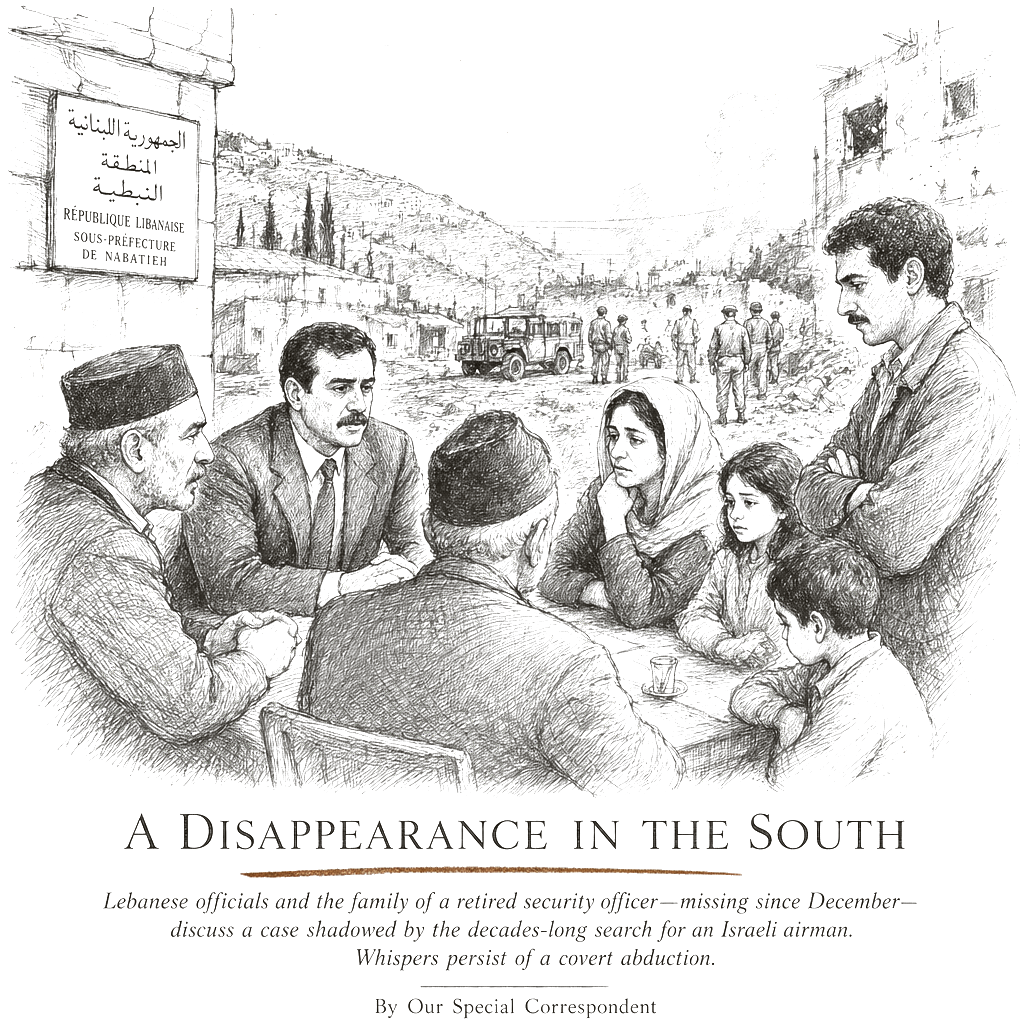
The alleged abduction and the Nabi Chit raid mark the latest chapters in Israel’s decades-long effort to determine Arad’s fate, a case that has driven prisoner exchanges and covert operations across Lebanon since 1986 and now intersects with a broader regional war following U.S. and Israeli strikes on Iran.
ZAHLE, Lebanon — Lebanese officials and the family of a retired security officer who vanished in December say Israel covertly abducted him to extract information about an Israeli airman missing for nearly 40 years, and an Israeli commando raid in Lebanon’s Bekaa Valley over the weekend that killed 41 people appears connected to the same four-decade-old search.
The retired officer, Ahmed Shukr, a former captain with Lebanon’s General Security Directorate, was last seen on Dec. 17, 2025, in the eastern Lebanese city of Zahle, where security footage showed him leaving his own car and entering another vehicle. His family has heard nothing from him since.
Lebanese officials and Shukr’s family believe he was taken to Israel in an intelligence operation aimed at obtaining information about the fate of Israeli air force navigator Ron Arad. The Israeli military declined to comment when asked whether Israel had taken Shukr.
A commando raid and 41 dead
Over the weekend before this report, Israeli commandos landed in the Bekaa Valley village of Nabi Chit and began digging in the Shukr family cemetery, residents told the Associated Press. Fighters from the Hezbollah militant group and armed civilians confronted the commando team. Intense clashes and subsequent airstrikes killed 41 people and wounded dozens, according to Lebanon’s Health Ministry. No Israeli casualties were reported.
The Israeli military acknowledged the operation aimed to find evidence of Arad’s fate. It said his remains were not found.
Whether the Nabi Chit raid came as a result of information obtained from Shukr was not immediately clear, the AP reported.
A search that began in 1986
Arad parachuted from his fighter jet in 1986 while attacking suspected Palestinian militants on the edge of the southern Lebanese port city of Sidon. A Shiite faction called the Believers’ Resistance captured him after he landed.
Israel has mounted operations over the decades since to determine what happened to him. In 1994, helicopter-borne commandos landed in Lebanon’s eastern Bekaa Valley and seized Mustafa Dirani, leader of the Believers’ Resistance, taking him to Israel. Dirani was released approximately a decade later in a prisoner exchange.
After lengthy indirect negotiations between Israel and Hezbollah, the Iran-backed group sent a report through mediators in 2008 suggesting Arad most likely died trying to reach Israel after escaping captivity. The question of his fate has remained unresolved.
The Shukr family connection
The suspected abduction centers on a family link to Arad’s captivity. An anonymous member of Shukr’s family told the AP that Shukr’s brother, Hassan Shukr — a Hezbollah member killed in battle on May 5, 1988 — knew where Arad had been held. The family member said Arad was kept in a locked room at the home of Hassan Shukr’s in-laws, who were members of Dirani’s Believers’ Resistance in Nabi Chit.
Lebanese judicial officials said a Lebanese army report from the 1980s stated that Arad was held by the Shukr family in Nabi Chit and that he was ill at some point and they brought doctors to treat him.
The anonymous family member told the AP that on May 5, 1988, when fighters returned from the Meidoun battle to Nabi Chit, they found the metal door of the room where Arad was kept standing open and Arad gone.
Shukr’s wife, Salwa Hazimeh, and his brother, Abdul-Salam Shukr, told the AP that Ahmed Shukr had no information about Arad’s fate. The family says Shukr was never part of a militant group and played no role in Arad’s disappearance.
How the disappearance unfolded
Months before Shukr went missing, a Lebanese citizen named Ali Morad contacted him through social media and rented an apartment Shukr owned south of Beirut, relatives told the AP.
In mid-December, Morad called Shukr to say a business owner was interested in buying a plot of land Shukr wanted to sell and wanted to see it at 5:30 p.m.
“I was standing by him as he spoke and told him that we cannot see the plot of land later in the afternoon but he (Morad) insisted,” Hazimeh said. Shukr drove the next day, Dec. 17, to Zahle, where security footage showed him getting out of his own car and entering another.
“Since then we know nothing about him,” Hazimeh said.
The family said Shukr’s phone was last active in the eastern Lebanese village of Ghazzeh around 7 a.m. on Dec. 18. They believe he was taken by land into Israel from southern Lebanon. Shukr has diabetes, high blood pressure, and heart problems and requires constant care and medication, the family told the AP.
Four charged; Human Rights Watch weighs in
Lebanese judicial officials said four people have been charged with crimes in the case: Morad, a Lebanese-French citizen, a Syrian-Swedish citizen, and a Lebanese woman who rented a villa overlooking Zahle. Officials said an SUV was purchased for $22,000 for the kidnapping and the woman paid $42,000 for a year’s rent on the villa.
Morad’s lawyer, Samaher Bourhan, said her client maintains he was a victim who believed he was working for a foreign company and ended up being used in the kidnapping. “He said that he handed himself over because he had no idea about the operation,” Bourhan said.
Adam Coogle, deputy director of the Middle East and North Africa division at Human Rights Watch, characterized the reported incident as an “extraordinary rendition.” “That is effectively kidnapping someone, then transporting them across borders without any due process,” Coogle said.
A pattern of operations inside Lebanon
The case fits a pattern of Israeli covert actions inside Lebanon to capture or kill people Israel says were involved in anti-Israel activities, according to the AP.
Israel has in some cases claimed responsibility for such operations, including the capture of a sea captain from northern Lebanon in November 2024 whom Israel said was a senior Hezbollah operative. In others — such as the abduction and killing of a Hezbollah-linked Lebanese currency exchanger in April 2024 — Israel has remained silent, while Lebanese officials said they have evidence of Israeli involvement.