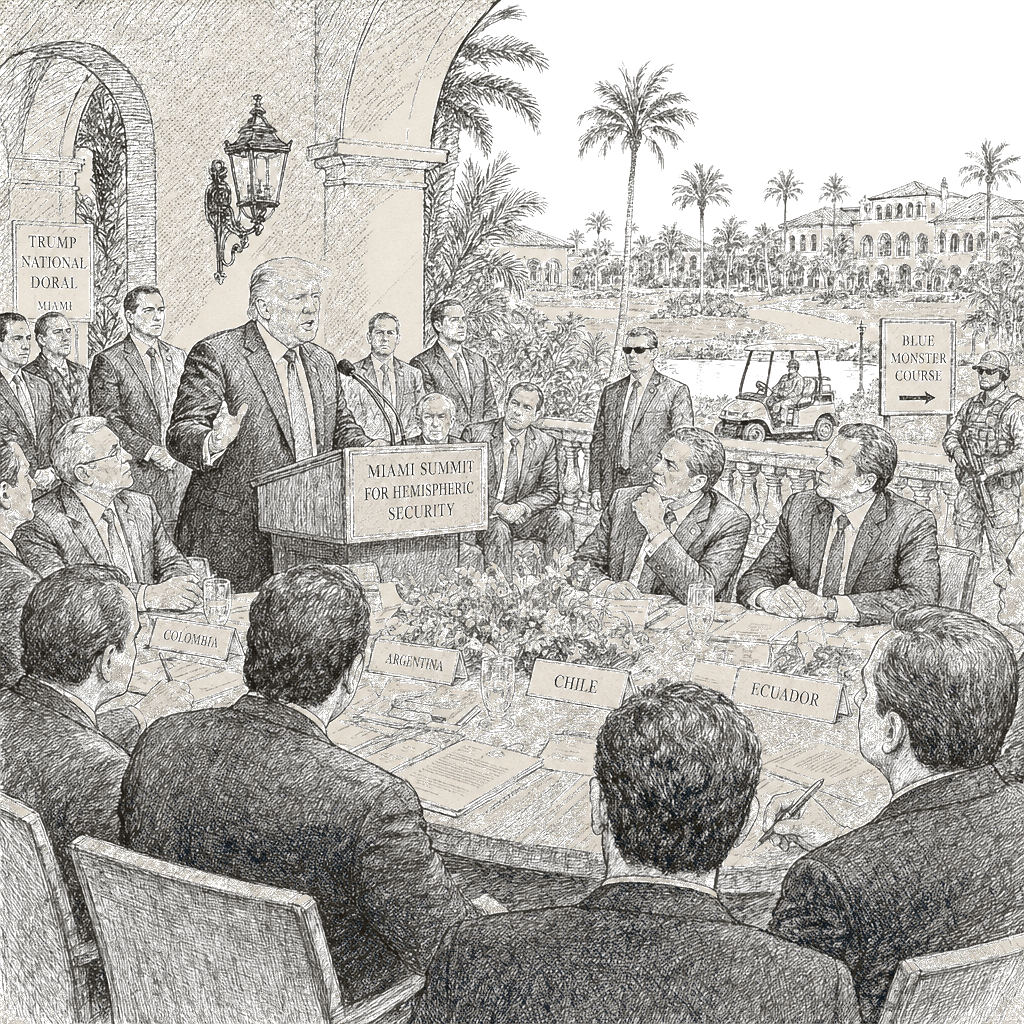
DORAL, Fla. — President Donald Trump convened conservative Latin American heads of state at his Miami-area golf resort Saturday, urging them to deploy military force against drug trafficking cartels and transnational gangs he described as posing an “unacceptable threat” to hemispheric security. The summit, which the White House called “Shield of the Americas,” came one week after Trump launched a war against Iran alongside Israel — a conflict that has left hundreds dead — and two months after a U.S. military operation captured then-Venezuelan President Nicolás Maduro.
The gathering drew leaders from 12 countries to Trump National Doral Miami and signaled Trump’s effort to reassert U.S. dominance in Latin America even as his administration manages simultaneous military crises abroad, though notable absences — including Brazil, Mexico, and Colombia — underscored the limits of the coalition he is assembling.
“The only way to defeat these enemies is by unleashing the power of our militaries,” Trump said. “We have to use our military. You have to use your military.”
Trump cited the U.S.-led coalition that confronted the Islamic State group in the Middle East as the model for the regional effort, saying that “we must now do the same thing to eradicate the cartels at home.”
Absent powers shadow the gathering
Leaders from Argentina, Bolivia, Chile, Costa Rica, the Dominican Republic, Ecuador, El Salvador, Guyana, Honduras, Panama, Paraguay, and Trinidad and Tobago joined Trump at the resort, which he is also set to host the Group of 20 summit later this year.
Absent were Brazil, Mexico, and Colombia — three of the region’s most influential economies and pillars of prior U.S. anti-narcotics cooperation in the hemisphere. Trump singled out Mexico from the podium.
“The cartels are running Mexico,” Trump said. “We can’t have that. Too close to us. Too close to you.”
The summit’s origins lie in the failure of what was to be the 10th Summit of the Americas. The Dominican Republic’s president, Luis Abinader, postponed that regional gathering after leftist leaders in Colombia and Mexico threatened to pull out in protest of the White House’s barring of Cuba, Nicaragua, and Venezuela, and after Trump declined to commit to attending. The Shield of the Americas name was meant to signal Trump’s vision for an “America First” approach to the region, leveraging U.S. military and intelligence assets at a scale unseen since the end of the Cold War, according to the Associated Press.
Kuwait deaths pull Trump away
Trump’s time with the assembled leaders was limited. He departed the summit to travel to Dover Air Force Base, Delaware, to attend the dignified transfer of six U.S. troops killed in a drone strike on a command center in Kuwait. The attack came one day after the U.S. and Israel launched their military campaign against Iran.
Trump called the American deaths a “very sad situation” and praised the fallen troops as “great heroes.”
Ecuador and U.S. strike cartel target
Ecuador demonstrated the kind of joint action Trump called for: Ecuadorian and U.S. security forces attacked a refuge belonging to the Colombian armed group Comandos de la Frontera in the Ecuadorian Amazon on Friday, authorities reported.
This joint fight against drug traffickers “is only the beginning,” said Ecuador’s president, Daniel Noboa.
Cuba warnings, China rivalry
Trump said the U.S. would turn its attention to Cuba after the war with Iran concludes and suggested his administration would cut a deal with Havana. “Great change will soon be coming to Cuba,” he said, adding that “they’re very much at the end of the line.”
Cuban President Miguel Díaz-Canel rejected the framing on Saturday. He described the summit as “small, reactionary, and neocolonial” and wrote in a social media post that Washington had committed right-wing governments from the region “to accept the lethal use of US military force to resolve internal problems and maintain order and tranquility in their countries.”
The summit also served as a backdrop for the administration’s intensifying competition with China for influence in the region. Trump’s national security strategy promotes what his team calls the “Trump Corollary” to the Monroe Doctrine — targeting Chinese infrastructure projects, military cooperation, and investment in the region’s resource industries.
The administration’s first major demonstration of that posture was its strong-arming of Panama to withdraw from China’s Belt and Road Initiative and to review long-term port contracts held by a Hong Kong-based company, amid U.S. threats to retake the Panama Canal. The January capture of Maduro also threatens to disrupt Venezuelan oil shipments to China — Venezuela’s largest crude buyer before the operation — and pull one of Beijing’s closest regional allies toward Washington’s orbit.
China’s Foreign Minister Wang Yi, speaking Sunday, said China’s diplomacy in Latin America was not targeted at any third party, but “nor should it be interfered with by any third party.” He added: “The international stage of the 21st century should no longer be a stage for the old dramas of the 19th century.”
Trump is scheduled to travel to Beijing later this month to meet with Chinese President Xi Jinping.
Noem debuts in new role
After Trump departed for Delaware, Secretary of State Marco Rubio hosted the assembled leaders for a working lunch. The session gave Kristi Noem, whom Trump fired as homeland security secretary Thursday, her debut in a new role as special envoy for the Shield of the Americas.
“We want our hemisphere to be safer, to be more sovereign, and to be more prosperous,” Noem told the leaders.