Body
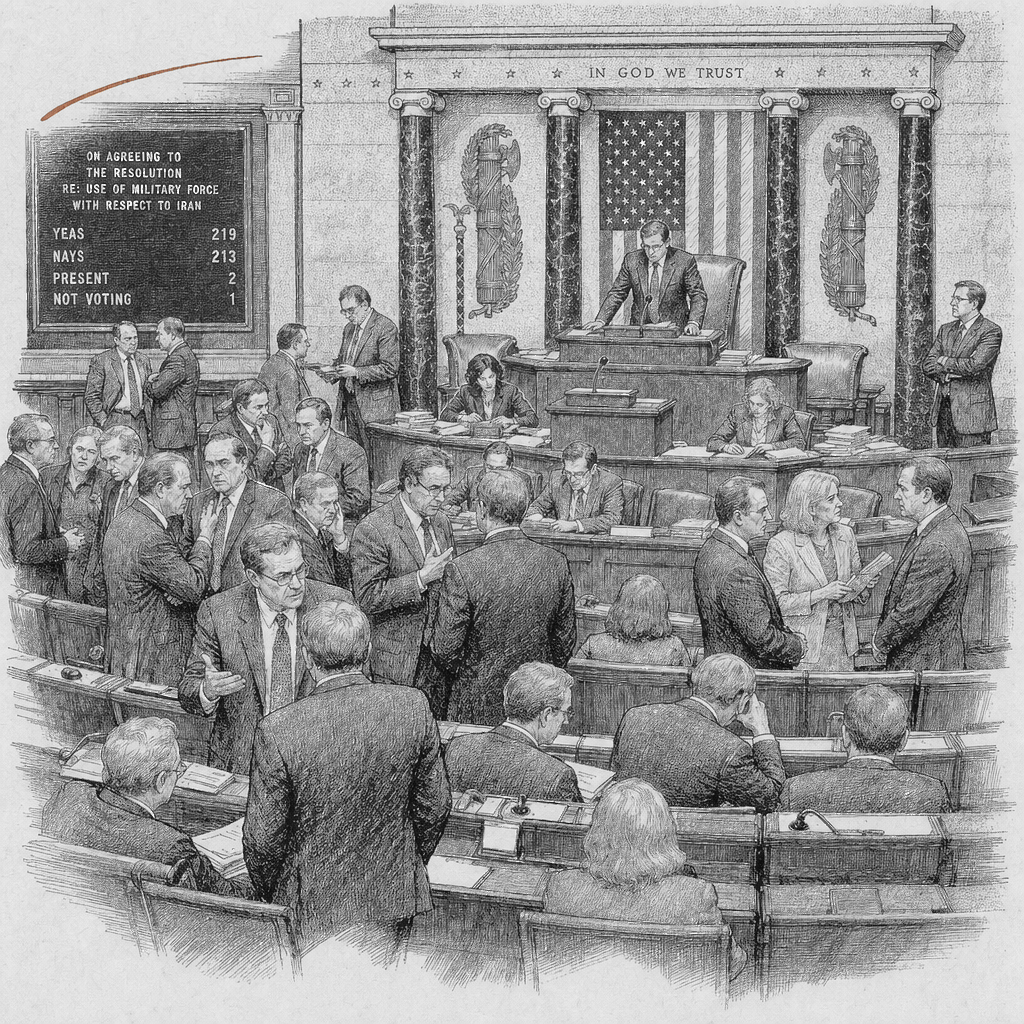
The House narrowly rejected a resolution Thursday to limit President Donald Trump’s war powers in the Iran conflict, an early sign of congressional unease as the fight expanded and began reordering U.S. priorities. The vote tallied 212-219, following the Senate’s defeat of a similar measure the day before.
The measure would have curtailed Trump’s ability to conduct the military operation unless Congress approved the action, and the resolution’s defeat reflected a split along party lines with some crossover. The House vote also served as a snapshot of political support for and opposition to the U.S.-Israel military operation and Trump’s rationale for acting without first seeking a congressional declaration of war.
At the Capitol, Rep. Gregory Meeks, the top Democrat on the House Foreign Affairs Committee, pressed the constitutional argument. “Donald Trump is not a king, and if he believes the war with Iran is in our national interest, then he must come to Congress and make the case,” Meeks said.
House Speaker Mike Johnson warned that limiting the president’s authority would be “dangerous” while the U.S. military was already in conflict. Johnson, who described himself as a close ally of Trump, said, “We are not at war,” and said the operation was limited in scope and duration, adding that the “mission is nearly accomplished.”
Republicans largely backed Trump, while most Democrats opposed the effort to restrict his war-making authority. The AP report said crossover coalitions emerged: two Republicans supported the war powers resolution with most Democrats, while four Democrats joined Republicans to reject it.
The resolution’s backers argued the Constitution gives Congress the authority to decide matters of war, while opponents emphasized executive power during an active conflict. Rep. Jamie Raskin, D-Md., said the framers were clear that only Congress can decide war matters, arguing, “It’s up to us.”
Supporters of Trump said the conflict was tied to an “imminent threat” and that the war powers resolution was effectively a demand that the president do nothing. Republican Rep. Brian Mast of Florida, who chaired the House Foreign Affairs Committee and is an Army veteran, publicly thanked Trump for taking action against Iran and said the resolution asked “that the president do nothing.”
Administration officials, meanwhile, were working to secure lawmakers’ confidence as the conflict progressed. The AP report said the administration spent hours behind closed doors with lawmakers, and noted that in the days leading into the vote, six U.S. military members were killed over the weekend in a drone strike in Kuwait, with Trump warning that more Americans could die.
The AP report described shifting administration rationales for the nearly week-old conflict. It said Trump had indicated he needed to be involved in choosing Iran’s new leader, while Johnson said this week that America had enough problems at home and was not in the “nation-building business.” Defense Secretary Pete Hegseth told lawmakers the war could extend eight weeks, and the AP report said Trump left open the possibility of sending U.S. troops even though the operation had largely been described as a bombing campaign.
On the war’s goals, the administration said the mission aimed to destroy Iran’s ballistic missiles that it believed were shielding Iran’s nuclear program and said Israel was ready to act. The AP report also said the U.S. torpedoed an Iranian warship near Sri Lanka on Wednesday and that more than 1,230 people in Iran had died, according to the AP account.
Some lawmakers who pushed the war powers measure criticized what they said was a lack of clarity from the administration. Rep. Thomas Massie, a Republican from Kentucky and an outlier in his party, said, “This administration can’t even give us a straight answer of as to why we launched this preemptive war.” Massie and Rep. Ro Khanna, D-Calif., were also among those who pushed the resolution to the floor after objections from Johnson’s GOP leadership.
Beyond the House vote, the AP report said the Senate’s earlier rejection contributed to the sense that the war powers debate had become a measure of congressional willingness to limit executive action. It said Senate Democratic leader Chuck Schumer told lawmakers that every senator would pick a side, while Sen. John Barrasso said Democrats would rather obstruct Trump than “obliterate Iran’s national nuclear program.” The Senate measure failed on a 47-53 tally that the AP report said broke mostly along party lines, with Rand Paul voting in favor and John Fetterman voting against.