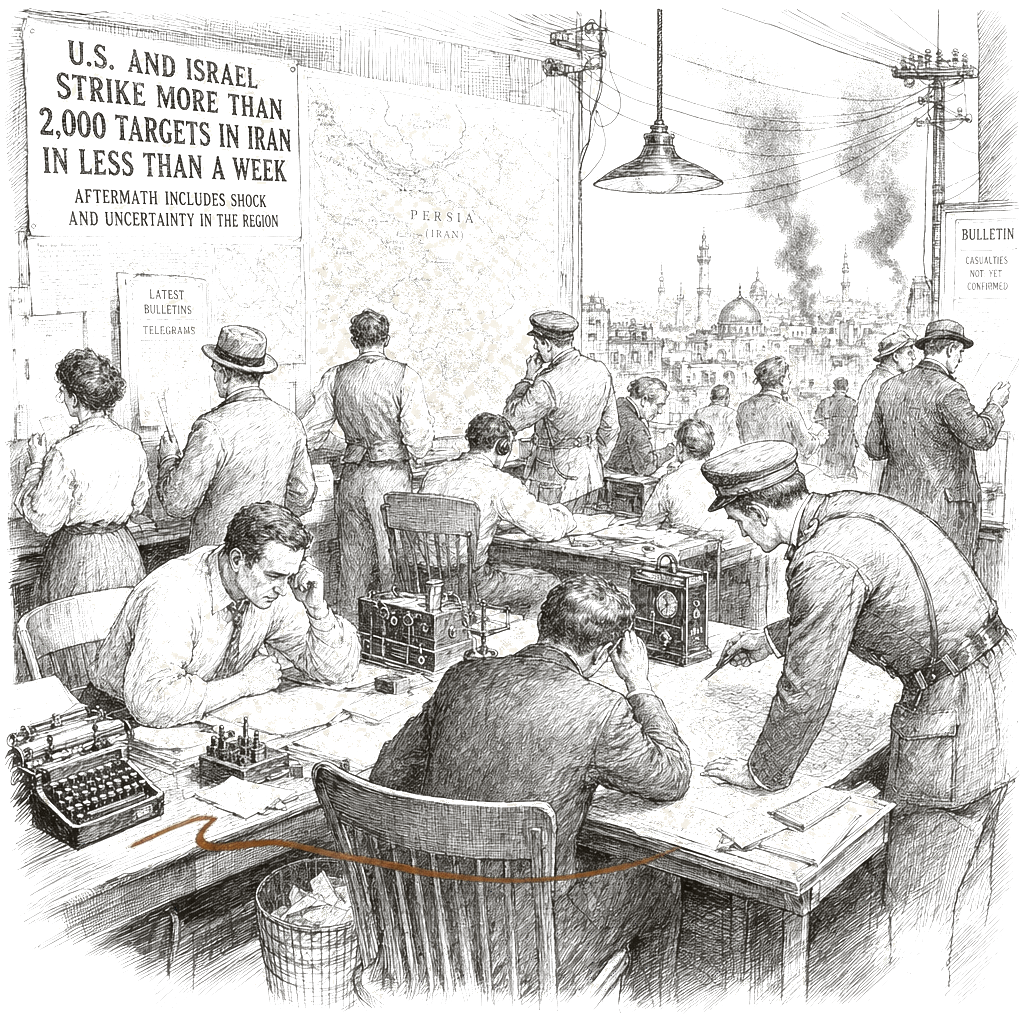
U.S. and Israeli forces have struck more than 2,000 targets across Iran in less than a week, U.S. Central Command said, killing Supreme Leader Ayatollah Ali Khamenei and a string of senior military and security officials in what conflict monitors describe as the most intensive American bombing campaign in the Middle East in more than a decade. An Iranian government agency says at least 1,230 people have been killed. More than 165 died when a school in southeastern Iran was struck, most of them children, according to Iranian state media.
The campaign marks a sharp escalation beyond the 12-day war last summer, when strikes focused on nuclear enrichment sites. Experts and independent monitors say the current operation now appears aimed at dismantling Iran’s military capacity and weakening its theocratic governance structure, though Iran’s emergency leadership is assessed to retain the ability to exercise domestic control.
Leadership Killed in Opening Strikes
U.S. and Israeli airstrikes hit Khamenei’s residential compound in central Tehran, killing him in the opening barrages on Feb. 28, the Associated Press reported. Strikes also killed Iran’s defense minister, the head of the Islamic Revolutionary Guard Corps, Khamenei’s top security adviser, and other senior figures.
A religious site connected to Khamenei’s predecessor was partially destroyed. An airstrike punched a hole through the dome of a building belonging to the Assembly of Experts, the council of senior Shiite clerics charged with appointing the next supreme leader.
Armed Conflict Location and Event Data, an independent monitoring group known as ACLED, said in a statement that the strikes represent “a more significant blow than anyone expected might happen in such a short time.” Even so, ACLED said, Iran’s emergency leadership still appears to have “the ability for domestic coercion.”
Revolutionary Guard and Basij Struck Across the Country
Of more than 280 strikes that ACLED documented as of Wednesday, over 20% targeted Revolutionary Guard or Basij positions, mostly in Tehran and in western and southern Iran. Garrisons, air bases, underground complexes, ammunition depots, weapons factories, and command buildings have all been attacked, according to ACLED.
Satellite photos from Vantor, a U.S. imaging company, show several buildings at the Revolutionary Guard’s headquarters in northern Tehran have been demolished. Small, local Basij branches have also been targeted, ACLED said.
On Thursday, two sports facilities in Tehran were struck, including the Azadi Sports Complex, where Iran once sought to host the Olympics. Video verified by AP shows a giant hole in the roof of a 12,000-person arena at the complex. The Revolutionary Guard and Basij have been known to use sports facilities as mobilizing points, according to the AP.
Not every strike yielded meaningful military impact. “A lot of empty buildings” have also been struck, ACLED said.
Missile Arsenal a Priority Target
Eliminating Iran’s missile stockpiles and launchers is a top priority, Israeli and U.S. officials have said. A suspected missile site in the mountains near Isfahan and another outside the western city of Kermanshah have been struck. Satellite photos from Planet Labs PBC show roads leading into tunnels beneath a mountain at the Kermanshah site now pockmarked with craters.
Iran has continued to fire missiles and drones at Israel, U.S. bases in the Persian Gulf, and energy facilities across the region. A senior Western official, speaking on condition of anonymity to discuss intelligence matters, said Iran has several days’ worth of ballistic missiles if it continues firing at current rates, but may hold some back to wage a longer campaign.
Naval Engagement Off Sri Lanka
A U.S. submarine sank an Iranian warship off the coast of Sri Lanka. Sri Lanka recovered 87 bodies and rescued 32 Iranian sailors on Wednesday, the AP reported.
Nuclear Facilities Not Yet a Priority
Nuclear facilities had not appeared to be a focus of the campaign as of Thursday, though Israel has indicated it intends to strike them. Satellite images from Monday show newly damaged buildings at the Natanz nuclear facility in central Iran, the country’s main enrichment site. The International Atomic Energy Agency said there was “no radiological consequence expected.”
Iran maintains its nuclear program is peaceful, though its officials had threatened to pursue a bomb while enriching uranium to near-weapons-grade levels.
Israel says it also struck mountains north of Tehran where it said Iran had moved some nuclear activities to underground bunkers following last summer’s 12-day war.