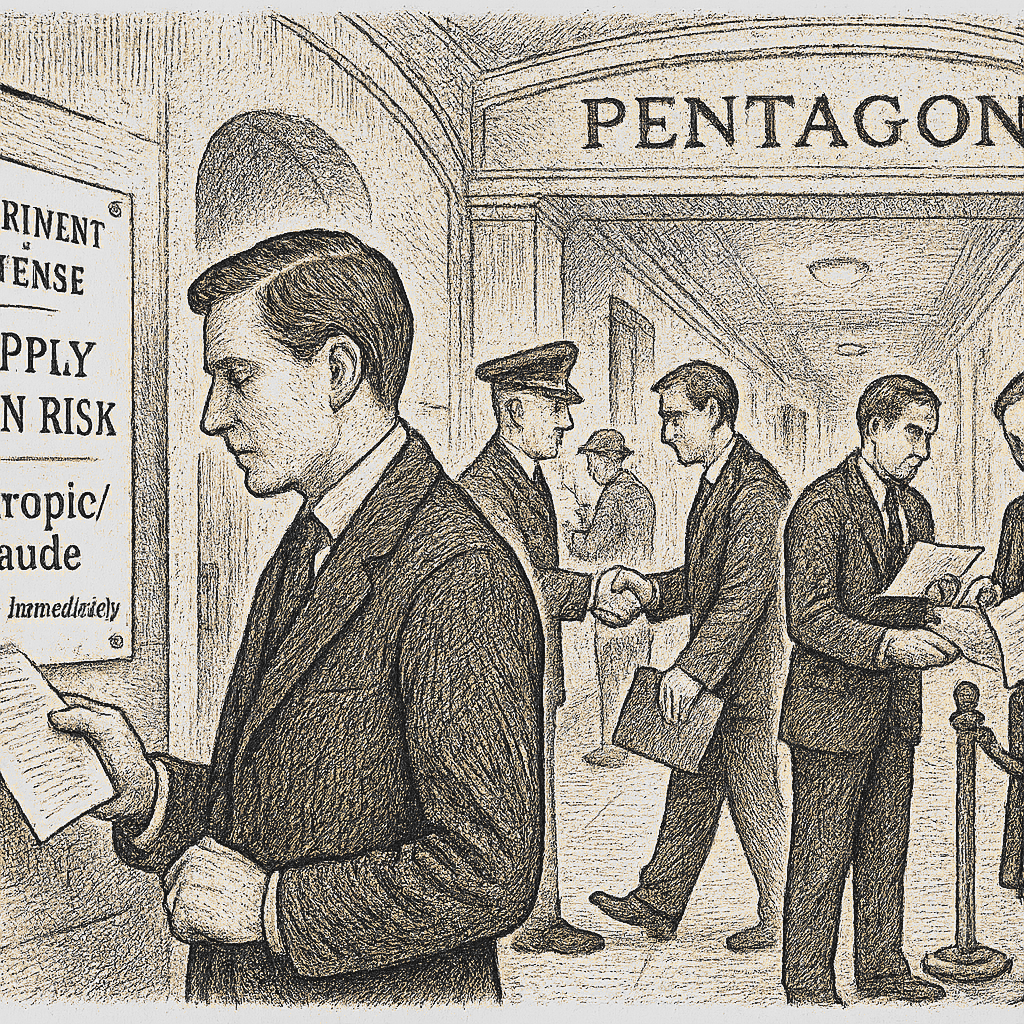
The designation invokes legal authority federal law has defined as reserved for foreign adversaries suspected of sabotage or espionage, and drew immediate criticism from former national security officials, lawmakers, and policy experts who said the Trump administration had repurposed the tool to punish a domestic company for declining to strip safeguards against mass domestic surveillance and fully autonomous weapons.
The Pentagon on Thursday officially designated AI company Anthropic and its Claude chatbot as a supply chain risk, effective immediately — a move that could force defense contractors to cut ties with one of the country’s fastest-growing AI companies and sets up an unprecedented legal clash between a U.S. tech firm and the Defense Department. Anthropic CEO Dario Amodei said the company will challenge the designation in court, calling it legally unsound.
“We do not believe this action is legally sound, and we see no choice but to challenge it in court,” Amodei said in a statement Thursday.
The confrontation has been building since last Friday, on the eve of the Iran war, when President Donald Trump and Defense Secretary Pete Hegseth accused Anthropic of endangering national security. The dispute began after Amodei refused to drop the company’s constraints limiting Claude’s use for mass surveillance of Americans or control of fully autonomous weapons.
Pentagon’s rationale
The Pentagon statement framed its decision as a matter of command authority. “This has been about one fundamental principle: the military being able to use technology for all lawful purposes,” it said. “The military will not allow a vendor to insert itself into the chain of command by restricting the lawful use of a critical capability and put our warfighters at risk.”
Amodei countered that the restrictions Anthropic sought “relate to high-level usage areas, and not operational decision-making.” He said there had been productive conversations with Pentagon officials over whether the military could continue using Claude, or arrange a smooth transition if no agreement was reached.
Trump directed the military to phase out Claude within six months. Claude is already widely embedded in military and national security platforms, and Amodei said it was a priority to ensure warfighters would not be “deprived of important tools in the middle of major combat operations.”
Amodei said a Pentagon notification Anthropic received Wednesday indicates the designation applies only to Claude’s use by customers as a “direct part of” their military contracts.
Contractor reactions
Some defense contractors were already cutting ties with Anthropic before the formal designation. Lockheed Martin said it will “follow the President’s and the Department of War’s direction” and look to other providers of large language models. “We expect minimal impacts as Lockheed Martin is not dependent on any single LLM vendor for any portion of our work,” the company said.
Microsoft took a narrower reading of the rule. After its lawyers reviewed the designation, the company said it “can continue to work with Anthropic on non-defense related projects.”
Broad criticism
The Pentagon’s decision to apply a legal tool that federal codes have reserved for threats posed by foreign adversaries drew criticism across the political spectrum. Those codes define supply chain risk as a threat that “an adversary may sabotage, maliciously introduce unwanted function, or otherwise subvert” a system to disrupt, degrade, or spy on it.
Sen. Kirsten Gillibrand, a New York Democrat who serves on the Senate Armed Services Committee and Senate Intelligence Committee, called it “a dangerous misuse of a tool meant to address adversary-controlled technology.” She added: “This reckless action is shortsighted, self-destructive, and a gift to our adversaries.”
Earlier Thursday, a group of former defense and national security officials sent a letter to lawmakers expressing “serious concern” about the designation. The letter was signed by figures including former CIA director Michael Hayden and retired flag officers from the Air Force, Army, and Navy. “The use of this authority against a domestic American company is a profound departure from its intended purpose and sets a dangerous precedent,” they wrote.
The former officials wrote that the authority exists to “protect the United States from infiltration by foreign adversaries — from companies beholden to Beijing or Moscow, not from American innovators operating transparently under the rule of law. Applying this tool to penalize a U.S. firm for declining to remove safeguards against mass domestic surveillance and fully autonomous weapons is a category error with consequences that extend far beyond this dispute.”
Neil Chilson, a Republican former chief technologist for the Federal Trade Commission who now leads AI policy at the Abundance Institute, described the decision as “massive overreach that would hurt both the U.S. AI sector and the military’s ability to acquire the best technology for the U.S. warfighter.”
Consumer surge amid lost contracts
While Anthropic faced the loss of defense contracts, the public dispute generated a surge of consumer interest. The company said more than a million people signed up for Claude each day during the past week, lifting it past OpenAI’s ChatGPT and Google’s Gemini as the top AI app in more than 20 countries in Apple’s App Store.
OpenAI rivalry
The confrontation also deepened the bitter rivalry between Anthropic and OpenAI, which began when former OpenAI leaders including Amodei founded Anthropic in 2021.
Hours after the Pentagon announced initial punishments against Anthropic last Friday, OpenAI announced a deal to effectively replace Anthropic with ChatGPT in classified military environments. OpenAI had sought similar protections against domestic surveillance and fully autonomous weapons but later amended its agreements. OpenAI CEO Sam Altman said he shouldn’t have rushed a deal that “looked opportunistic and sloppy.”
Amodei said Thursday that he wanted to “directly apologize” for an internal note he had sent to Anthropic staff that attacked OpenAI’s behavior and suggested Anthropic was being punished for not giving “dictator-like praise” to Trump.