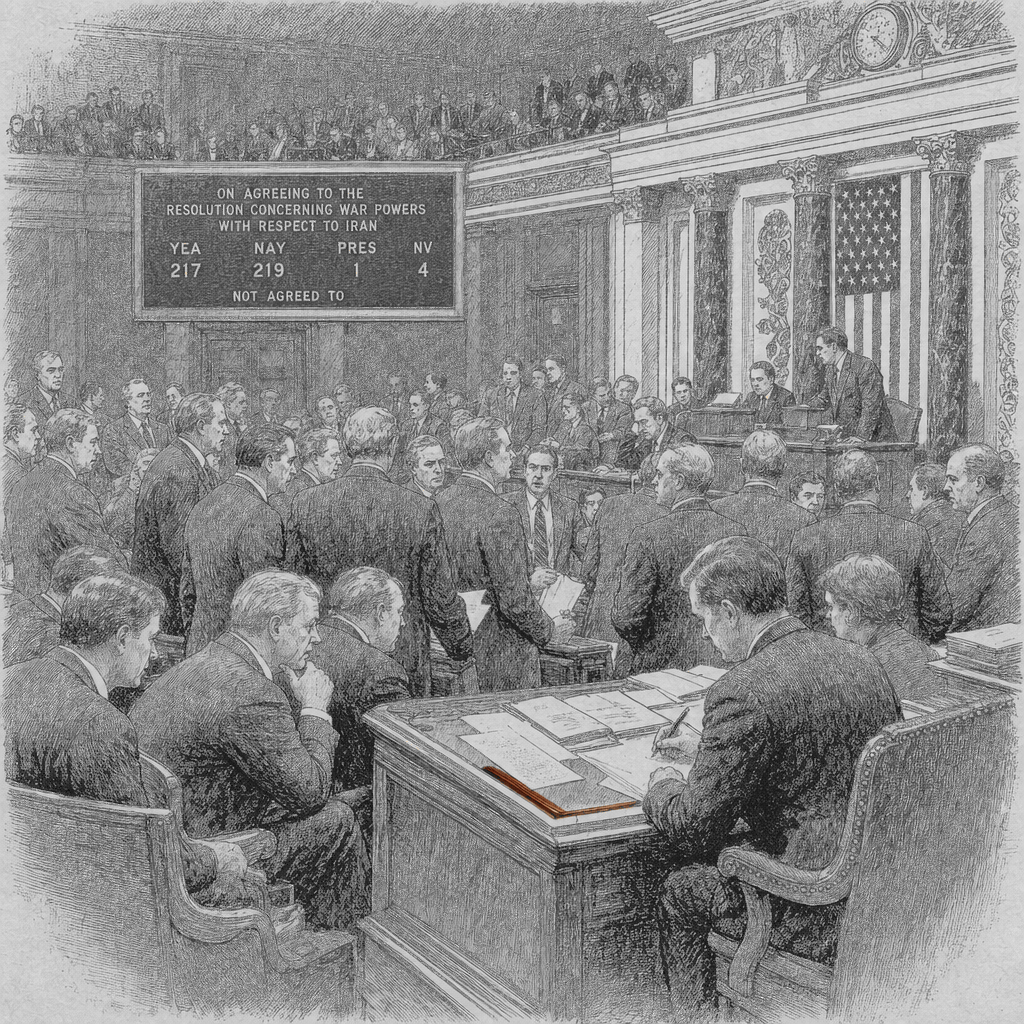
The House narrowly rejected a resolution Thursday that sought to curb President Donald Trump’s war powers in the Iran conflict, signaling early unease in Congress as the fighting widens and reshapes U.S. priorities. The vote came after the Senate had defeated a similar measure the day before, leaving the White House to continue acting without the congressional check the resolution proposed.
House Speaker Mike Johnson argued that limiting the president’s authority would be inappropriate while the United States military was already engaged, and he said, “We are not at war.” Johnson, who described the operation as limited in scope and duration, said the “mission is nearly accomplished,” framing the vote as a challenge to the president’s ability to direct active military operations.
Rep. Gregory Meeks, the top Democrat on the House Foreign Affairs Committee, urged lawmakers to require Trump to seek congressional input, saying, “Donald Trump is not a king, and if he believes the war with Iran is in our national interest, then he must come to Congress and make the case.” Meeks’ remarks came as lawmakers confronted what the House vote reflected: political unease over a rapidly expanding conflict and the constitutional balance involved in going to war.
Republicans largely backed Trump and the approach taken to act in Iran, while Democrats opposed the resolution as a test of the Constitution’s balance of powers in wartime. The AP account described the broader political divide as Republicans seeing the conflict as not the start of a new war, but the end of a long era in which Iran had menaced the West, while Democrats characterized the attack as a war of choice.
During the debate, Rep. Brian Mast of Florida, chairman of the House Foreign Affairs Committee, thanked Trump for taking action and said the president was using his own constitutional authority to defend the United States against the “imminent threat” Iran posed. Mast, an Army veteran who worked as a bomb disposal expert in Afghanistan, described the resolution as effectively asking “that the president do nothing,” positioning the measure as an attempt to halt executive action during active hostilities.
House Republicans and Democrats did not vote in lockstep with no exceptions. The AP report said two Republicans joined most Democrats in voting for the war powers resolution, while four Democrats joined Republicans to reject it, highlighting a measure that split lawmakers across party lines rather than strictly along them.
The resolution, as described in the AP account, would have immediately halted Trump’s ability to conduct the war unless Congress approved the military action, and the president would likely have vetoed it. For Trump officials, the vote unfolded amid a scramble for support and efforts to reassure lawmakers about the situation, with administration officials spending hours behind closed doors on Capitol Hill this week.
As the war continued, members described a moving landscape of rationales and operational timelines. The AP report said six U.S. military members were killed over the weekend in a drone strike in Kuwait, and Trump said more Americans could die. The administration said its goal was to destroy Iran’s ballistic missiles it believes were shielding Iran’s nuclear program, and it also said Israel was ready to act, with American bases facing retaliation if the United States did not strike Iran first.
Rep. Thomas Massie of Kentucky, an outlier in his party, said the administration had not provided a clear explanation for initiating the war, telling lawmakers, “This administration can’t even give us a straight answer of as to why we launched this preemptive war.” Massie and Rep. Ro Khanna of California, who had pushed for the release of the Jeffrey Epstein files, helped bring the war powers resolution to the floor past objections from Johnson’s GOP leadership; additional voters mentioned by AP included Republican Rep. Warren Davidson of Ohio for the measure and Democratic Reps. Henry Cuellar of Texas, Jared Golden of Maine, Greg Landsman of Ohio and Juan Vargas of California against.
While the House took its vote, the AP account said lawmakers also were watching the Senate’s stance on similar measures during Trump’s second term. In the Senate, Republican leaders defeated a series of war powers resolutions pertaining to several other conflicts, and this one also failed, the AP report said, on a 47-53 vote mostly along party lines.
Senate Democratic leaders and top Republicans used the debate to frame the vote as both a test of congressional authority and an appraisal of the administration’s approach. AP reported that Senate Democratic leader Chuck Schumer said every senator would pick a side, while Sen. John Barrasso said Democrats would rather obstruct Trump than “obliterate Iran’s national nuclear program,” and that Sen. Rand Paul voted in favor while Sen. John Fetterman voted against.
The House vote left the immediate question—whether Congress would act to rein in the executive during active conflict—answered for now by a narrow margin, even as lawmakers continued to press for explanations about the war’s purpose, duration, and constitutional footing.