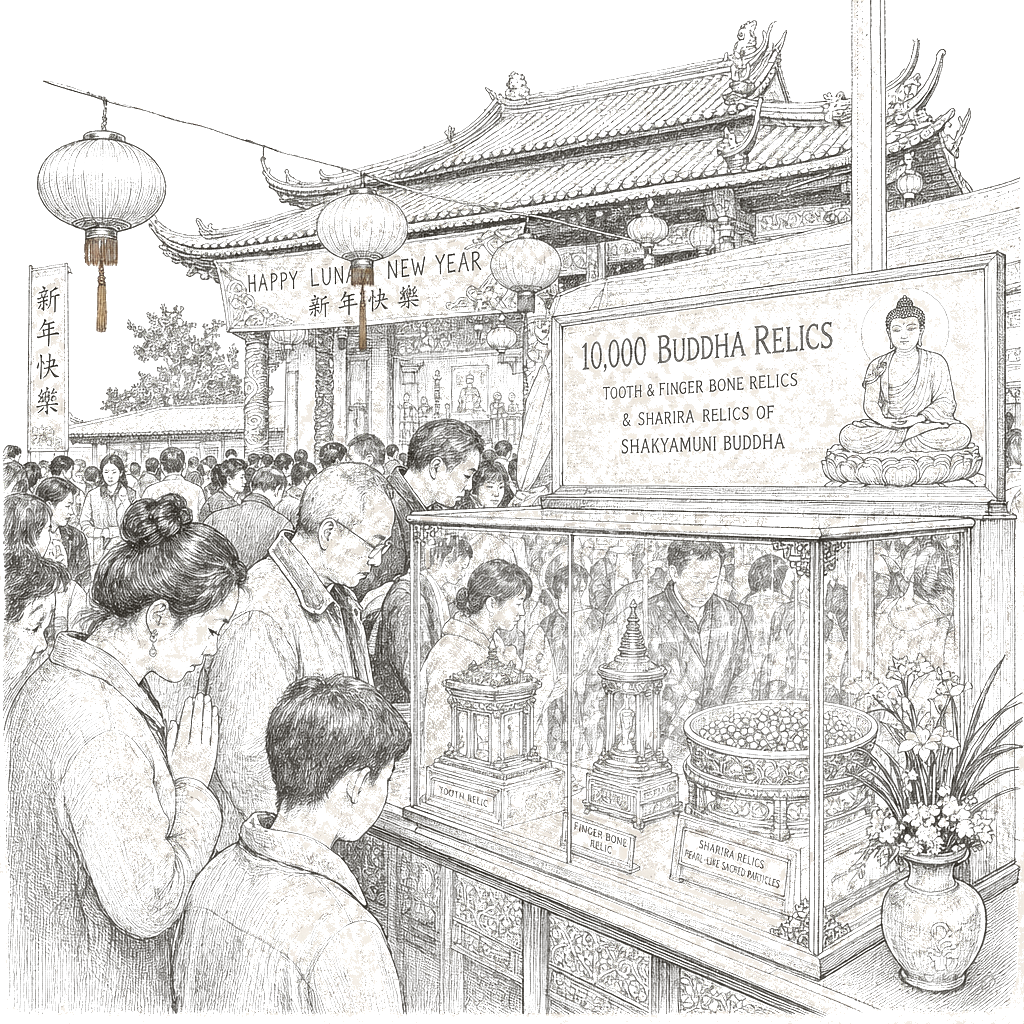
At the Wei Mountain Temple in Rosemead, California, Lunar New Year draws visitors looking to get close to what the temple presents as Buddha’s relics, including teeth and finger bones that believers say come from Shakyamuni Buddha. Katherine Nguyen, standing with hands folded and head bowed at the altar, said the experience felt personal: “To be able to see the Buddha, to get close to him and feel the energy — it’s very special for a Buddhist,” she said.
The temple holds the display publicly every Lunar New Year and calls it its “10,000 Buddha Relics,” though the AP story said the actual number across glass cases and miniature stupas or reliquaries is far larger. The exhibit includes bones and teeth believed to have come from the bodies of the Buddha, his relatives and disciples, alongside shariras described as colorful pearl- or crystal-like objects said to have been drawn from the cremated ashes of Buddhist masters and the Buddha.
Master YongHua, the temple’s founder, said the items’ size reflects the way believers explain their history. He told visitors that tooth and finger bone relics are significantly larger than what would be expected in the average human body because, in his description, they have “grown” over time. He also said the tooth relic produces “baby shariras,” with multicolored crystals that he said have multiplied and filled several containers in the exhibit.
Relic practice varies by faith, but the AP story described a specific emphasis in Buddhism: relics are generally treated as living, active sources of blessings rather than as passive reminders. The tradition includes beliefs that relics can appear on their own, grow or even multiply, and that they are typically enshrined in a stupa, a dome-shaped monument used for meditation and pilgrimage.
The AP story also placed the Rosemead display in the broader challenge facing relic traditions: authenticity. Over the years, it said there have been reports of fake tooth and bone relics and manufactured acrylic shariras flooding markets in Asia and online, sometimes sold with falsified authenticity certificates. The story pointed to a case in Singapore’s Buddha Tooth Relic Temple and Museum, which houses a tooth relic said to have been recovered from the Buddha’s funeral pyre; it came under scrutiny in 2007 after dental experts said the tooth’s characteristics did not match a human tooth’s dimensions.
In that Singapore case, the temple’s abbot, the Venerable Shi Fazhao, said he had never questioned its authenticity and that “if you believe it’s real, it’s real.” YongHua, by contrast, said the main purpose of the relics donated to the Rosemead temple about 14 years ago by a collector is to inspire faith, and that he has “no doubts” about their ethereal nature. He said, “I have seen them multiply with my own eyes,” and added, “They move on their own, they levitate. … I’ve seen people get cured of various ailments just by being in their presence.”
The story cited John Strong, a professor emeritus of religion at Bates College, who wrote “Relics of the Buddha” in 2004. Strong said the earliest accounts of Buddha’s funeral appear in Pali texts dating from about the 2nd century B.C.E., and that later commentaries describe relics that came out of the Buddha’s ashes as glittering jewels, with sizes ranging from mustard-seed-like amounts to objects described as gems or gold nuggets. He said relics do connect Buddhists to the Buddha, whom he described as “essentially absent” after attaining enlightenment and liberation from the cycle of birth, death and reincarnation.
Geshe Tenzin Zopa, a Tibetan monk and educator, told the AP that relics are “the most precious, most sacred, most powerful holy objects in our understanding,” and he described his beliefs around how relics can arise during cremation. As a young monk in Nepal, he said he believed he saw his teacher, Geshe Lama Konchog, recognized as a realized yogi by the Dalai Lama, generate relics as his body was being cremated; Zopa said the guru died in October 2001. He said senior monks advised that the cremation structure be sealed and left undisturbed for three days, and that when they returned disciples found hundreds of relics and, according to Zopa, the guru’s intact heart, tongue and eyes.
Zopa said he saw pearl-like relics popping out “like popcorn,” described the moment as “truly a miracle,” and said he believed the relics later multiplied and were enshrined in a memorial stupa at Kopan monastery in Nepal. He also said that for students of yogis, searching for relics in cremains is not a morbid fascination but an act of faith tied to expectation that a guru leaves behind a physical sign of spiritual realization; he added that believers see the creation of relics as requiring strong and extensive prayers and preservation of “pure morality for many lifetimes” to create the causes that produce relics.
Not all teachers emphasize relics in the same way. In Southern California, at the U.S. headquarters for the Fo Guang Shan Buddhist order, the Venerable Hui Ze said the order’s founder, Venerable Master Hsing Yun, taught followers not to focus solely on relics. “Our venerable master emphasized Humanistic Buddhism — how we can bring Buddha’s teachings into our daily lives with good thoughts, words and actions,” Hui Ze said, adding that Hsing Yun instructed that relics should not distract believers from the path to liberation.
Hui Ze said the order’s headquarters in Taiwan houses a Buddha tooth relic gifted to Hsing Yun by Kunga Dorje Rinpoche, who carried it as he fled Tibet in 1968 and safeguarded it for three decades. Hui Ze said he was moved when he saw it, describing an “intimate experience” and saying he felt connected with the Buddha “here 2,600 years ago,” calling the connection “priceless.” Hui Ze also said Hsing Yun instructed disciples not to look for relics in his ashes, died Feb. 5, 2023, and that following the cremation disciples sifted through the cremains and found several colorful, pearly relics, which were then left in the ashes to be spread across the order’s dozen centers across five continents. The story said Hsing Yun’s ashes containing the relics are set to be enshrined in the Southern California headquarters during a ceremony on March 21.