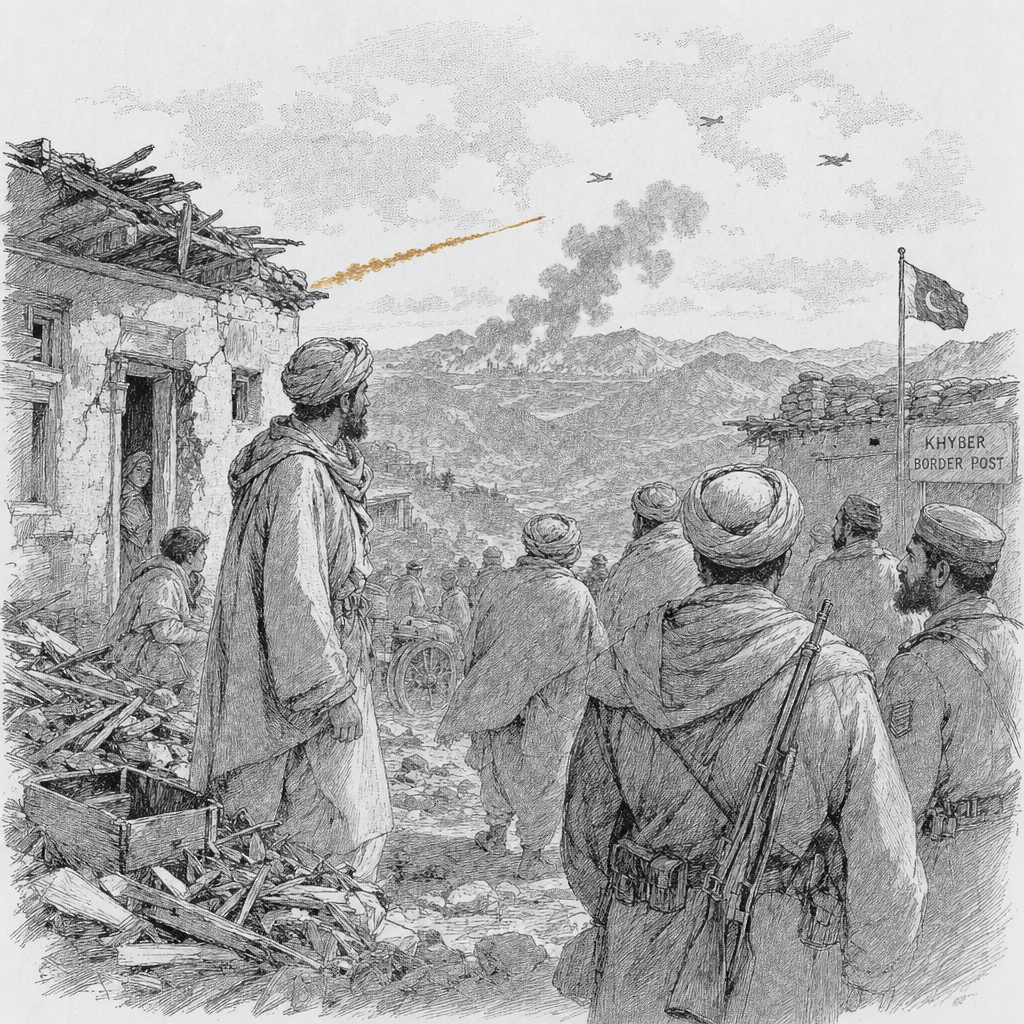
Pakistan’s military struck more military installations deep inside Afghanistan as clashes along the border continued after Pakistan’s defense minister said the two countries were in “open war,” according to the Associated Press. Pakistan’s campaign, carried out with artillery and air power, began after Pakistan said it responded to an earlier Afghan cross-border attack into Pakistan late Thursday, and the fighting continued into the weekend.
Pakistan’s defense minister Khawaja Mohammad Asif declared Friday, “Our patience has now run out. Now it is open war between us.” Pakistan later said the strikes targeted the outlawed Pakistani Taliban, or TTP, which it said was behind the attack. Afghanistan rejected Pakistan’s characterization, and Afghanistan said Pakistan’s earlier airstrike last Sunday killed civilians rather than combatants.
In its account of losses, Pakistan’s military and information minister Attaullah Tarar said Saturday that more than 331 Afghan forces had been killed and more than 500 others had been wounded during the ongoing strikes in Afghanistan. Tarar also said Pakistan destroyed 102 Afghan posts, captured 22 others and destroyed 163 tanks and armored vehicles at 37 locations. Afghanistan’s government dismissed those casualty claims as inaccurate.
Afghanistan said it responded to Pakistan’s strikes by attacking Pakistani military bases in Miranshah and Spin Wam overnight, according to the Associated Press. Afghan officials said these attacks destroyed military installations and caused heavy casualties, and they also presented their own figures for Pakistani losses.
Pakistan and Afghanistan also issued conflicting claims about battlefield losses on Friday. Pakistan’s army spokesperson, Lt. Gen. Ahmed Sharif Chaudhry, said 12 Pakistani soldiers were killed in the fighting, while Afghanistan’s deputy spokesman Hamdullah Fitrat accused Pakistan of targeting civilian areas in Afghanistan’s provinces of Paktika, Khost, Kunar, Nangarhar and Kandahar, and also said refugee camps in Torkham and Kandahar were hit. Fitrat said 52 people were killed, most of them women and children, and 66 others were wounded; the report said there was no immediate response from Islamabad to that accusation.
Afghan officials also cited earlier casualty and capture claims from both sides. On Saturday, Afghanistan’s Defense Ministry spokesman Enayatullah Khawarazmi wrote on X that Afghan forces killed 110 Pakistani soldiers during ongoing fighting and captured 27 Pakistani posts. Pakistan’s state-run media reported that the air force struck key military installations in various areas of eastern Afghanistan, while Pakistan’s own figures put losses at 12 killed and 27 wounded, with one soldier missing in action.
As the fighting continued, Afghan government spokesman Zabiullah Mujahid also said earlier that 13 Afghan forces were killed and 22 wounded and that 55 Pakistani soldiers were killed, according to the AP report. The United Nations, in a post on X, said major cities in Afghanistan were reportedly bombed by Pakistan’s military on Friday, raising fears for civilians already under Taliban rule.
The AP report described displacement and hardship for people near the border. Pakistan’s authorities said hundreds of residents living near the northwestern Torkham border crossing fled, and the report said Pakistan had deported dozens of Afghan refugees to Torkham in recent days. An Afghan refugee stranded near Torkham, Ejaz Ul Haq, told the AP he could not return to Afghanistan because of the fighting, and he said many others were struggling to obtain food during Ramadan.
The sides continued to exchange accusations about civilian harm. In eastern Afghanistan, the Department of Information and Culture accused Pakistan of destroying homes and killing at least 11 people, while there was no immediate response from Pakistan, which has said it was targeting only military installations. On the Afghan side of Torkham, commissioner Mullah Taj Mohammad Naqshbandi said in a statement that “brave forces of the Islamic Emirate” destroyed Pakistani military targets including a commissariat, military units, and three security towers.
The latest clashes follow months of tension between Pakistan and Afghanistan. The report said tensions were high since October, when dozens of soldiers, civilians and suspected militants were killed in earlier border clashes. A Qatari-mediated ceasefire ended intense fighting that month, but peace talks in Turkey in November failed to produce a lasting agreement, and the two sides intermittently traded fire until last week, when Pakistan struck what it described as TTP hideouts. Since then, countries including Turkey, Saudi Arabia, Qatar and China have sought to mediate to defuse tensions, including Qatar’s statement that a minister of state, Mohammed bin Abdulaziz Al-Khulaifi, spoke Friday with the foreign ministers of Afghanistan and Pakistan.
FRED figure references are not used in this article body.