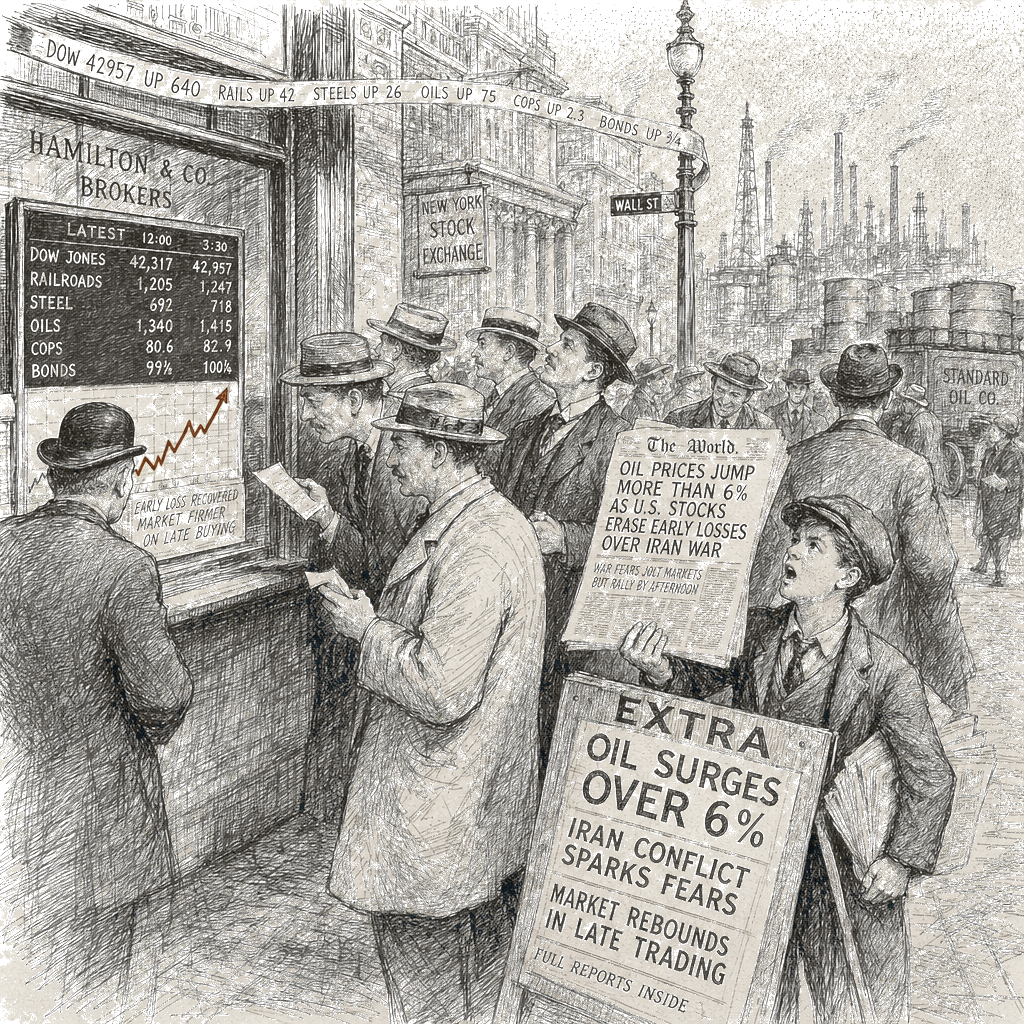
The market’s reaction to attacks in the Middle East played out sharply across energy, equities, and rates on Monday, with U.S. stocks giving back early declines after opening weak. Oil jumped on concern that the war risk could clog the global flow of crude and add to already strained inflation expectations, while investors also weighed higher natural-gas costs tied to a supplier’s decision to stop production because of the conflict. Gold climbed as some investors moved toward perceived safety, as U.S. officials argued the situation would not last.
Oil prices led the move, climbing more than 6% during the session. Benchmark U.S. crude rose 6.3% to settle at $71.23 per barrel, and Brent, the international benchmark, rose 6.7% to $77.74 per barrel, according to the AP’s market reporting. The AP noted the implication for gasoline prices, saying the crude jump would likely translate into higher prices at gasoline pumps soon and could weigh on both households and fuel-buying businesses.
U.S. equities, meanwhile, swung from sharp losses to a near-flat close. The S&P 500 fell as much as 1.2% in early trading, then erased those losses to finish up less than 0.1%. The Dow Jones Industrial Average dipped 73.14 points, or 0.1%, and the Nasdaq composite rose 80.65 points, to 22,748.86.
Sectors tied most directly to fuel costs and travel demand bore the brunt of early pressure. Stocks of airlines were among Monday’s steepest decliners as higher oil prices threatened fuel bills and the conflict reportedly disrupted air travel, with airports closed and travelers stranded. American Airlines fell 4.2%, United Airlines dropped 2.9%, and Delta Air Lines fell 2.2%. Norwegian Cruise Line Holdings fell 10.6% as investors also considered how higher costs could pressure consumers’ spending after gasoline and other essentials.
Higher Treasury yields helped drag down parts of the housing industry. The AP reported that homebuilder D.R. Horton fell 3.7% and Builder FirstSource sank 4.7%, attributing the weakness in part to the prospect that higher yields could translate into higher mortgage rates. At the same time, oil and defense-related companies helped cushion the overall market after the opening slide.
Oil companies gained on the crude surge, with Exxon Mobil up 1.1% and Marathon Petroleum rising 5.9%. Military equipment makers also strengthened, with Northrop Grumman climbing 5.9% and RTX rallying 4.7%. Palantir Technologies jumped 5.8% as one of the biggest gainers in the S&P 500, while Big Tech shares—including Nvidia—supported indexes, with Nvidia rising 2.9% and serving as the strongest single force pushing the S&P 500 higher.
In rates and commodities, the AP said Treasury yields did not fall despite investor nervousness, noting that the 10-year Treasury yield rose to 4.04% from 3.97% late Friday. The report said higher oil prices could add upward pressure on inflation, which is already worse than most people want, and that this could “tie the Federal Reserve’s hands” and limit the central bank’s ability to cut interest rates. Higher rates, it added, can worsen inflation even as lower rates can support growth and job gains.
International markets reflected the broad risk tone, with indexes sinking across much of Europe and Asia. The AP reported Germany’s DAX fell 2.6%, France’s CAC 40 dropped 2.2%, and Hong Kong’s Hang Seng fell 2.1%, while Shanghai was an outlier with a 0.5% rise. The AP also said prices for natural gas stayed higher, including for Europe, after a major liquefied natural gas supplier said it would stop production because of the war, a move that could raise heating bills for the remainder of winter.
U.S. officials sought to reassure markets about the conflict’s duration. Defense Secretary Pete Hegseth said Monday, “This is not Iraq,” adding, “This is not endless.” The AP also reported that gold rose 1.2% as investors sought safer assets and as U.S. officials worked to persuade the world that the war would not last forever. The report’s market bottom line was that, for now, fear still ran through trading even as stocks recovered from their early losses.