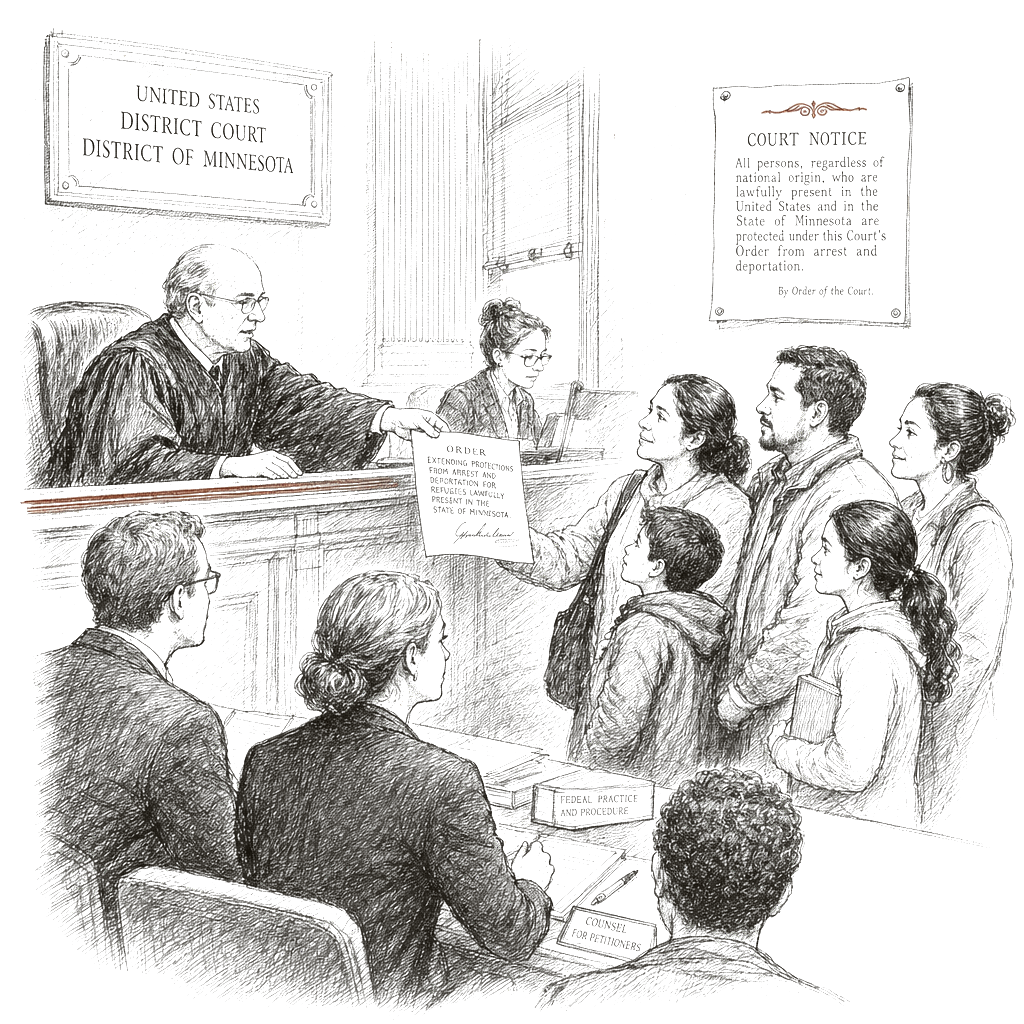
A federal judge in Minnesota extended an order shielding refugees in the state who are lawfully in the U.S. from being arrested and deported, a decision that turned a short-term court protection into a preliminary injunction as the lawsuit challenges a Trump administration interpretation of immigration law. U.S. District Judge John Tunheim granted the request by advocates for refugees to convert a temporary restraining order issued in January, setting the matter on a longer track for continued legal review.
The extended order is limited to Minnesota. But it comes as the judge and the parties focused on a new national policy on refugees announced Feb. 18 by the Department of Homeland Security, according to reporting tied to the hearing.
Advocates argued that the new policy threatens refugees’ ability to live in the U.S. without fear of being taken into federal custody. Kimberly Grano, an attorney with the International Refugee Assistance Project, told The Associated Press that “Minnesota refugees can now live their lives without fear that their own government will snatch them off the street and imprison them far from loved ones.”
The Trump administration’s position, as described in court and in the administration’s response to the judge’s ruling, is that federal authorities may arrest refugees who entered legally but have not yet received green cards. A Homeland Security memo, as characterized by the reporting, interprets the immigration law to require refugees applying for green cards to return to federal custody one year after being admitted, so that their applications can be reviewed.
Tunheim said in a 66-page opinion that he was not persuaded by that interpretation. The judge said the court would not allow federal authorities to use what he called a new and erroneous statutory interpretation to target refugees who, he said, came to the U.S. after promises that they would be welcomed and allowed to live in peace away from persecution.
In his remarks, Tunheim contrasted the policy with what he said the U.S. had promised refugees decades ago after they fled persecution, describing that promise as background-checked protection that would allow them to build a new life. “We promised them the hope that one day they could achieve the American Dream,” Tunheim said, adding, “The Government’s new policy breaks that promise — without congressional authorization — and raises serious constitutional concerns. The new policy turns the refugees’ American Dream into a dystopian nightmare.”
The administration pushed back after the ruling. Homeland Security and U.S. Citizenship and Immigration Services said in a statement Friday night that the decision was “yet another lawless and activist order from a federal judge” and that the Trump administration expected to be “vindicated in court.” The agencies also said USCIS is committed to “rooting out fraud and protecting the public safety and national security interests of the American people by screening and vetting aliens.”
During a court hearing last week, a Justice Department attorney, Brantley Mayers, argued that the government should have the right to arrest refugees one year after entering the U.S., according to the report, though the attorney also indicated that arrest would not necessarily always occur.
Tunheim also cited what he said was an example from within the case. He said one refugee identified as D. Doe was arrested in January after being told someone struck his car, and that the person was immediately flown to Texas, where he was interrogated about his refugee status. Tunheim said the refugee was kept in “shackles and handcuffs” for sixteen hours, later released in Texas, and left to find his way back to Minnesota.
The Associated Press reported that the story was updated to correct the date Homeland Security announced the national policy: Feb. 18 rather than Feb. 19. White reported from Detroit, and Associated Press reporter Rebecca Boone in Boise, Idaho, contributed to the story.