Body
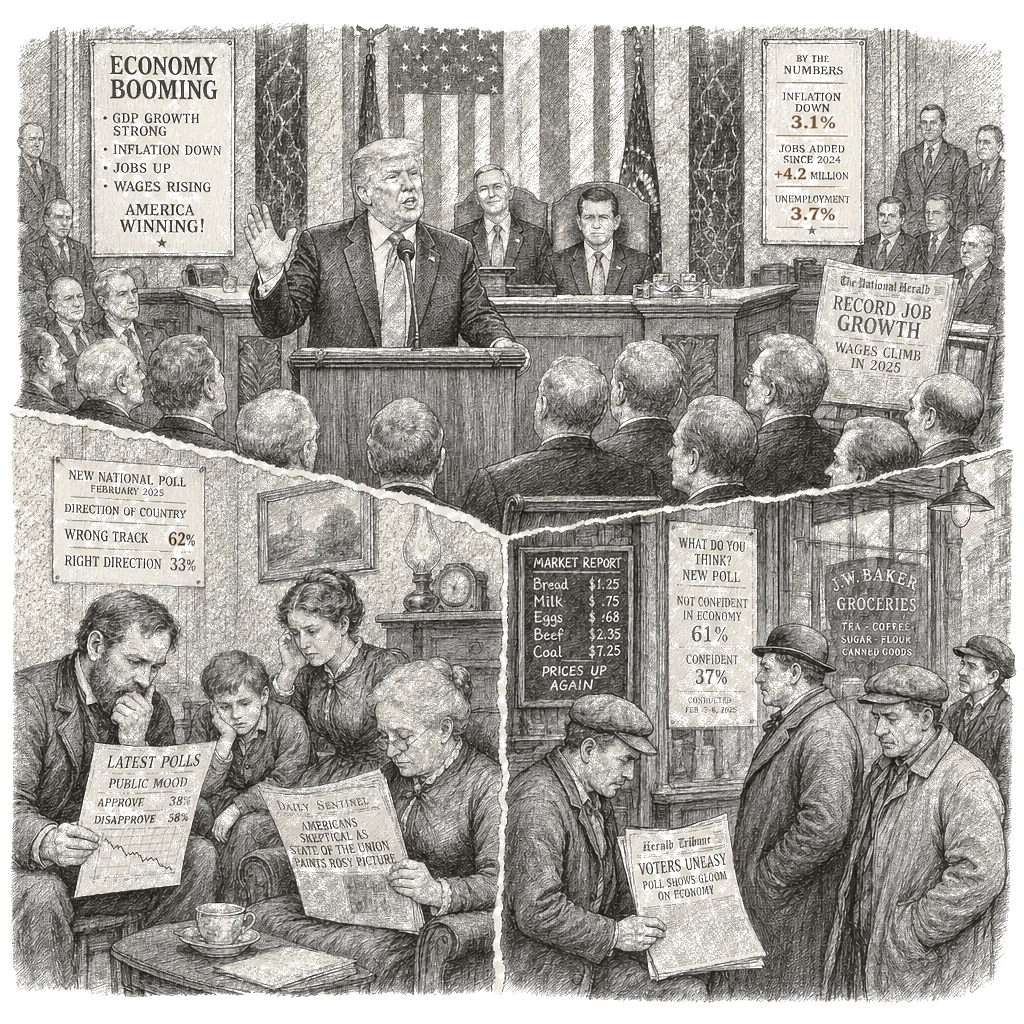
President Donald Trump’s first State of the Union pitch aimed to frame the U.S. economy as strong enough to justify sweeping optimism—falling prices, rising incomes and jobs, and a “roaring” pace that he said rivaled previous growth eras. But in the roughly half-day stretch leading into the speech, polling and price-linked survey feedback pointed in a different direction, suggesting that many Americans still feel economic strain even as some inflation measures ease.
The immediate counterweight came from The Conference Board’s consumer confidence report, released barely 12 hours before Trump spoke. The group said overall confidence remained historically low and only barely above the level it fell to during the depths of the COVID recession. In February, its index ticked up to 91.2, which was well below a four-year high of 112.8 reached in November 2024.
The Associated Press-NORC Center for Public Affairs Research survey referenced in the reporting added to the skepticism by showing only 39% of Americans approve of Trump’s economic leadership. The University of Michigan’s consumer sentiment survey was also described as staying at recessionary levels, underscoring that households’ outlook did not match the president’s upbeat framing.
Trump attempted to bridge that gap by pointing to economic data he said showed improving trends. In the address, he claimed: “Inflation is plummeting, incomes are rising fast, the roaring economy is roaring like never before,” according to the reporting. The same account described that the comparison between Trump’s claims and the economic reality many Americans face created visible strain in the message.
On growth, the reporting said the economy expanded last year but not at a pace that fits Trump’s “roaring” framing. It cited that real economic growth was 2.2% in 2025, compared with 2.8% in the first year under President Joe Biden and 2.9% in 2023, while describing that “roaring” eras in the past were marked by higher multi-year growth, such as the late 1990s and the 1980s.
Price pressure remained a central reason the surveys stayed gloomy. The reporting said Trump was correct that core inflation—excluding volatile food and energy—fell to a five-year low in January, but it highlighted that other price measures still suggested stubborn elevation. It cited a gauge of core prices monitored by the Federal Reserve as being 3% higher in December than a year earlier, above the Fed’s 2% target, and said the measure Trump cited places less weight on housing costs, which have cooled.
The University of Michigan data offered a direct window into how households perceive those costs. In February, the reporting said, nearly half of respondents in the survey “spontaneously mentioned high prices eroding their personal finances,” with Joanne Hsu, the survey director, saying that in a statement. The reporting also described that while Trump noted eggs prices have fallen from their peak, many other necessities remain much higher than five years ago, and said electricity prices rose 6.3% over the prior 12 months.
Hiring also appeared to undercut the most job-focused parts of the address. The reporting cited that employers added just 181,000 jobs in 2025, or about 15,000 per month, described as the worst job-growth year outside of a recession since 2002. It also said factories lost 108,000 jobs in 2025 after losing 202,000 jobs in the last two years of the Biden administration, with auto and auto parts plants cutting nearly 74,000 jobs over the past two years.
The reporting said Trump has blamed tariffs as part of an economic boom narrative, but it also raised questions about who has actually absorbed the costs. It described Trump as insisting that tariffs are paid by foreign countries, saying instead that the burden is paid by U.S. importers who often pass it along through higher prices. It cited a study by Harvard economist Alberto Cavallo and colleagues that found U.S. consumers were eating 43% of the higher tariff costs, with U.S. companies absorbing most of the rest.
Even as the reporting described examples of rising prices for imported goods—including furniture, auto parts, tools and clothes—it said the early results from the import taxes had not delivered much toward Trump’s trade-deficit goals. It cited that the goods trade deficit, including in areas such as automobiles and appliances that protectionist policies target, hit a record $1.24 trillion last year, increasing 2% from 2024—an outcome the reporting said ran counter to the idea of prompt, painless benefits from tariffs.
In that context, Trump’s economic messaging in the address appeared to clash with the public’s lived assessment: confidence measures stayed low, survey respondents highlighted high prices as eroding their finances, and hiring growth was weak enough to reinforce households’ sense of limited opportunity. The reporting portrayed those realities as creating gaps between the administration’s “golden age” story and the economic experience Americans have been reporting.