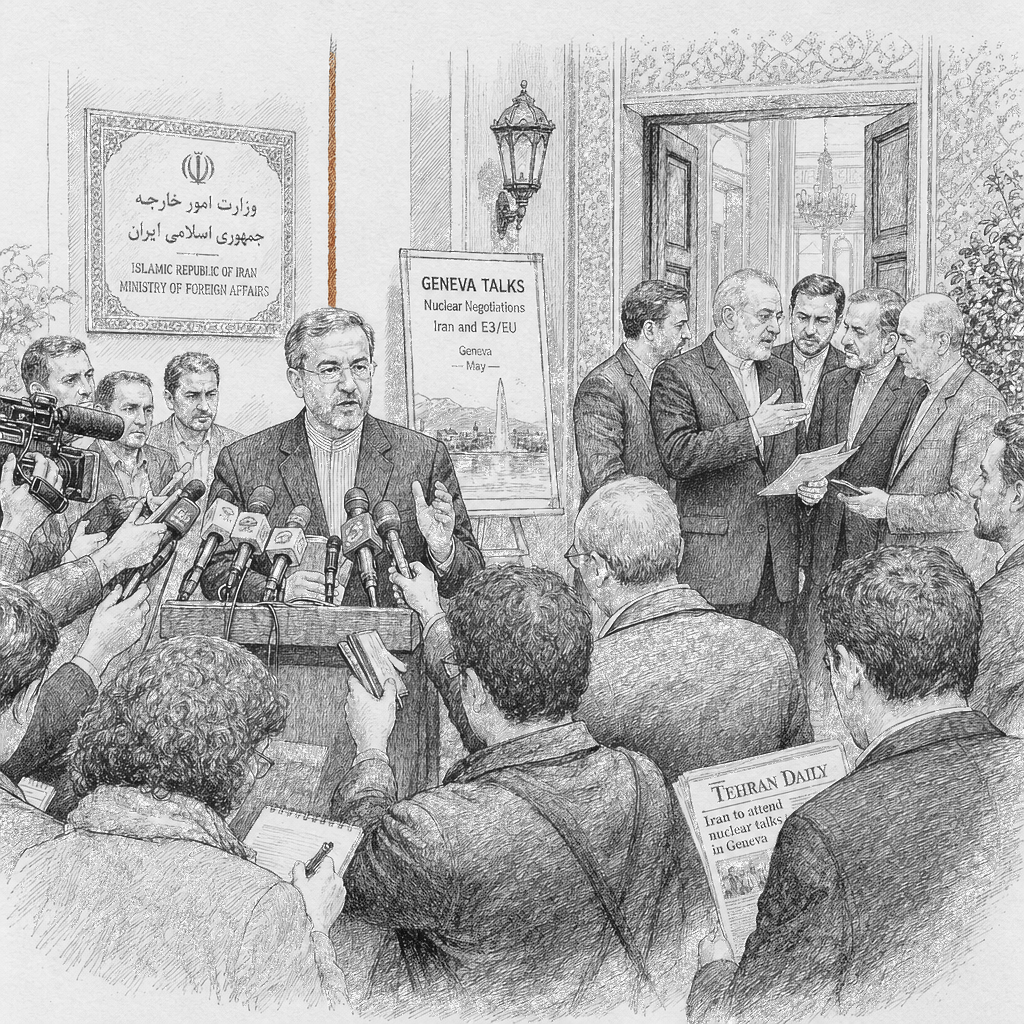
Iran pushed back on U.S. pressure tactics and disputed U.S. claims about Tehran’s nuclear work ahead of Geneva talks scheduled to begin Thursday, as American and Iranian officials traded remarks following President Donald Trump’s recent public comments.
Iran’s foreign ministry spokesman Esmail Baghaei accused Trump and his administration of running a “disinformation & misinformation campaign” and wrote on X that whatever the U.S. was alleging about Iran’s nuclear program, its ballistic missiles and the number of casualties during January’s unrest was a repetition of “big lies,” according to the Associated Press report.
Baghaei’s response came a day before the Geneva meetings, which are the third round under the mediation of Oman, a longstanding interlocutor between Tehran and Western governments. A flight carrying Iranian Foreign Minister Abbas Araghchi and his team arrived late Wednesday in Geneva to meet American officials led by special U.S. Middle East envoy Steve Witkoff.
While Iran was casting Trump’s statements as propaganda, Iranian officials also signaled a willingness to negotiate. Mohammad Bagher Qalibaf, Iran’s parliament speaker, said the U.S. could choose “the table of diplomacy” or face Iran’s “wrath,” according to a report on the semiofficial Student News Network, an outlet believed to be close to the volunteer Basij force of Iran’s Revolutionary Guard.
Rubio told reporters on Wednesday that the discussions will be focused largely on Iran’s nuclear program, and he said the talks are meant to gauge how serious Tehran is about reaching a deal to avoid potential U.S. military action. But Rubio also noted the U.S. has major concerns beyond nuclear issues, including Iran’s conventional weapons.
Trump, meanwhile, touched on Iran and the nuclear negotiations in his State of the Union speech late Tuesday in Washington, warning that Iran has continued work related to missiles and restarting its weapons program even after being “warned to make no future attempts” to rebuild, according to the AP account. The report also said satellite photos analyzed by the Associated Press showed signs that Iran was beginning to rebuild missile-production sites and was doing some work at three nuclear sites attacked by the U.S. in June.
Iran has long maintained that its nuclear program is peaceful. The report said that the West and the International Atomic Energy Agency have said Iran had a nuclear weapons program until 2003 and that, before the June attack, Iran had been enriching uranium up to 60% purity, a step away from weapons-grade levels of about 90%. The Associated Press report also said IAEA inspectors have not been allowed to inspect the sites and verify what remains after the June strikes.
The Geneva talks are unfolding alongside sharp military and deterrence signals in the region. The Associated Press said America has assembled what it called its biggest deployment of aircraft and warships to the Middle East in decades, and it reported that satellite photos taken Tuesday and analyzed by Planet Labs showed U.S. vessels that usually are docked in Bahrain—home of the U.S. Navy’s 5th Fleet—had scattered at sea.
The U.S. military’s Central Command declined to comment, the AP report said. It added that, before Iran’s attack on Qatar in June, the 5th Fleet similarly scattered its ships at sea to protect against a potential attack.
The threat environment extends beyond nuclear questions. The Associated Press report said Trump has repeatedly threatened to attack Iran if negotiations fail, and it reported that Iran has said all U.S. military bases in the Middle East would be considered legitimate targets, putting tens of thousands of American service members at risk.
With U.S. and Iranian officials positioning their public arguments while delegations arrive for talks, the next test for the negotiations is whether both sides can narrow disputes over Iran’s nuclear program while also addressing the broader security concerns that could shape the outcome if the diplomacy breaks down.