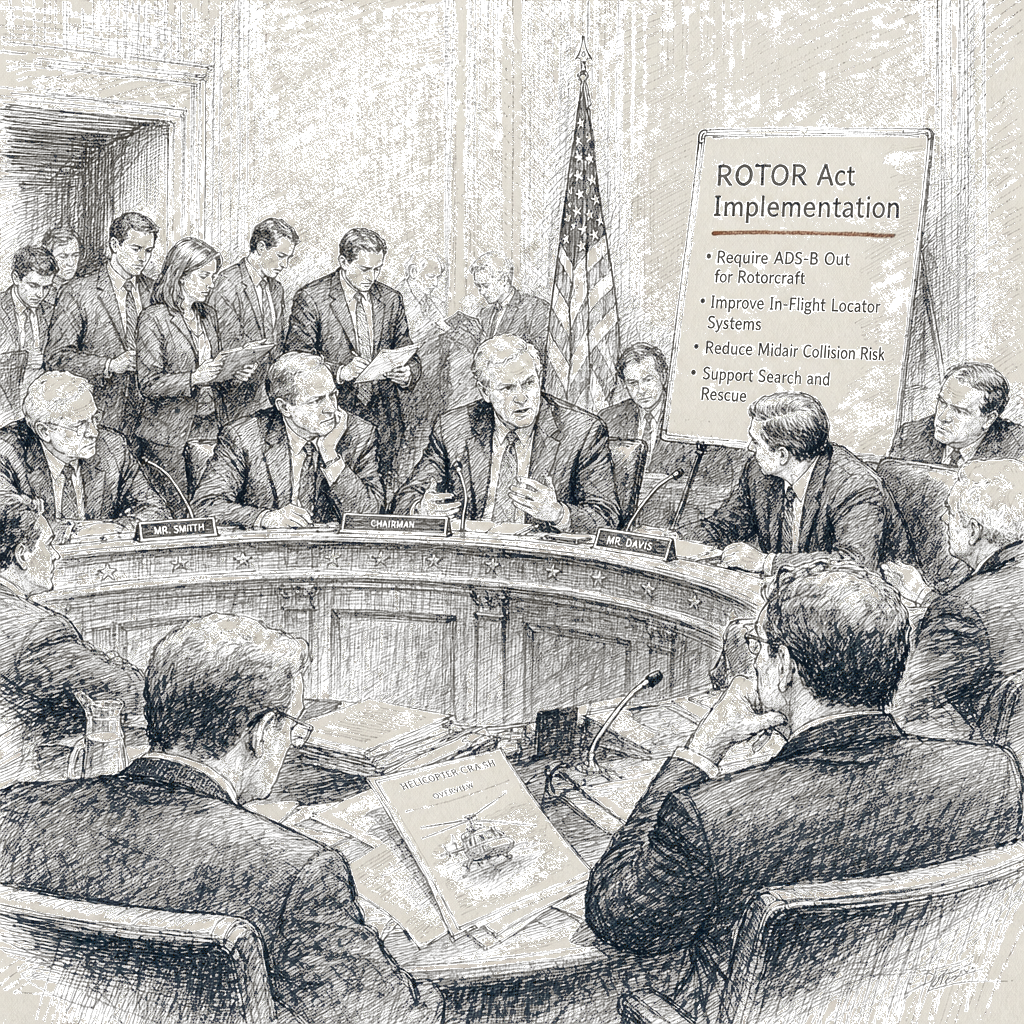
House rejects ROTOR Act after families press for ADS-B In mandate
The U.S. House on Tuesday rejected legislation aimed at reducing the risk of midair collisions near busy airports, dealing a setback to families and aviation advocates who have pushed for more mandatory technology after a deadly crash near Washington, D.C., in January 2025. The bill—crafted in response to that crash—failed to win enough support under a special fast-track process, with House leaders signaling they would continue seeking an aviation-safety deal.
The crash that lawmakers pointed to involved an American Airlines jet colliding with an Army helicopter, killing 67 people, according to the National Transportation Safety Board. In the aftermath, the NTSB has been recommending that aircraft in such environments be equipped with systems capable of receiving other aircraft location data, not only broadcasting their own location.
A central point of debate has been whether lawmakers should require “ADS-B In” systems—receivers that can use data from aircraft that already broadcast—rather than pursue a more open-ended approach that could delay or leave to future rulemaking decisions the technology pilots would ultimately use. “ADS-B Out” systems that broadcast an aircraft’s location are already required, the Associated Press reported, but “ADS-B In” is not standard on airliners even though many general aviation pilots use portable receivers to display traffic information.
The House vote on Tuesday came as a competing set of supporters and critics argued over the scope and structure of reforms. Families of victims who died in the D.C. crash, including some who watched the vote from the House gallery, pressed for meaningful changes that would require ADS-B In equipment. But Airlines for American, the military, and major general aviation groups that represent business jets and small plane owners backed a different, more comprehensive House bill that was introduced the previous week, the AP reported.
Tim Lilley, whose son Sam was the first officer on the airliner, said he was disappointed by the outcome and that the families would continue pressing for reforms, with an eye toward preventing another tragedy. “We’re going to end up back here having the same conversation because of another midair (collision) is what’s going to happen. Hopefully — fingers crossed — that doesn’t,” Lilley said, according to the report.
Under the special process used to fast-track the bill, the ROTOR Act needed more than two-thirds support to pass. It received 264 votes, but 133 representatives voted against it, leaving it short of the threshold. The legislation’s full name is “Rotorcraft Operations Transparency and Oversight Reform,” and supporters framed it as a first step toward requiring aircraft locator systems beyond ADS-B Out alone.
House Speaker Mike Johnson told the Associated Press that the Senate and the House would work together to get an aviation safety bill done. “We’re committed to it,” Johnson said, while House Transportation & Infrastructure Committee Chairman Sam Graves said the House bill could move through committee as soon as next week. Graves and others described the committee-markup effort as designed to address all 50 recommendations the NTSB made after the crash, not just the locator technology, while NTSB Chairwoman Jennifer Homendy has said the House bill falls short of accomplishing that goal.
Lawmakers and advocates also disputed what changes were necessary beyond a requirement for ADS-B In. The AP reported that Homendy testified in Congress that American Airlines was able to equip more than 300 of its Airbus A321s for $50,000 apiece, and that general aviation pilots can use a portable receiver that costs about $400 and works with an iPad. Researchers involved in developing the locator technology argued that aircraft pilots should not need to overhaul their dashboards to use it and that the system was designed to provide pilots an audible warning and details of nearby traffic if a collision risk exists.
Supporters of the Senate-backed ROTOR Act argued that requiring both sides of the ADS-B system—broadcasting location and receiving it—would help create a more effective collision warning. A bipartisan group of Senate leaders behind ROTOR Act said it was a good first step, the AP reported, and Sen. Ted Cruz and Sen. Maria Cantwell framed the measure as ensuring all aircraft play by the same set of rules.
Several groups that represent families of the crash victims, including Families of Flight 5342, opposed the House approach because they said it did not clearly require ADS-B In equipment. Sara Nelson, president of the Association of Flight Attendants, said her union would keep pushing for changes because the bill that failed was the clearest and most direct way to avoid midair collisions, while Doug Lane said he was angry the House rejected a measure he viewed as inadequate. Lane argued that some provisions in the House bill would call for study or rulemaking without requiring actual change and could leave loopholes.
The Associated Press also reported that Rep. Nick Langworthy, chair of an aviation safety caucus, voted for the House bill and said he was puzzled by a last-minute shift he attributed to the Pentagon, and he pointed to absences among House members due to weather that also affected the outcome. Langworthy said he expected disappointment among the families but added that he believed there were avenues to bring the proposals back and said there was “will to solve this problem.”