Body
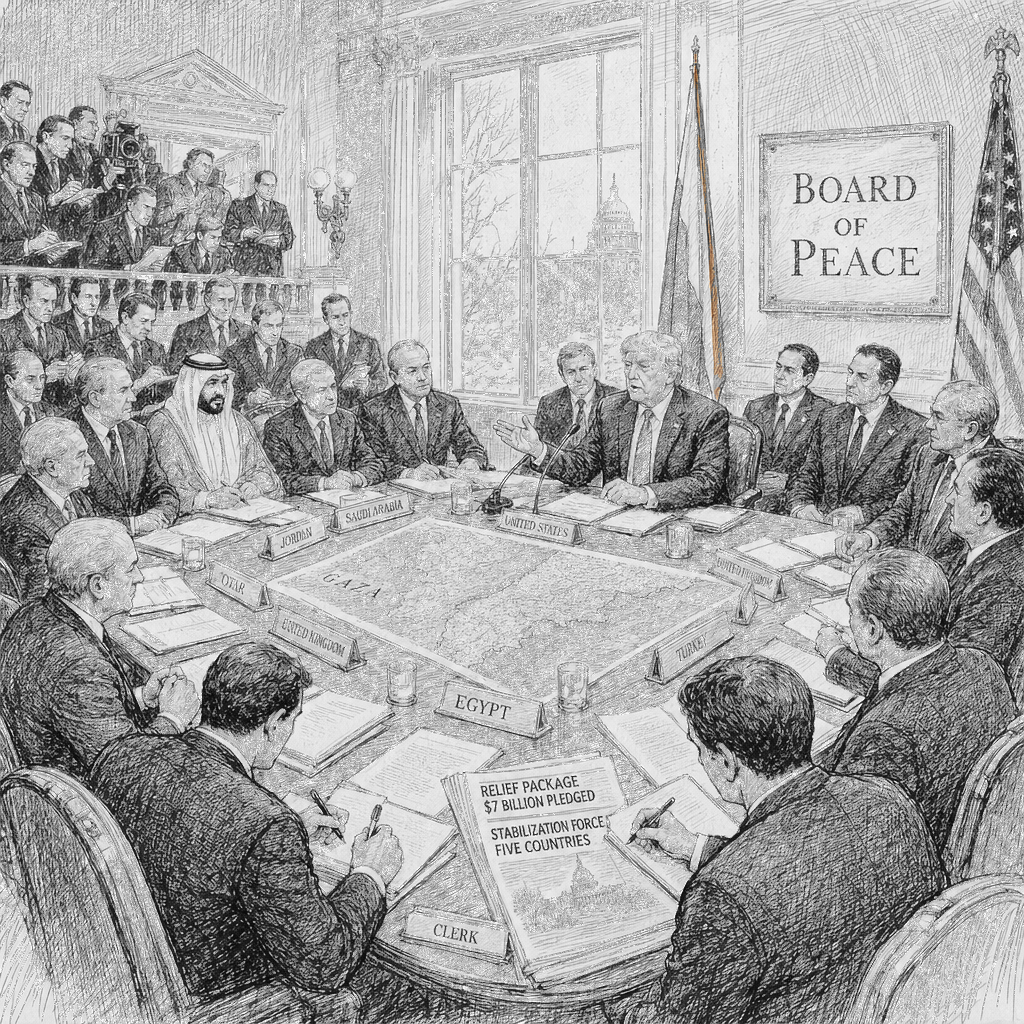
President Donald Trump announced new pledges for a postwar Gaza stabilization effort at an inaugural “Board of Peace” meeting in Washington on Feb. 19, saying nine members agreed to contribute $7 billion toward a Gaza relief package and five countries agreed to deploy troops as part of an international stabilization force. The meeting was framed as a step toward carrying forward a fragile Gaza ceasefire, but Trump’s plan still faced an unresolved test: whether Hamas would agree to disarm.
Trump said the pledges for funding and troop commitments would help move toward a more durable peace, but he did not outline when participating governments would begin implementing their pledges. He also said the United States would pledge $10 billion for the Board of Peace, though he did not specify what the U.S. funds would cover, and it was not immediately clear how the money would be authorized.
Trump’s remarks were accompanied by language aimed at positioning the new board as a mechanism for stability beyond Gaza. He said the Board of Peace was initiated as part of a 20-point plan to end the Israel-Hamas conflict in Gaza, but he described an expanded vision for the forum that would also address other conflicts. At the same time, Trump faced criticism and skepticism about the board’s role, including fears that the United States was trying to create a rival to the United Nations.
In response to that concern, Trump argued that the board could help make the U.N. viable in the future. He said that one day he would not be there, and that the United Nations “will be,” adding that the Board of Peace would “almost be looking over the United Nations and making sure it runs properly,” according to the meeting remarks reported by the Associated Press.
The meeting also unfolded amid heightened U.S.-Iran tensions. Trump referenced Iran in the context of warning Tehran that it would face American military action if it did not denuclearize, give up ballistic missiles and stop funding extremist proxy groups, including Hezbollah and Hamas. “We have to make a meaningful deal. Otherwise bad things happen,” Trump said, according to the reporting.
The countries described as pledging troop support for a Gaza stabilization force were Indonesia, Morocco, Kazakhstan, Kosovo and Albania, while Egypt and Jordan committed to train police. Trump said troops would initially be deployed to Rafah, described as a largely destroyed and mostly depopulated city under full Israeli control, where the administration hopes to focus first on reconstruction efforts. For reconstruction funding, Trump named Kazakhstan, Azerbaijan, the United Arab Emirates, Morocco, Bahrain, Qatar, Saudi Arabia, Uzbekistan and Kuwait.
Jeffers, identified as the leader of the newly created international stabilization force, said the planning for Gaza includes 12,000 police and 20,000 soldiers. “With these first steps, we help bring the security that Gaza needs for a future of prosperity and enduring peace,” Jeffers said, according to the account of the meeting.
Several countries and regional actors also attended the meeting as observers, including Germany, Italy, Norway, Switzerland and the United Kingdom, the Associated Press reported. Trump told reporters later that “almost everybody’s accepted,” and said that those that had not joined would do so, characterizing some non-participants as seeking to avoid commitments.
International leaders at the meeting offered praise for Trump’s ability to end conflicts while also underscoring concerns about implementation. Pakistani Prime Minister Shehbaz Sharif called him the “savior of South Asia,” and Turkish Foreign Minister Hakan Fidan said the humanitarian situation remained fragile and that ceasefire violations continued to occur. “A prompt, coordinated and effective response is therefore essential,” Fidan said, according to the reporting. He also said Turkey was prepared to contribute troops to the stabilization force.
Central to the discussions was assembling the stabilization force in a way that supports disarming Hamas, a condition that Israel has emphasized as key to any lasting ceasefire. The Associated Press reported that Hamas has provided little confidence that it is willing to move forward on disarmament, while a U.S. official said the administration was “under no illusions on the challenges regarding demilitarization” but had been encouraged by what mediators reported back.
Israeli officials reiterated their conditions for Gaza’s reconstruction. Netanyahu said there would be no reconstruction before demilitarization, and Foreign Minister Gideon Saar said there must be a fundamental deradicalization process, according to the reporting. Trump said Hamas has promised to disarm and that it would be met “very harshly” if it fails, but he did not provide details on how that would be carried out.
Secretary of State Marco Rubio said there is a “long ways to go” in Gaza, and he said the work would require contributions from every nation state represented at the meeting. The U.S. administration’s ability to translate the pledges into an operating stabilization effort, however, appears tied to progress on disarmament—an issue that the meeting did not resolve.