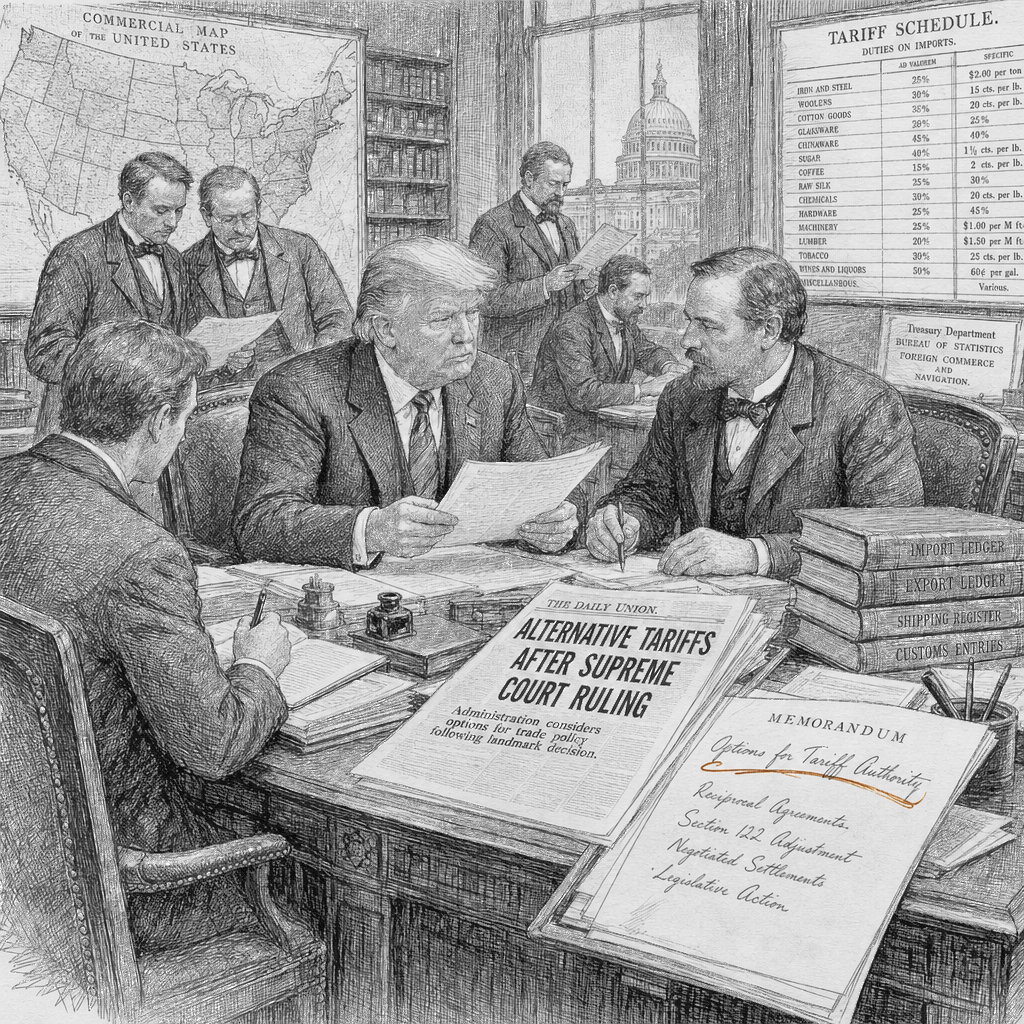
The decision undercuts a central pillar of Trump’s economic agenda and creates uncertainty over whether he can execute on tariff-centered promises heading into midterm elections. With roughly $175 billion in import taxes now blocked, and the president’s planned alternatives capped at 150 days, the ruling likely extends tariff chaos through the year.
The Ruling
The U.S. Supreme Court struck down President Trump’s global tariff authority Friday, voting 6-3 to reject his assertion that he could unilaterally impose sweeping import taxes without congressional approval. The decision marked a rare institutional check on a president who has wielded tariff power aggressively throughout his second term, rewriting the rules of global commerce at will.
The Court’s rebuke was unambiguous. Trump had expanded executive power across a range of policies; on tariffs, the justices determined he had exceeded constitutional limits.
Trump’s Response
Trump said on social media Friday night that he had signed an executive order enabling him to bypass Congress and impose a 10% tax on imports from around the world. The government would also begin national security investigations to charge new tariffs on specific products.
The 10% tariffs are legally capped at 150 days. When asked about that limit during a campaign stop in Georgia, Trump brushed off the constraint, saying “we have a right to do pretty much what we want to do.”
Trump’s public composure masked simmering anger at the ruling. During a private Friday morning meeting with governors, he was handed a note about the decision. According to two people briefed on his reaction, he called it “a disgrace” and indicated he has “to do something about these courts.” The meeting ended shortly thereafter.
Trump called the ruling “deeply disappointing” and “ridiculous,” saying he was “absolutely ashamed” of the six justices who voted against him. He described them as “fools and lapdogs” who are “very unpatriotic and disloyal to our Constitution.”
Addressing the Court’s constitutional objections, Trump said: “I have the right to put tariffs on for national security purposes, countries that have been ripping us off for years.”
Political Backlash
The ruling exposed deep divisions within the Republican Party. Mitch McConnell, the former top Senate Republican, praised the decision and directly rejected Trump’s assertion that he could bypass Congress.
“Congress’ role in trade policy, as I have warned repeatedly, is not an inconvenience to avoid,” McConnell said. “If the executive would like to enact trade policies that impact American producers and consumers, its path forward is crystal clear: convince their representatives under Article 1” of the Constitution.
Earlier this month, six House Republicans had already voted with Democrats on a resolution opposing Trump’s tariffs on Canada. During Trump’s second term, at least seven Republican senators have voiced concerns about the tariff agenda, some doing so publicly and others privately.
Democrats seized on the ruling to argue Trump had violated the law and middle-class families had suffered as a result. Rep. Suzan DelBene, chair of the Democratic Congressional Campaign Committee, said Trump “is not a king” and his “tariffs were always illegal.”
“Republicans in Congress could have easily ended this economic crisis by standing up for their communities,” DelBene said. “Instead, they chose to bend the knee to Trump while families, small businesses and farmers suffered from higher prices.”
Public Concerns
The ruling addressed a significant anxiety among Americans. An AP-NORC poll conducted after Trump announced worldwide tariffs last April found that 76% of Americans said the policies would increase the cost of consumer goods—a concern for a president elected on promises to address inflation.
A poll from January found that about 6 in 10 Americans said Trump had gone too far in imposing new tariffs on other countries.
Trump has consistently claimed that foreign governments, not American consumers and businesses, bear the cost of tariffs. But public polling and statements from figures like former Vice President Mike Pence suggested otherwise.
“American families and American businesses pay American tariffs—not foreign countries,” Pence wrote on social media after the ruling. “With this decision, American families and businesses can breathe a sigh of relief.”
What Happens Next
The Supreme Court’s ruling struck down approximately $175 billion in import taxes that Trump had imposed under disputed authority. Whether those amounts would be refunded remained unresolved.
Trump stressed Thursday at a campaign stop in Georgia that tariffs were central to his economic vision. He used the word “tariff” 28 times in a single speech at a steel company, Coosa Steel, which credited import taxes with making its products more competitive with goods from China.
“Without tariffs, this country would be in such trouble right now,” Trump said.
But the Supreme Court’s determination that the president lacks unilateral constitutional power to act on tariffs collides directly with Trump’s campaign message. His new executive order for 10% universal import taxes is capped at 150 days, meaning tariff policy and uncertainty are likely to dominate headlines through the midterm elections in November.
Until questions are resolved—whether Congress will chart its own tariff policy, whether Trump’s new order will face legal challenge, whether $175 billion in voided tariffs will be refunded—American importers, foreign trading partners, and voters concerned about prices remain in limbo.
License: This work is released under CC0 (public domain).