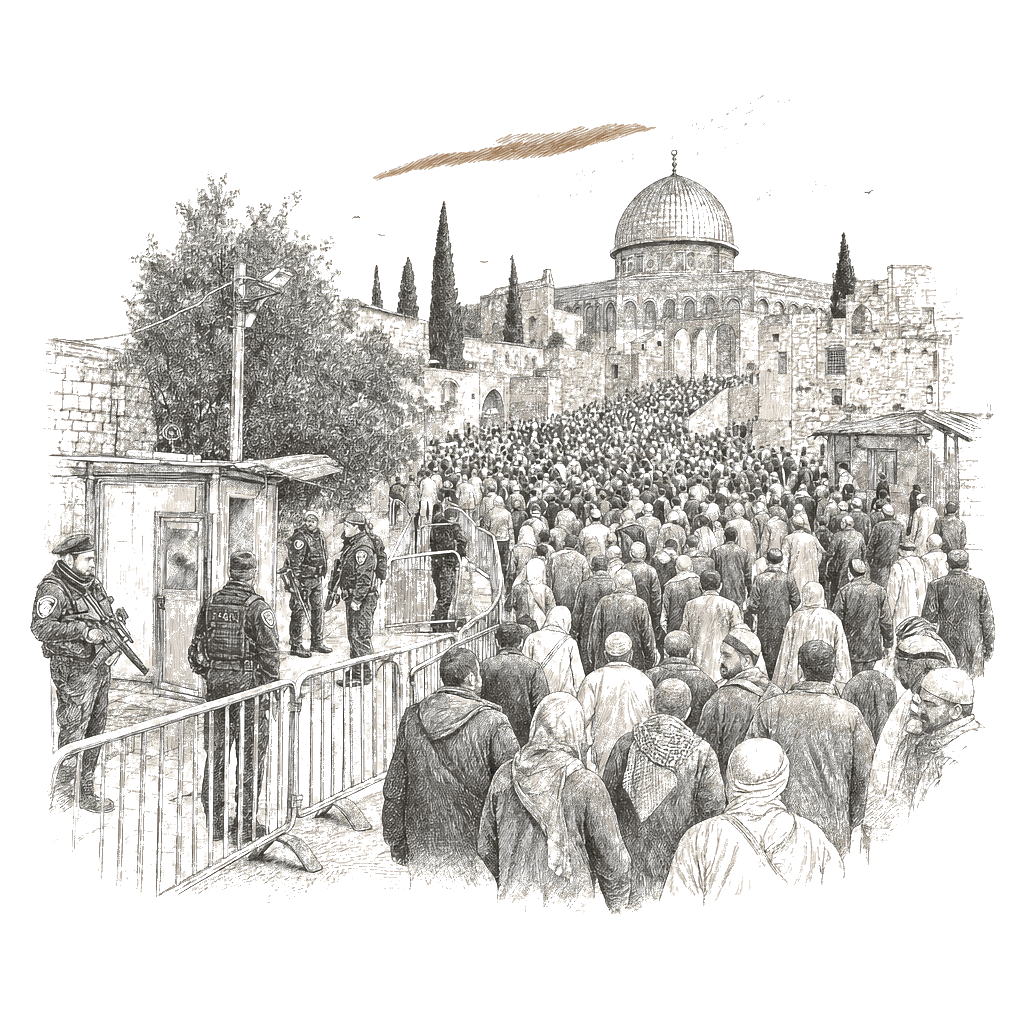
The prayer gathering took place under heavy security, with over 3,000 Israeli police deployed across Jerusalem, underscoring ongoing tensions over one of the world’s most contested religious sites. It marks the resumption of worship for Palestinians at a location central to both Islamic and Jewish tradition after two years of intensive military operations in Gaza.
Tens of thousands of Palestinians gathered Friday at Jerusalem’s Al-Aqsa Mosque compound for the first Friday prayers of Ramadan since a ceasefire deal between Israel and Hamas began in October. Israel restricted Palestinian entries from the occupied West Bank to 10,000 people, allowing only men over 55, women over 50, and children under 12. For many, it was the first opportunity to leave the West Bank and pray at the site since Ramadan last year.
Security and Sacred Significance
Israeli police deployed more than 3,000 officers across Jerusalem Friday, saying their presence was not meant to show aggression or force but was aimed at providing help in case of an emergency.
Israel has imposed similar restrictions at Al-Aqsa in the past, citing security concerns. The hilltop is referred to as the Temple Mount by Jews, the holiest site in Judaism, and was home to ancient biblical temples. It is home to Al-Aqsa Mosque, the third-holiest site in Islam. The site has frequently been a flashpoint in the Israeli-Palestinian conflict.
According to Jerusalem’s Islamic Waqf, the Jordanian religious authority that administers the compound, 80,000 people attended Friday’s prayers. In normal times, Ramadan Friday prayers at Al-Aqsa draw up to 200,000 people.
Ezaldeen Mustafah, a Palestinian from the West Bank, voiced frustration with the restrictions. “We need more people than this,” he said.
Access Barriers
Some Palestinians from the West Bank said they were turned away from crossing into Jerusalem despite having permits. Jihad Bisharat said his permit was canceled and he was sent back. Israel’s army did not immediately respond to a request for comment regarding individual permit cancellations.
Many Palestinians view the heightened Israeli security presence and increasing visits by religious and nationalist Israeli Jews as a provocation. They fear that Israel intends to take over or partition the compound. The Israeli government denies having any such plans.
Ramadan in Gaza
In Gaza, many Palestinians said the month’s typically festive spirit is eluding them as they struggle with grief following two years of conflict sparked by Hamas’s October 7, 2023 attack into Israel.
Ramiz Firwana, a Gaza resident who gathered with others for Friday prayers held in a schoolyard, said “All the mosques have been bombed.”
On Thursday evening, families gathered for iftar, the meal held at the end of the daily dawn-to-dusk fast, amid the rubble and destruction across the territory.
Mohammad Kollab, from Khan Younis, said “Despite the displacement, the pain and the destruction, we want to rejoice and live.” He added, “We are not a people destined only for destruction and killing.”
Toll and Aftermath
Israel’s military offensive has killed more than 72,000 Palestinians according to Gaza’s Health Ministry, and caused widespread destruction and displacement across the territory. The offensive was launched after Hamas-led militants killed some 1,200 people, mostly civilians, and took 251 hostages in the initial October 7, 2023 attack.
An October 10 U.S.-brokered ceasefire deal brought an end to major military operations and resulted in the release of remaining hostages. However, Palestinians, including civilians, continue to be killed in near-daily strikes that Israel says are aimed at militants who threaten or attack its forces.