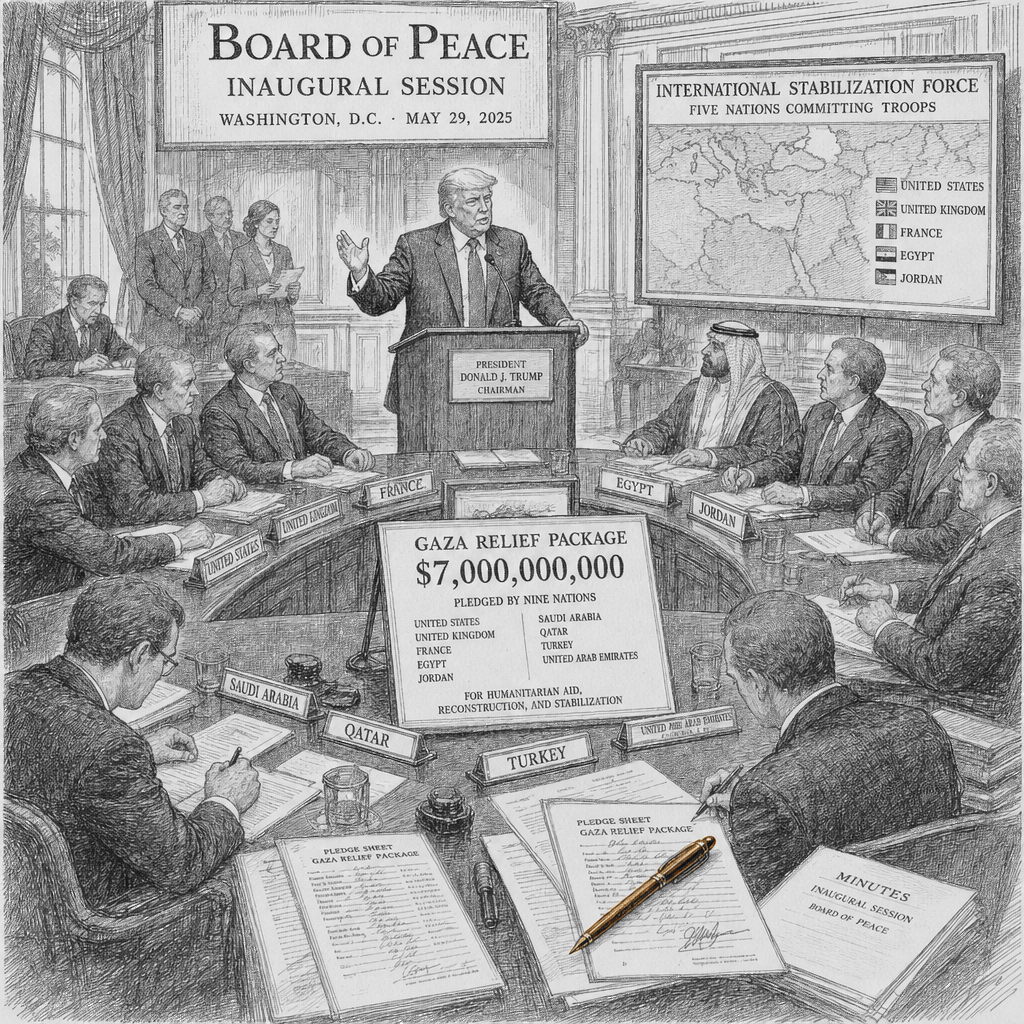
As President Donald Trump laid out the early commitments for his newly created Board of Peace, the meeting mixed concrete pledges for Gaza with warnings about a sticking point that could determine whether reconstruction and stabilization plans can move forward.
Trump told attendees that nine countries agreed to pledge $7 billion toward a Gaza relief package and that five countries agreed to deploy troops as part of an international stabilization force for the war-battered territory. While he praised the funding and troop commitments, he did not provide details on when the pledges would be implemented.
The U.S. administration also said it would pledge $10 billion for the board, but Trump did not specify what the money would be used for. It also remained unclear where that U.S. funding would come from, a large pledge that would likely require congressional authorization, according to the report of the meeting.
Trump said the countries making troop pledges were Indonesia, Morocco, Kazakhstan, Kosovo and Albania, and that Egypt and Jordan committed to train police. He said troops would initially be deployed to Rafah, described as a largely destroyed and mostly depopulated city under full Israeli control, with reconstruction efforts expected to begin there.
On the force size, Maj. Gen. Jasper Jeffers, identified as leader of the newly created international stabilization force, said the plans call for 12,000 police and 20,000 soldiers for Gaza. Jeffers framed the opening steps as aimed at delivering the security needed for a future of “prosperity and enduring peace,” according to the meeting report.
Jeffers’ figures came alongside Trump’s list of countries that agreed to fund reconstruction, which he said included Kazakhstan, Azerbaijan, the United Arab Emirates, Morocco, Bahrain, Qatar, Saudi Arabia, Uzbekistan and Kuwait. The administration set the meeting’s immediate reconstruction and stabilization focus against a broader accounting of the scale of damage, with the report noting that the pledged dollars represented a small fraction of the estimated $70 billion needed to rebuild Gaza after two years of war between Israel and Hamas.
Trump’s remarks repeatedly turned back to the Gaza ceasefire, which he described as a major foreign policy win for the administration, while the ceasefire itself remained fragile. The report said the unresolved challenge of disarming Hamas threatened to delay or derail the ceasefire plan, making demilitarization a central condition for any stabilization effort.
At the meeting, the report said Hamas had provided little confidence it would move forward on disarmament. A U.S. official, speaking on condition of anonymity, described the administration as “under no illusions” about the challenges around demilitarization, while saying mediators had encouraged the administration with what they reported back.
Israeli Prime Minister Benjamin Netanyahu reiterated in the context of the reconstruction debate that there would be “no reconstruction” of Gaza before demilitarization. His foreign minister, Gideon Saar, said during the gathering that “there must be a fundamental deradicalization process,” as discussion continued around how security arrangements would work once ceasefire monitoring and reconstruction efforts begin.
The meeting drew officials from nearly 50 countries and the European Union, with observers including Germany, Italy, Norway, Switzerland and the United Kingdom, according to the report. While some leaders traveled to Washington for the gathering, including Indonesian President Prabowo Subianto, Argentine President Javier Milei and Hungarian President Viktor Orban, other officials used their turns to argue that the United Nations should lead crisis management instead of a new body.
Vatican Secretary of State Cardinal Pietro Parolin told reporters that “at the international level, it should above all be the U.N. that manages these crisis situations.” French Foreign Minister Jean-Noël Barrot said on X that the European Commission should never have attended because it had no mandate to do so. Trump, pushing back against fears of a rival to the U.N., said the creation of his board would help make the U.N. viable in the future and quoted a belief that the United Nations would be stronger after he was no longer there.
Even as officials praised the board and discussed early coordination, Turkish Foreign Minister Hakan Fidan cautioned that the situation remained precarious. Fidan said, according to the report, that “the humanitarian situation remains fragile and ceasefire violations continue to occur,” adding that a prompt, coordinated and effective response would be essential.
In his remarks, Trump also sent new warnings to Iran amid broader tensions between the United States and Tehran. The report said a U.S. military buildup in the region was underway, with one aircraft carrier group already present and another on the way, and that Trump warned Iran it would face American military action if it did not denuclearize, give up ballistic missiles and halt funding to extremist proxy groups such as Hezbollah and Hamas.
In the same meeting, Secretary of State Marco Rubio acknowledged, in a separate point about Gaza, that there is a “long ways to go,” and said the work would require contributions from the nations represented at the gathering. Questions remained about how Hamas would respond to disarmament demands and whether stabilization and reconstruction commitments can be carried out without delay.