Prose
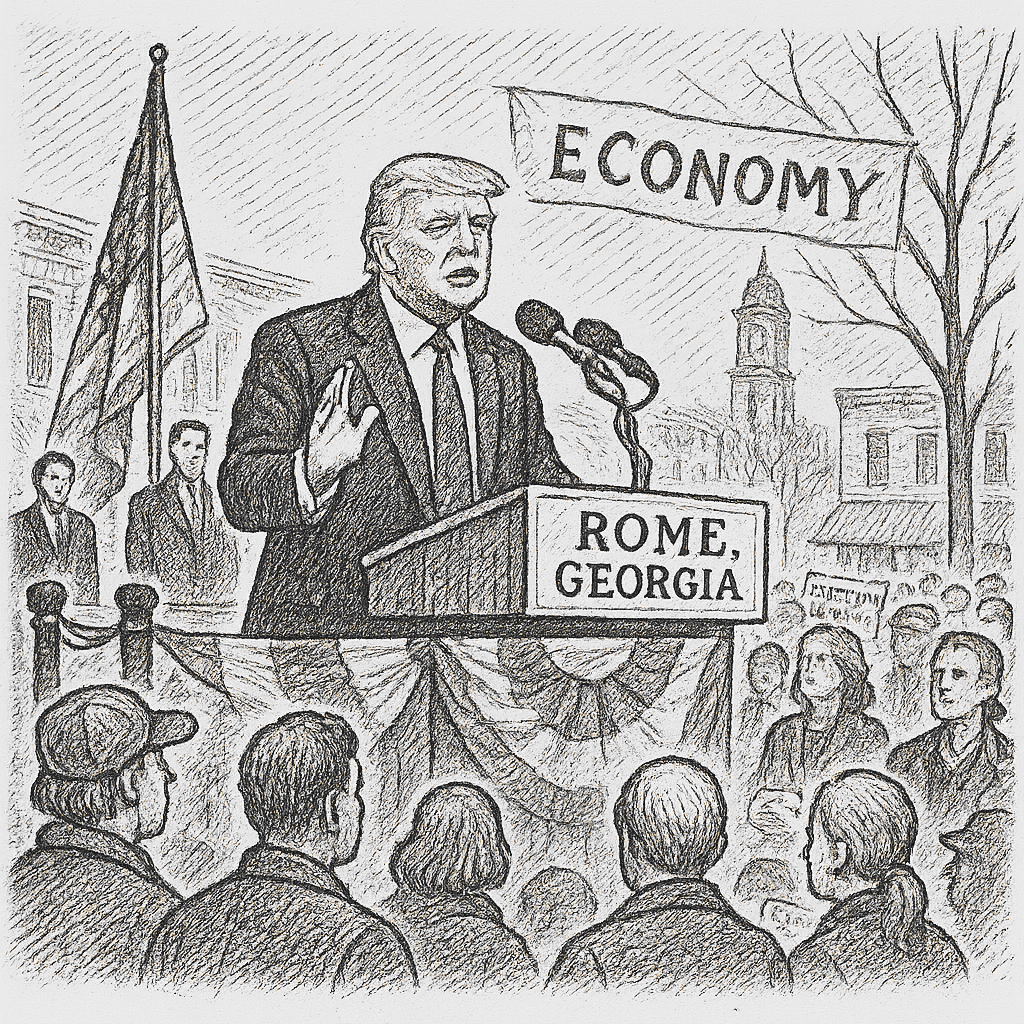
ROME, Ga. — President Donald Trump visited Rome, Georgia, on Feb. 19 as Republicans looked to energize supporters ahead of a March 10 special election to replace Marjorie Taylor Greene, a former supporter who resigned from Congress in January after feuding with Trump. The White House had said Trump was coming to promote the economy, but his remarks began with renewed focus on voting-related claims.
At his first stop at a local restaurant before touring a steel company, Trump invoked debunked allegations of election fraud and described what he said were actions by the other side involving ballots. In the opening minutes of the visit, he also spoke in favor of requiring voter identification before people cast ballots, and he referenced the FBI raid of election offices in Fulton County, Georgia’s most populous county.
Trump’s comments combined the election themes with sharply political contrasts. He argued that Democrats did not want voters to see ballots, and he suggested the FBI had taken items from election offices during the raid. Later, at Coosa Steel Corporation, Trump returned to election-related accusations, saying Democrats “cheated like dogs” in the 2020 election.
The Georgia trip came at a time when other issues—both domestic and international—had been prominent in Trump’s recent political messaging. The AP account described recent months as dominated by topics ranging from deadly clashes during deportation efforts in Minneapolis and potential military action in Iran, alongside Trump’s repeated false claims that the 2020 election was stolen.
Trump’s itinerary and the political context in the district also put Greene’s legacy at the center of the visit. The trip took place in the congressional district previously represented by Greene, and early voting had already begun in the special election to fill the seat. Trump did not address fresh attacks from Greene during the visit, and Greene had recently criticized the White House and Republican leaders’ midterm messaging while linking health-insurance concerns to broader political failures, according to the account.
As Trump toured the steel industry site, he shifted from voting claims to economic talking points, including tariffs. The AP report said the owner of Coosa Steel Corporation told Trump the company had benefited from his tariffs, and Trump responded by emphasizing the policy and its impact. Trump also attacked the Supreme Court, which he said was weighing the legality of his use of an emergency powers law to impose worldwide tariffs, and he shouted that “The tariff is the greatest thing that has happened to this country.”
In a broader economic theme, Trump also claimed that inflation was no longer a problem in the United States, blaming Democrats for rising costs. The AP account also described new research tied to a leading bank that found tariffs paid by midsize U.S. businesses tripled over the past year, and it said the additional taxes forced employers—companies employing a combined 48 million people—to absorb costs through higher prices, fewer workers or lower profits.
Election-related disputes remained a key thread in the visit. Less than a month earlier, federal agents seized voting records and ballots from Fulton County, and the AP account described Trump as having long viewed Georgia as central to his stolen-election narrative involving Democrats and President Joe Biden. It also said that audits, state officials, courts, and Trump’s own former attorney general have rejected the idea of widespread problems that could have altered the election.
Beyond Trump’s remarks, some Republicans were exploring ways to reshape election oversight in Fulton County. The AP account said some Republicans are pushing Georgia’s State Election Board—whose majority is aligned with Trump—to take control of elections in Fulton County, citing a step made possible by a 2021 state law. Board member and conservative commentator Janelle King said she was aware of calls for a takeover but said it was not something the board was “looking to do without having all of the information,” and she said she expected a clearer picture once the FBI’s investigation concludes.
White House communications suggested the election-fraud message was not limited to speeches. Press secretary Karoline Leavitt said Trump was “exploring his options” regarding a potential executive order he teased on social media over the weekend designed to address voter fraud. The AP report also described Trump’s social media post pinned at the top of his account using highly charged language about cheating, and it said the former president urged Republicans to feature such claims at the top of speeches.
Even with the repeated focus on voting disputes, some Georgia Republicans at the event expressed a preference for turning back to kitchen-table concerns. Scott Johnson, a longtime GOP leader in Georgia who attended the speech, said he expected the economy to be the decisive issue, while also saying he was concerned about “relitigating the past” and wanted more focus on moving forward.
Other parts of the campaign lineup reinforced how central Trump remains to the special-election field. The AP account said Trump was traveling with his preferred candidate, Clay Fuller, a district attorney who prosecutes crimes in four counties and described himself as “a MAGA warrior” before Trump took the stage. It also said other candidates include Republican former state Sen. Colton Moore, who previously gained attention with criticism of Trump’s prosecution in Georgia, and who said he was still in communication with Trump even after Trump endorsed Fuller.