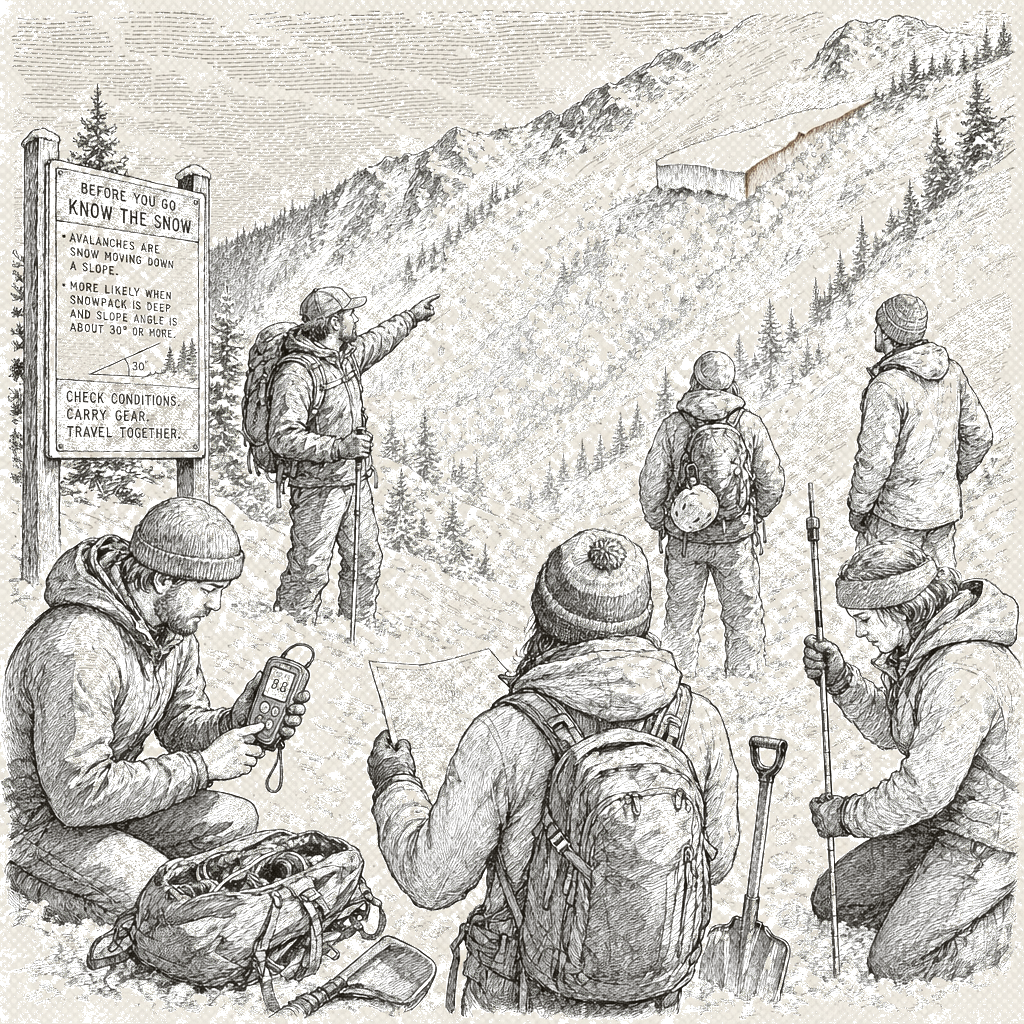
An avalanche—a mass of snow moving down a slope—can happen when snowpack conditions line up and triggers disrupt the layers holding it in place. The National Avalanche Center says about 25 people on average die in avalanches each winter in the United States, adding that “Some days are dangerous and some days are not,” a reminder that risk varies from day to day even within the same region.
Avalanche specialists say dangerous conditions often begin with two basic ingredients: a slope of 30 degrees or more and layers upon layers of snow, according to the National Avalanche Center. When extra pressure hits the snowpack—such as weight from people, wind loading, rain, heavy snowfall, or even the motion of skiers or snowmobilers—some layers can shear off and slide downhill.
Experts describe different avalanche types that matter for what rescuers may encounter. The Sierra Avalanche Center says loose-snow slides, called sluffs, account for only a small percentage of avalanche deaths and property damage, while slab avalanches—when a large layer of snow breaks away—account for most fatalities. The Colorado Avalanche Information Center also notes a separate hazard: wind can create a snow cornice over a ridge or the edge of a steep slope, and the overhang can collapse suddenly, catching people underneath or on top of it.
When asked what sets avalanches off, avalanche forecasting groups emphasize that movement, rapidly changing weather, and wind can start slides. Still, experts say 90% of slides that cause injury or death are triggered by the victim or a companion. That point drives preparation advice for people who ski, snowmobile, snowshoe or otherwise travel in the winter backcountry, including the recommendation to check avalanche forecasts before heading out and to carry appropriate rescue equipment.
Experts also warn against underestimating how fast avalanches move once they start. The Sierra Avalanche Center says dry slab avalanches can reach speeds up to 80 mph (129 kph) within seconds, while wet avalanches usually travel around 20 mph (32 kph). In context, the Sierra Avalanche Center compares those speeds with Usain Bolt’s 100-meter dash record of just under 28 mph (45 kph) in 2009—on a flat track, not a snow-covered slope—underscoring that people on the slope can get caught quickly.
Ski resorts typically rely on established avalanche protocols and mitigation systems, which often include checking snowpack stability. Chris Lundy, an avalanche specialist with the National Avalanche Center, said remote detonations are also used to trigger slides intentionally and remove risky buildup before skiers are allowed on slopes.
For individuals planning their own outings beyond resort boundaries, the guidance shifts toward reducing exposure and building rescue readiness. Outdoor travelers can check forecasts at regional avalanche centers or at www.avalanche.org. If they do venture out, experts recommend using the buddy system and being versed in wilderness first aid, and they point to three essential pieces of gear: an avalanche beacon or transceiver to send location signals, a shovel to test snowpack and dig out companions, and a thin, folding pole to poke into the snow to search for anyone buried.
Specialized equipment can also play a role in keeping people near the surface during a slide. Experts say an avalanche airbag backpack inflates after a trigger is pulled, giving a person a chance to stay above or close to the surface during an avalanche. They also caution that the plan should not depend on speed or luck after the fact—avalanche avoidance begins with deciding whether conditions are safe enough to travel.
Recent avalanche reports show how quickly those safety steps can matter in real incidents. In California’s Sierra Nevada on Jan. 5, an avalanche buried a snowmobiler and killed him, authorities said; the Nevada County Sheriff’s Office said the snowmobiler was initially reported missing but was found under the snow several minutes later.
In Alaska, the Denali National Park and Preserve said in June 2025 that a skier died after being caught in an avalanche on Mount McKinley, North America’s tallest peak. The park said the skier and his climbing partner, a snowboarder, triggered the avalanche high on the 20,310-foot (6,190-meter) peak while descending a slope.
The cluster also described a March avalanche in the Anchorage region: a snowmachiner riding on the backside of a popular winter recreation area about 60 miles (97 kilometers) southeast of Anchorage triggered an avalanche after riding over a weak layer of snow buried under newer snow, according to the Chugach National Forest Avalanche Center. The center said he was buried about 10 feet (3 meters) deep in a slide measuring about 500 feet (152 meters) wide, and it also reported that three heli-skiers were killed in an avalanche near Girdwood, about 40 miles (64 kilometers) south of Anchorage, during heli-skiing access to remote slopes.