Body
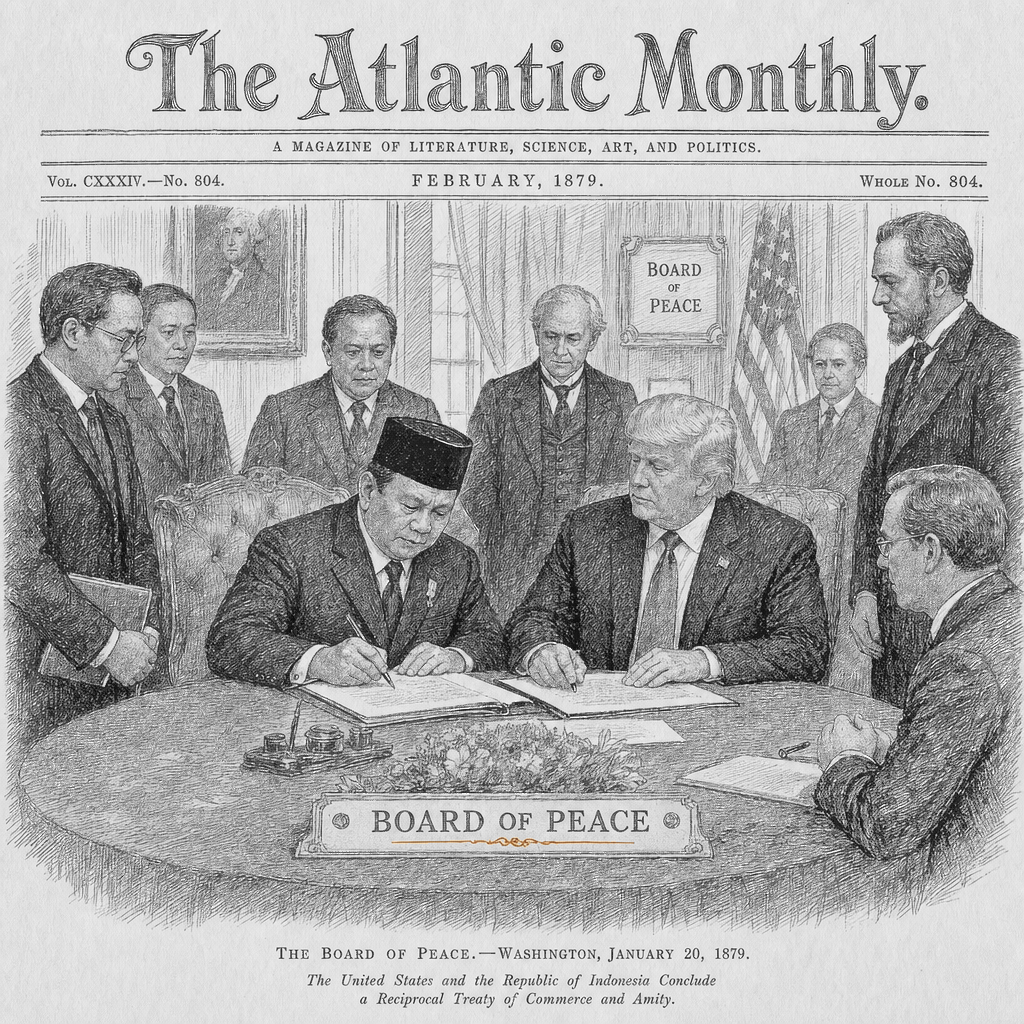
Indonesia’s President Prabowo Subianto met with President Donald Trump in Washington as the White House announced a reciprocal trade agreement between the two countries and as Trump’s inaugural “Board of Peace” convened leaders from Southeast Asia and beyond. The agreement was announced Thursday while Prabowo was in the U.S. capital for the Board of Peace’s first meeting, according to the White House and the Associated Press report.
Under the terms announced by the White House, Indonesia will eliminate tariffs for 99% of American goods, while the United States will keep tariffs on most Indonesian goods at 19%. The White House said that 19% rate matches what the U.S. has set for Cambodia and Malaysia, and it described the overall package as aiming to bolster economic security and growth in both countries.
The White House also said Indonesia agreed to address non-tariff barriers to U.S. goods and to remove restrictions on exports to the United States for critical minerals and other industrial commodities. The agreement’s critical-minerals track reflects the Trump administration’s view that such restrictions can protect U.S. manufacturers from supply-chain disruptions, with the administration citing concerns about China’s role in supplying key inputs.
In Washington, Prabowo told business executives at the U.S. Chamber of Commerce that officials had negotiated “very intensively over the last few months,” and said he believed the sides had reached “solid understandings on many issues,” according to the Associated Press account. A White House statement called the trade agreement a “great deal,” and said it would help both countries strengthen economic security, promote economic growth, and “thereby continuously lead to global prosperity.”
The trade agreement later received signatures from U.S. Trade Representative Jamieson Greer and Indonesia’s Trade Minister Airlangga Hartarto, the report said. It also noted that the presidents announced the deal but did not sign it; their representatives completed the signing afterward.
Alongside the tariff and critical-minerals commitments, Indonesian and U.S. companies reached 11 deals worth $38.4 billion during the week, the White House said. Those deals included purchases of U.S. soybeans, corn, cotton and wheat, as well as cooperation in critical minerals, oil field recovery, and joint ventures in computer chips.
Indonesia’s trade diplomacy unfolded in parallel with its role at the Board of Peace meeting, where Prabowo reiterated a pledge to send 8,000 troops—“more if necessary”—to support an international stabilization force in Gaza. The Associated Press report said Indonesia was among the first countries to make a firm commitment to what it described as a critical element of Trump’s postwar Gaza reconstruction plan.
At the Board of Peace meeting, Trump thanked Prabowo, saying, “President Prabowo of Indonesia, thank you very much,” and calling his country a “big country” that “do[es] a great job.” Prabowo responded by praising Trump and saying, “We are very optimistic with the leadership of President Trump, this vision of real peace will be achieved,” adding, “There will be problems, but we will prevail.”
The Board of Peace includes Cambodia and Vietnam as other Southeast Asian participants, with the group’s ambitions extending beyond the Gaza ceasefire even as it began with that focus. Cambodia had already inked a trade deal with the U.S., while Vietnam had reached a framework agreement, the report said.
Trump also told Vietnam’s leader To Lam at the meeting that it was “a really great honor to have you,” and described Vietnam as “incredible as a country and as a force.” Lam’s visit marked his first trip to the U.S. since he was reelected to lead Vietnam’s ruling Communist Party last month, with the Associated Press report noting that sequencing among major-power partners has shifted compared with earlier patterns.
Vietnam-U.S. talks also continued alongside the Board of Peace’s diplomacy, with the Associated Press report saying negotiations are ongoing following the Trump administration’s 20% tariffs on Vietnamese exports. It said the latest, sixth round of talks concluded in early February, and that analysts viewed Lam’s U.S. visit ahead of a trip to Beijing as a notable shift, with Hanoi describing its foreign policy as independent and balanced among major powers.