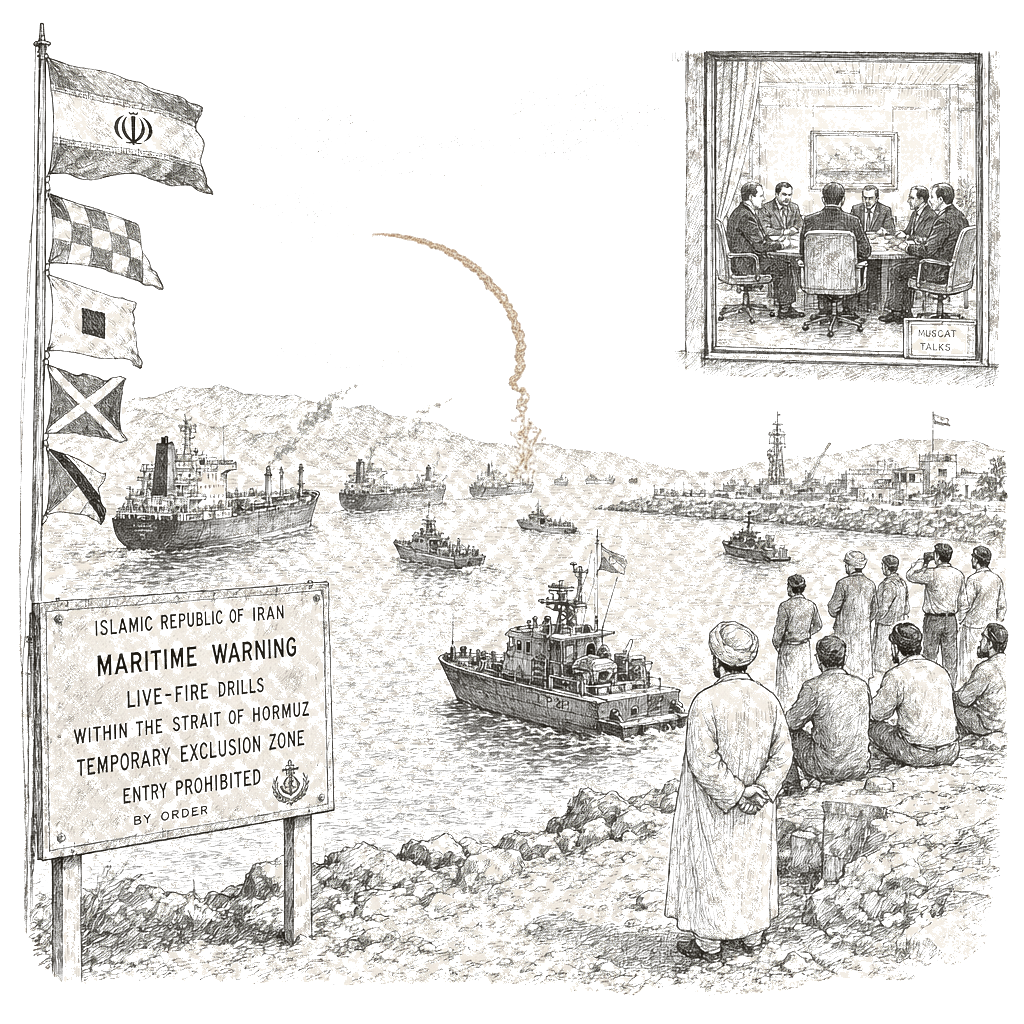
Iran announced it would temporarily close the Strait of Hormuz for live fire drills on Tuesday, a rare step for the key waterway as it continued indirect nuclear discussions with the United States in Geneva. The announcement, made as the talks were underway, raised concerns among regional observers about further escalation even as officials on both sides described the diplomacy as having made some progress.
Iran’s state media said Iranian forces fired live missiles toward the strait and would close it for several hours, citing “safety and maritime concerns.” Iran also presented the move as a show of force, with Supreme Leader Ayatollah Ali Khamenei warning that the United States could receive a decisive blow, saying that the “strongest army in the world might sometimes receive such a slap that it cannot get back on its feet.”
In separate remarks, Iranian Foreign Minister Abbas Araghchi told a U.N. disarmament conference in Geneva that “a new window has opened” for reaching an agreement. He also said the talks were aimed at a “sustainable and negotiated solution” that serves the interests of relevant parties and the broader region.
On the U.S. side, President Donald Trump told reporters that he said he would be involved in negotiations with Iran, according to the reporting. Trump also said Iran “remains fully prepared to defend itself against any threat or act of aggression,” and he warned that the consequences of any attack would not be confined to Iran’s borders, while making no specific mention of drills or the Hormuz closure.
U.S. officials said the latest indirect negotiations inside Geneva proceeded with progress but that gaps remained. A U.S. official speaking on condition of anonymity said the Iranian delegation would present more detailed proposals in the next two weeks to narrow the differences, and U.S. Vice President JD Vance later told Fox News Channel that “In some ways, it went well,” adding that “in other ways, it was very clear that the president has set some red lines that the Iranians are not yet willing to actually acknowledge and work through.”
The negotiations were led by U.S. envoys Steve Witkoff and Jared Kushner, according to the report, after an earlier round of indirect talks hosted by Oman on Feb. 6. The new round was held inside the residence of the Omani envoy to Geneva, and it came alongside other diplomatic activity in the city, including talks between envoys from Russia and Ukraine.
Iran also said the Revolutionary Guard started a drill early Monday in the Strait of Hormuz, the Persian Gulf and the Gulf of Oman, shipping lanes described as crucial to international trade. While Iran has sometimes conducted military drills in the strait that can impede maritime traffic, analysts cited in the report said the announced closure went further, calling it a message that any strike on Iran could have global impact.
The report said oil prices fell after the talks concluded, with U.S. oil down 1.3% to $62.06 per barrel and Brent crude down 2.3% to $67.03 per barrel. The decline followed a period of increased pricing after Trump began bolstering U.S. military presence in the region, and it reflected expectations that a potential eventual deal could ease market concerns.
Khamenei’s warnings intensified in parallel with Iran’s military actions, with the report citing remarks attributed to him on Iranian state TV about warships and weapons. He also warned the United States against “forcing the result of talks in advance,” as Iran and the United States pressed ahead with discussions over constraints on Iran’s disputed nuclear program.
The wider context included U.S. military deployments and past setbacks to nuclear negotiations. The report said last week Trump announced the USS Gerald R. Ford would be sent to the Middle East, to join the USS Abraham Lincoln and other destroyers already in the region, and it described the ships’ movement into the mid-Atlantic. It also cited that U.S. forces shot down an Iranian drone that approached the Lincoln, alongside prior warnings by Gulf Arab nations that any attack could spiral into another regional conflict.
In addition to nuclear diplomacy, the report linked the talks to earlier violence in the region. It said the U.S. and Iran had been in months of meetings when Israel’s launch of a 12-day war against Iran in June halted those discussions, and it reported that U.S. forces bombed Iranian nuclear sites during that war, likely destroying many centrifuges. Before the June war, the report said Iran had been enriching uranium up to 60% purity.