Summary
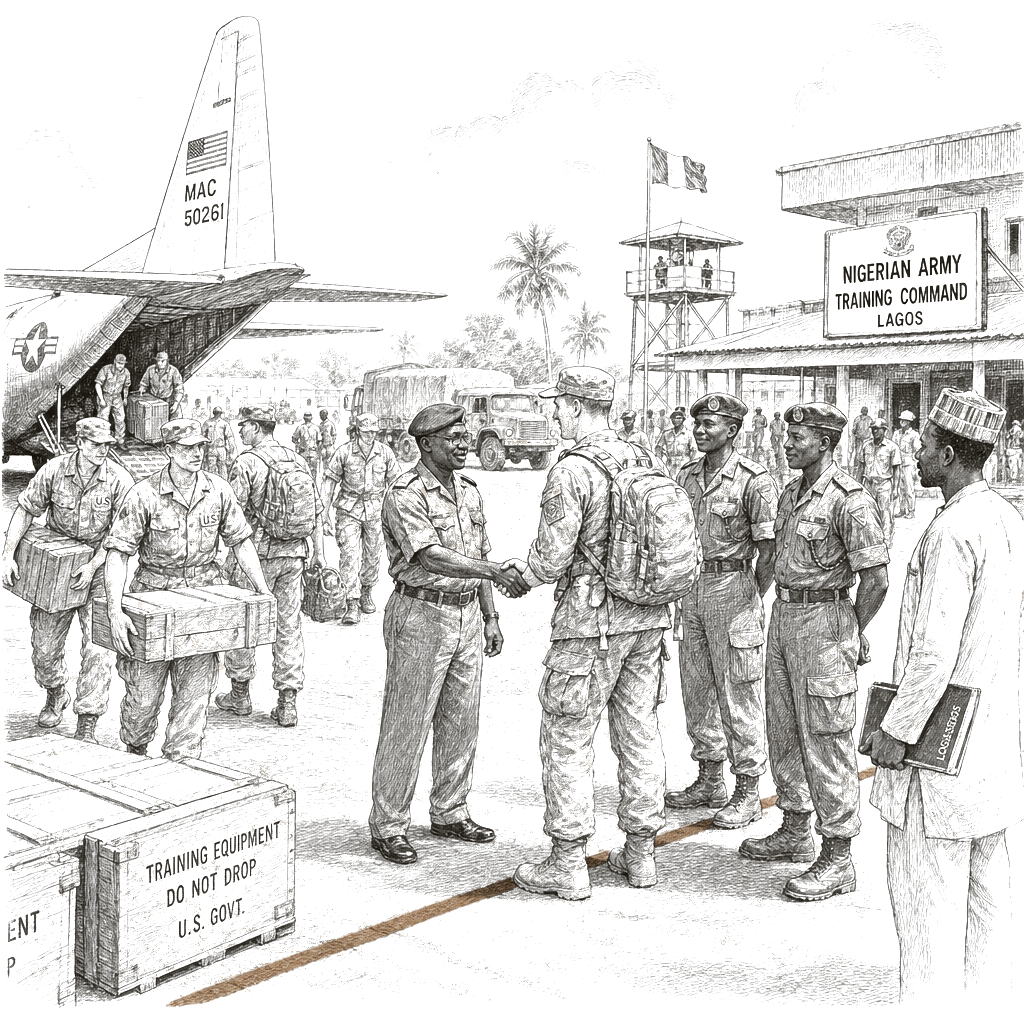
About 100 U.S. troops and equipment arrived in Nigeria to help train the country’s military as Nigeria’s government fights Islamic militants and other armed groups, the Nigerian military said Monday.
The Nigerian military said the arrival followed a request from Nigeria to the U.S. government for help with training, technical support and intelligence-sharing. The deployment comes after a period of heightened tensions between the two countries, sparked when President Donald Trump said Nigeria was not protecting Christians from an alleged genocide. The Nigerian government rejected that accusation, and analysts said the dispute oversimplified a broader conflict in which people are targeted for reasons that often do not align neatly with faith.
Nigeria’s Defense Headquarters spokesman Maj. Gen. Samaila Uba previously said the U.S. troops would not engage in combat or have a direct operational role. In his comments, Uba also said Nigerian forces would have complete command authority, placing the operational control with the Nigerian military.
The training effort arrives as U.S. military involvement in Nigeria continues on a limited basis. The deployment follows an earlier step when U.S. forces launched airstrikes on Islamic State group-affiliated militants in northwestern Nigeria in December.
Last month, after discussions with Nigerian authorities in Abuja, the head of U.S. Africa Command confirmed that a small team of U.S. military officers was in Nigeria focused on intelligence support. Officials have described the newer group as part of the broader assistance package tied to training and support.
Nigeria’s conflict is shaped by a mix of militant factions and criminal armed groups that compete for territory, including Islamic sects such as Boko Haram and its breakaway faction, Islamic State West Africa Province. The fighting has also involved the IS-linked Lakurawa, as well as armed groups described as “bandit” groups that carry out kidnapping for ransom and engage in illegal mining.
In addition to these groups, the crisis has widened to include militants from neighboring Sahel countries. The Jama’at Nusrat al-Islam wal-Muslimin has claimed its first attack on Nigerian soil last year, and data from the United Nations has shown that several thousand people in Nigeria have been killed as the violence has persisted.
Analysts and residents have said the government’s security response has not been sufficient to protect citizens. While Christians have been among those targeted, analysts and residents said the majority of victims are Muslims in Nigeria’s Muslim-dominated north, where most attacks occur.