Body
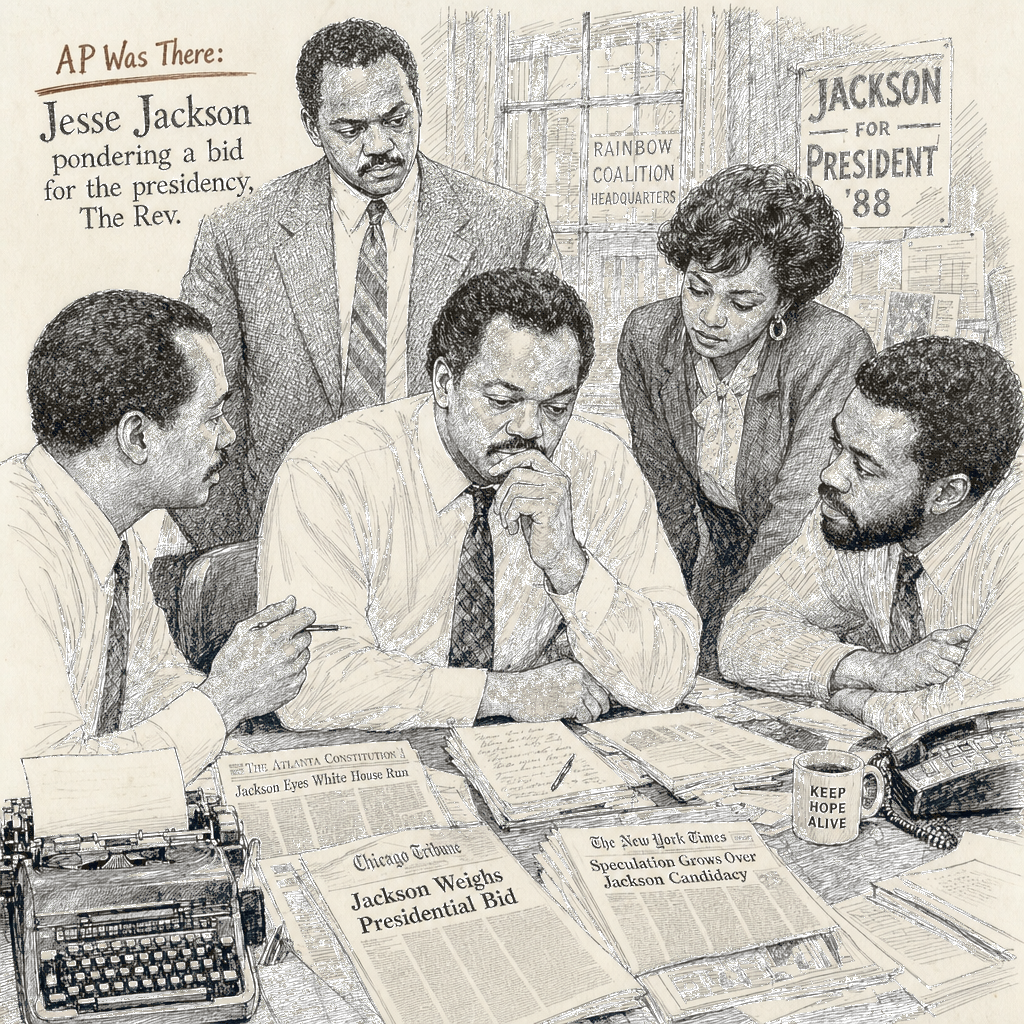
The Associated Press republished an older profile describing the Rev. Jesse Jackson in 1983, when he was 41 and weighing whether to pursue the Democratic nomination for the 1984 presidency. Written by AP journalist Sharon Cohen for an Aug. 7, 1983, edition of “AP Was There,” the profile portrays Jackson as a civil-rights leader who framed politics through religion and spoke to crowds with slogans built for chanting and belief.
Jackson, Cohen reported, described himself as a prophet on a “lonely, dusty road,” saying he was “very much driven by my religion to rise.” In the profile, he also described his calling in terms of the “prophetic ministry,” saying it was the kind of ministry “ancient prophets engaged in when they challenged the conduct of kings and queens.” He tied that view of purpose to political urgency and kept pressing his message of hope as he moved from event to event.
The AP profile described Jackson’s public style as both rhythmic and media-effective, emphasizing slogans that urged listeners to hold out and avoid destructive choices. In one exchange with church audiences, he said, “If you are behind in a race, you CAN’T run equally,” and that “The race does not go to the fast or to the strong but to those who hold out.” Cohen’s account also includes Jackson’s language warning that people who “pickle your brains with liquor” or “shoot cocaine in your membrane” “CAN’T hold out,” as crowds responded with chants such as “Preach, brother. Preach it.”
Cohen wrote that after Jackson spoke, crowds flocked to him for photos and autographs and asked him to kiss babies, with Jackson telling the reporter, “My gift is a gift of the spirit.” The profile presented that gift as a driver behind Jackson’s political rise and described a shift in Jackson’s focus over decades—from what it described as work on equal rights in the 1960s, to stress on self-respect and economic justice in the 1970s, to leadership and a drive for voter registration in later years.
Operation PUSH, Cohen said, was Jackson’s base and his organization, even as he moved beyond Chicago politics into national issues. The profile said Jackson founded the group in 1971 after splitting from the Southern Christian Leadership Conference and has been its president since then, citing an annual salary of $40,000. It described PUSH as the organization through which he pursued voter registration across the South, increased Black participation in public office, and advanced the idea of a Black president—“maybe Jesse Jackson,” as the profile put it.
The AP profile also described tensions within the political scene around a potential candidacy. Cohen wrote that for “the past few months, and maybe longer,” Jackson sounded increasingly like a candidate, though the profile said other Black leaders responded with skepticism about the political wisdom of a Black run at that time. Cohen included a reference to a poll showing Jackson as more popular than some announced candidates, and the profile quoted him saying, “God did not limit genius to white males,” and that “He distributed it all over town.”
In the profile, supporters and critics described different sides of Jackson’s behavior and methods. Half-brother Noah Robinson, Cohen reported, said Jackson “seems himself on a messianic mission” and credited his ego as a motivating force, while PUSH chairman Richard Hatcher of Gary, Ind., was quoted saying Jackson “always describe a visionary as someone who looks at cloudy skies and does not see the clouds, but sees the sun” and adding, “He’s able to do that.” Mary Frances Berry, a member of the U.S. Civil Rights Commission, was quoted as saying Jackson was not “really an organization man,” and Don Rose, a political strategist who worked with Jackson in the 1960s, was quoted describing the “most pungent criticism” as Jackson’s campaigns and crusades that “evaporate after the TV set is turned off.”
The profile also touched on Jackson’s political positions and the controversies and questions that accompanied them. Cohen wrote that Jackson assailed “dirty lyrics in disco music,” mediated local labor disputes and led boycotts of national corporations, and that he advocated for the rights of Haitians, Palestinians and Poles. The profile said American Jews were appalled when Jackson embraced Yasser Arafat, and it noted that legislators applauded Jackson when he addressed Alabama’s Legislature, “the first black to do so this century,” according to Cohen’s account.
Cohen’s portrait of Jackson’s preparation for national politics included how he defended his qualifications when critics questioned his ability to speak on issues such as jobs or defense spending. In a quote included in the profile, Jackson said, “I wasn’t trained in auto mechanics and brick masonry,” and then contrasted that with a “liberal arts education,” adding that if Mr. Reagan could speak about agricultural and trade policy and international affairs and art and culture and science, “who’s to suggest I should be less able to speak to a broad range of issues?” The profile also quoted Jackson on the Democrats’ role for Black voters, saying they had “made us like the Harlem Globetrotters,” providing “thrills and excitement” but not “participate in the other room where policy decisions are made.”
The AP profile closed with how Jackson’s political ambition was viewed by friends and leaders who remained divided, but who still saw some value in putting the possibility on the table. It quoted Georgia state Sen. Julian Bond saying Jackson had “made the party more cognizant of black voters” and that it had made race “in a positive way” an agenda item in the Democratic nomination campaign.