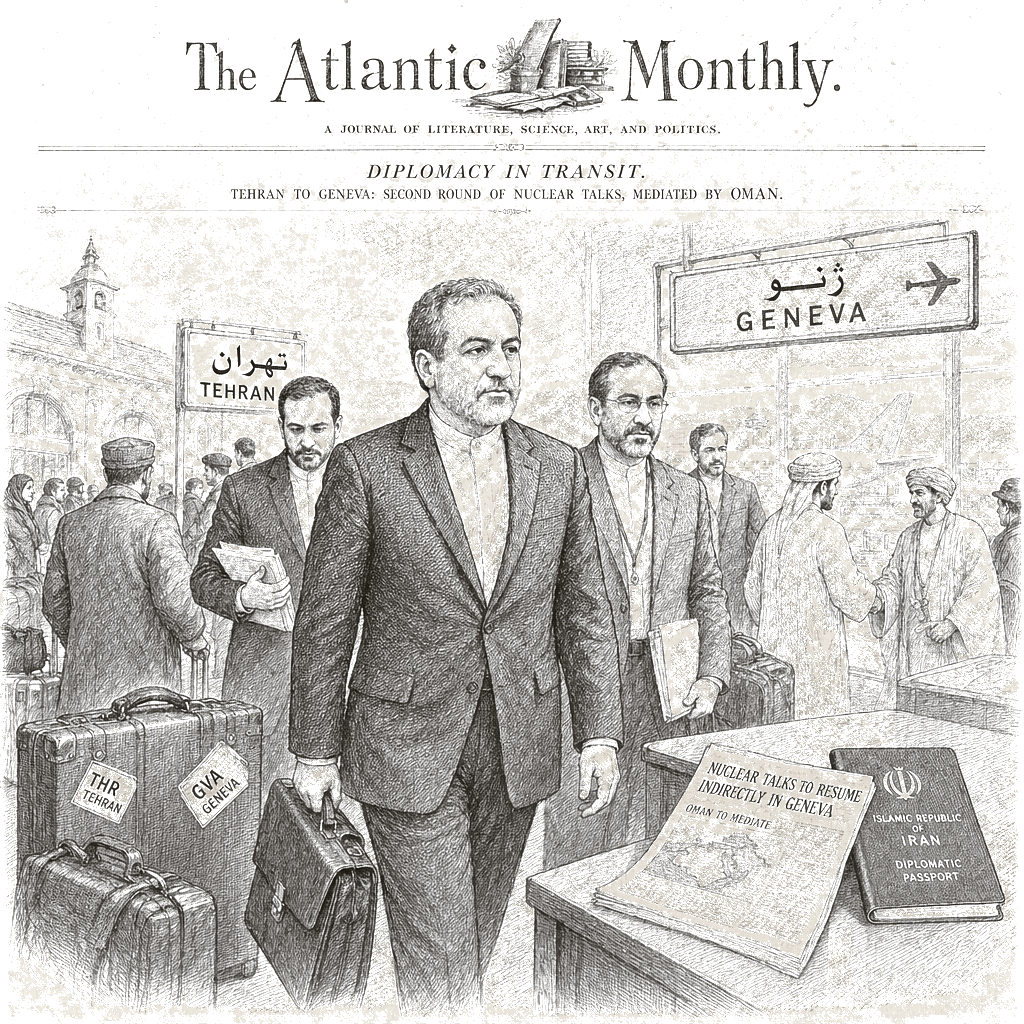
Iran’s top diplomat, Foreign Minister Abbas Araghchi, left Tehran for Geneva on Sunday to attend a second round of indirect nuclear negotiations with the United States, Iranian state media reported.
Iranian state-run IRNA said Araghchi and his delegation departed for the Swiss city after the first round of indirect talks took place in Oman last week. IRNA also said Oman will mediate the negotiations in Geneva.
In Washington, U.S. Secretary of State Marco Rubio said the United States remains interested in a diplomatic solution aimed at ending differences with Tehran. Rubio said Trump’s envoys, Steve Witkoff and Jared Kushner, were traveling for the new round of talks.
Before Araghchi’s departure, the reported diplomatic push unfolded amid heightened warnings on both sides. Rubio said recent U.S. military deployments in the Middle East were intended to protect American facilities and interests, and Iran has threatened to attack U.S. bases in the region if Washington decides to strike.
Both governments have insisted they are seeking negotiations, but they remain far apart on key terms. The Trump administration has maintained that Iran can have no uranium enrichment in any form, while Iran has said it will not agree to such a demand. Iran has also continued to say its nuclear program is for peaceful purposes, even as U.S. officials have argued that diplomacy needs to curb Iran’s nuclear advances.
Iran continues to insist on its peaceful intent, and Iranian and U.S. officials have pointed to dramatically different end states. Before the June war in the region, Iran was enriching uranium up to 60% purity—described in the reporting as a technical step short of weapons-grade material—according to the account cited by the Associated Press.
The Geneva trip also places Araghchi in meetings beyond the indirect talks themselves. The IRNA report said he was expected to meet with Swiss and Omani counterparts as well as the director general of the U.N.’s atomic watchdog, the International Atomic Energy Agency.
The diplomatic track has faced skepticism shaped by recent history. Similar indirect talks last year broke down after Israel launched what became a 12-day war on Iran that included U.S. bombing of Iranian nuclear sites, according to the Associated Press report.
The wider regional context includes signals about potential escalation. Gulf Arab countries have warned that any attack could spiral into another regional conflict, and the Trump administration has separately threatened to use force to compel Iran to constrain its nuclear program.
Trump has also threatened Iran in connection with Iran’s deadly crackdown on recent nationwide protests, the reporting said. He has additionally suggested that a change in power in Iran would be “the best thing that could happen,” and he said Friday that the USS Gerald R. Ford, the world’s largest aircraft carrier, was being sent from the Caribbean to the Middle East to join other U.S. military assets in the region.
As the Geneva talks get underway, Israeli Prime Minister Benjamin Netanyahu is pressing for a deal that goes beyond uranium enrichment limits. Netanyahu, who met Trump earlier this week in Washington, has argued in a Sunday speech that any agreement must ensure that “all enriched material has to leave Iran,” and he has been pressing for an approach that would neutralize Iran’s ballistic missile program and end funding for proxy groups such as Hamas in Gaza and Hezbollah in Lebanon.
It remains unclear how much influence Netanyahu will have over Trump’s policy as the indirect negotiations proceed, the Associated Press report said.