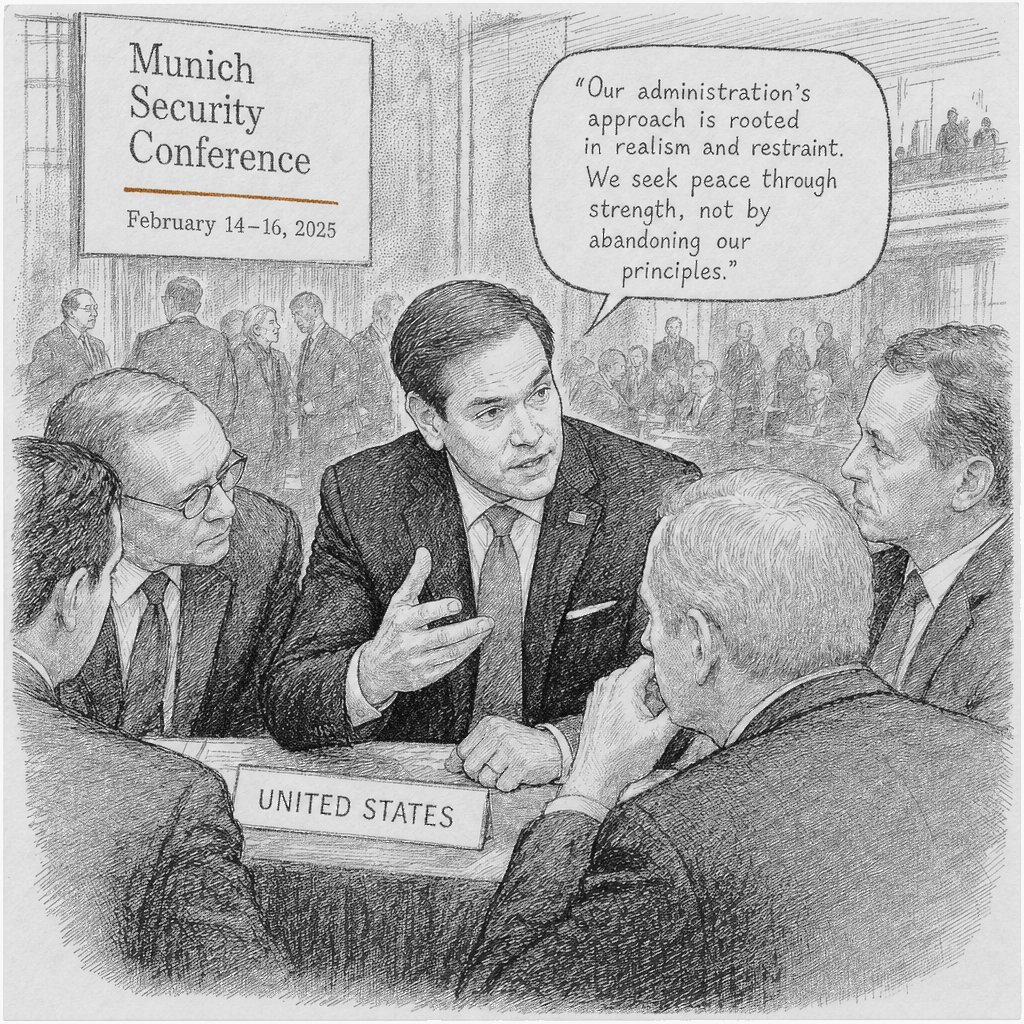
Rubio’s speech at the annual Munich Security Conference aimed to calm the tone of U.S. diplomacy toward Europe, even as he framed the Trump administration’s approach as firm on policy and intent on altering how allies cooperate across the Atlantic. He reminded the audience of the long American-European relationship, and he sought to signal continuity of U.S. engagement by stressing that the United States “will always be a child of Europe,” despite pushing for changes in institutions and the partnership itself.
The conference address landed in a period of heightened strain, after Trump’s administration faced criticism for often-hostile rhetoric toward traditional allies and for moves that targeted European partners. Rubio’s remarks came about a year after Vice President JD Vance drew an outcry in front of the same Munich audience with a harsh critique of European values, and they followed additional developments that European leaders said have unsettled trust.
Rubio said the relationship would not end, telling his audience that “an end of the trans-Atlantic era” was neither a goal nor a wish. He also said the United States “would remain forever tied” to Europe even while it pursues adjustments to the terms of the alliance, including changes to the institutions that shaped the post-World War II order.
While Rubio described his tone as less aggressive than recent U.S. statements, he said the administration was still focused on specific policy priorities. He denounced “a climate cult” and warned about “an unprecedented wave of mass migration that threatens the cohesion of our societies.” He also argued that Western optimism after the Cold War victory produced “a dangerous delusion” that countries would become liberal democracies and that trade-based ties would replace nationhood and lead to a borderless world.
Rubio added a personal and historical appeal by recalling that Americans and Europeans “have bled and died side-by-side on battlefields from Kapyong to Kandahar.” He contrasted his argument with earlier remarks by Trump about NATO allies’ troops in Afghanistan, which had drawn an outcry, and he said the U.S. was “charting the path for a new century of prosperity” together with “our cherished allies and our oldest friends.”
U.S. officials accompanying Rubio told the Associated Press that his message was much the same as Vance’s last year but was intended to land with a softer tone after the audience recoiled at much of Trump’s rhetoric over the previous year. At the same time, the speech made clear that the administration’s approach would demand “seriousness and reciprocity from our friends here in Europe,” including through language Rubio said was “a little direct and urgent.”
European leaders used their own remarks to underscore both reassurance and limits on complacency. Ursula von der Leyen, president of the European Union’s executive commission, said Rubio’s speech was “very reassuring” but noted that “in the administration, some have a harsher tone on these topics.” She also stressed that Europe must become more independent, including on defense, and she emphasized “digital sovereignty,” including approaches to hate speech on social media.
British Prime Minister Keir Starmer warned against a “warm bath of complacency,” saying the U.K. must reforge closer ties with Europe to help the continent “stand on our own two feet” in defense. Starmer also called for investment that would “moves us from overdependence to interdependence,” while signaling that Europe’s strategic direction would not be defined by Washington alone.
Estonia’s defense minister Hanno Pevkur said it was “quite a bold statement to say that America is ‘a child of Europe.’” He told the Associated Press that Rubio’s speech was “a good speech, needed here today,” but added that it “doesn’t mean that we can rest on pillows now,” saying “a lot of work has to be done.”
Greenland and Arctic security still sat behind the speeches, even though Rubio did not mention Greenland directly. After last month’s escalation over Trump’s designs on the Arctic island, the U.S., Denmark and Greenland started technical talks on an Arctic security deal, and Denmark’s prime minister Mette Frederiksen described a brief Friday meeting in Munich with the Danish and Greenlandic leaders as constructive.
Asked Saturday whether the crisis had passed, Frederiksen said: “No, unfortunately not.” She said she believes the U.S. president’s “desire from the U.S. president is exactly the same. He is very serious about this theme.” When asked whether she could put a price on Greenland, she replied “of course not,” adding that Denmark and Greenland must “respect sovereign states” and “respect people’s right for self-determination,” and she said “the Greenlandic people have been very clear, they don’t want to become Americans.”