Body
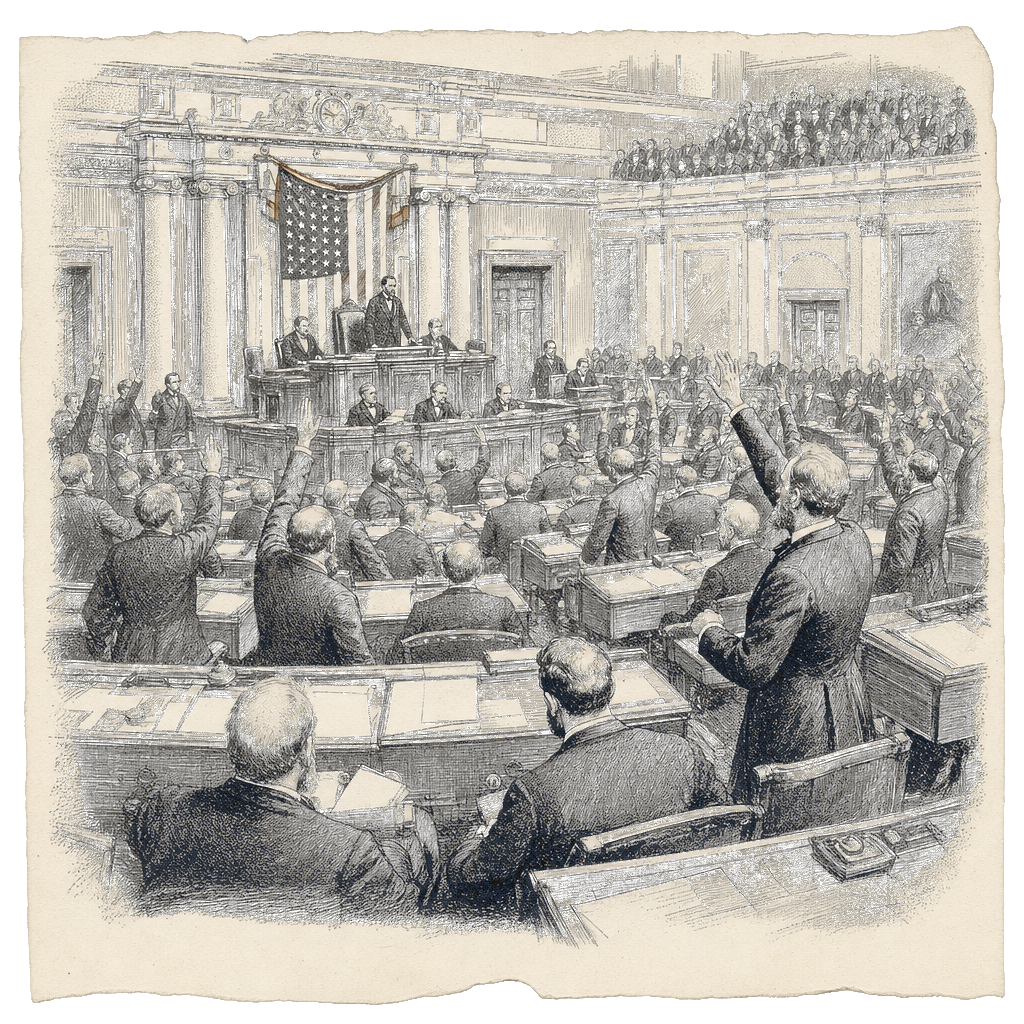
The House voted Wednesday to terminate President Donald Trump’s national-emergency tariffs on Canada, in a rare rebuke that drew Republican defections and a swift response from the White House. The resolution was designed to end the emergency that Trump declared a year ago to impose the tariffs, though it would still require the president’s cooperation to fully undo the policy.
Rep. Gregory Meeks of New York, the top Democrat on the House Foreign Affairs Committee, said the vote was about whether lawmakers would “vote to lower the cost of living for the American family” or keep prices high “out of loyalty to one person — Donald J. Trump.” The House adopted the measure 219-211, with six House Republicans voting for it and one Democrat voting against it.
President Trump reacted immediately after the gavel struck, posting a warning on social media that any Republican—“in the House or the Senate”—who votes against “TARIFFS” would “seriously suffer the consequences come Election time,” including in primaries. The vote, supporters said, offered a window into unease within the Republican conference over the administration’s direction on trade, especially as economic issues resonate with voters ahead of midterm elections.
The measure now moves to the Senate, where supporters noted that the resolution’s prospects remain uncertain. Even if the Senate approves it, the policy would ultimately depend on whether Trump signs the bill or vetoes it, a step that critics argued is unlikely given the president’s view of tariffs as leverage in negotiations.
Ahead of the vote, House Speaker Mike Johnson tried to prevent lawmakers from taking action, urging them to wait for a pending Supreme Court ruling in litigation over the tariffs. Johnson engineered a procedural approach to block floor action, arguing for “more runway” for coordination between the executive and judicial branches, but Republicans broke ranks during a late Tuesday procedural effort, according to the report.
At the White House on Wednesday morning, Kevin Hassett, director of the National Economic Council, told reporters that the administration was disappointed and said the president would “make sure they don’t repeal his tariffs.” Johnson had previously argued that Congress should allow time for the courts to decide, but the resolution advanced after members aligned behind the idea that Congress should exercise its own role over tariff policy.
Meeks’ resolution also framed the underlying dispute as an emergency-power question. The administration previously said an illicit drug flow from Canada creates an unusual and extraordinary threat that authorizes tariffs outside the terms of the U.S.-Mexico-Canada trade agreement. Rep. Brian Mast of Florida, chairman of the House Foreign Affairs Committee’s Republican panel, argued that the fentanyl flow is a dire national emergency and that the tariffs should remain in place, saying Democrats were “trying to ignore that there is a fentanyl crisis,” and that the resolution was not really a tariffs debate.
Some Republican members described the decision in terms of Congress’s authority, not only economic impact. Rep. Don Bacon, R-Neb., voted for the resolution, saying he was unpersuaded by Johnson’s call to wait for Supreme Court action and arguing that “we should defend our authorities.” Bacon also said he believed tariffs are bad economic policy, while other Republicans said they felt forced to align quickly as the procedural timeline narrowed.
Trump’s tariff showdown with Canada came amid broader tensions over trade. The report said Trump recently threatened a 100% tariff on goods imported from Canada over that country’s proposed China trade deal, intensifying a feud with Prime Minister Mark Carney. From Canada, Ontario Premier Doug Ford called the House vote “an important victory with more work ahead,” thanking lawmakers from both parties who “stood up in support of free trade and economic growth between our two great countries,” and saying “Let’s end the tariffs” together.