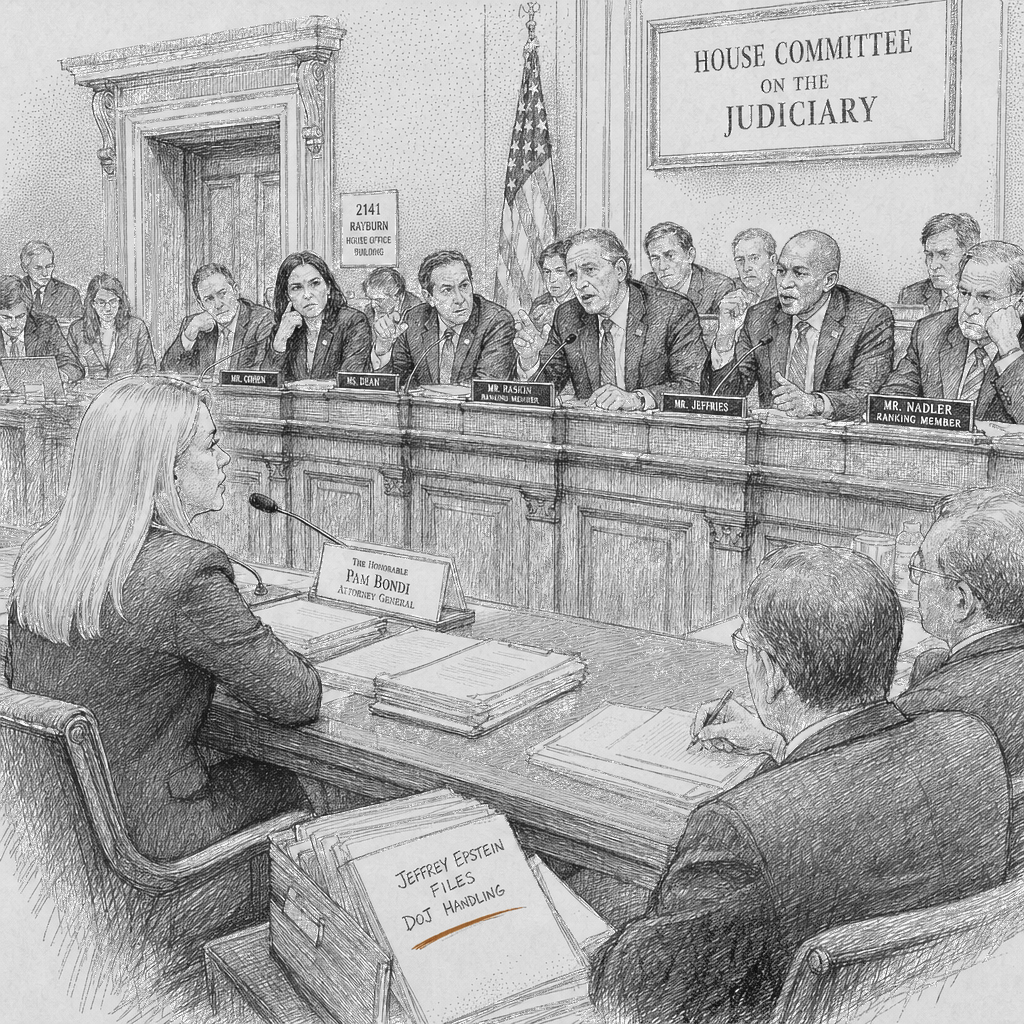
Bondi’s appearance before the House Judiciary Committee turned into a sharp fight over the Justice Department’s release of records tied to Jeffrey Epstein, with the attorney general repeatedly pivoting from Democrats’ questions into a broader defense of President Donald Trump and the department’s performance on law enforcement.
As she faced lawmakers in a combative hearing, Bondi launched into what she described as a needed reset after weeks of criticism about the Epstein files, accusing Democrats of using the issue to distract from Trump’s successes and depicting the president as a target of past investigations and impeachments.
“You sit here and you attack the president and I’m not going to have it,” Bondi told lawmakers, adding, “I am not going to put up with it,” while survivors of Epstein’s abuse sat behind her in the hearing room.
In the exchange that followed, Rep. Jamie Raskin accused Bondi of refusing to answer his questions. Bondi responded by calling Raskin a “washed-up loser lawyer — not even a lawyer,” as the hearing devolved into partisan clash-making rather than a sustained answer-by-answer review of the department’s handling of the files.
Democrats pressed Bondi on what they said were ties between Epstein-related records and Trump administration officials and on the Justice Department’s decision-making around the materials. Rep. Becca Balint, a Vermont Democrat, said, “I am not asking trick questions here. The American people have a right to know the answers to this,” as she tried to force direct responses from the attorney general.
The hearing also highlighted the political momentum built after Bondi distributed binders to conservative influencers at the White House in February 2025 as part of efforts to raise expectations around releasing Epstein-related records. The binders, according to the AP account of the hearing, did not contain new revelations, and the controversy continued to grow as calls from Trump’s base for additional transparency increased.
Bondi, in her opening remarks, told Epstein victims to come forward to law enforcement with any information about their abuse and said she was “deeply sorry” for what they had suffered. She also told the survivors that “any accusation of criminal wrongdoing will be taken seriously and investigated,” positioning the department’s approach as responsive to alleged wrongdoing.
But Democrats said Bondi refused to make a direct apology when Rep. Pramila Jayapal, D-Wash., pressed her to turn and face the victims and apologize for what Trump’s Justice Department has “put them through,” with Bondi calling the request “theatrics.”
Republicans, aiming to limit the fight to other policy priorities, tried to steer Bondi back to law enforcement issues such as violent crime and illegal immigration. Bondi continued to deflect questions from Democrats and, in the account, responded instead with attacks and references that Democrats said appeared drawn from news headlines.
The hearing arrived as Democrats and others have continued to scrutinize the Epstein files release, including the scope and quality of redactions. Democrats argued that haphazard or incomplete redactions exposed sensitive private information about victims, including intimate details and nude photographs, with a review by the Associated Press and other news organizations finding examples of sloppy, inconsistent or nonexistent redactions.
Republicans also criticized elements of the release. Rep. Thomas Massie, a Kentucky Republican who had backed legislation that forced the release of the Epstein files, told Bondi she had done “Literally the worst thing you could do to survivors,” referring to the release of victims’ personal information.
Bondi told Massie that his focus on the files was shaped by his interest in how Trump appears in them, calling him a “hypocrite” with “Trump derangement syndrome.”
Bondi’s defense of the department included an explanation that officials had attempted to protect survivors, saying errors were inevitable given the volume of materials and the speed of the release required by legislation. She told lawmakers that the Justice Department had taken down files after it was made aware that they included victims’ information, and she said staff tried to do their “very best in the time frame allotted by the legislation” mandating the release of the Epstein records.
In the broader context, the fight over the Epstein files has drawn renewed attention to whether the Justice Department’s law enforcement power is being used politically. The day before Bondi’s hearing, the department sought to secure charges related to Democratic lawmakers who produced a video urging military service members not to follow “illegal orders,” but a grand jury in Washington refused to return an indictment, a development Republicans highlighted as part of a rebuke of prosecutors.
Just days before Bondi’s testimony, Democrats and lawmakers have been pressing questions about the Justice Department’s oversight and conduct during the Epstein-files dispute, and the attorney general used the hearing to insist that the department should return to its core missions after what she described as “years of bloated bureaucracy and political weaponization.”
GOP Rep. Jim Jordan praised Bondi for reversing actions under former Attorney General Joe Biden that Republicans said targeted conservatives, while Democrats continued to accuse Bondi of covering up the Epstein record. Bondi’s hearing underscored how the Epstein-files controversy remains a flashpoint in Washington, with survivors, redactions, and the department’s motives all colliding in a public fight over accountability.