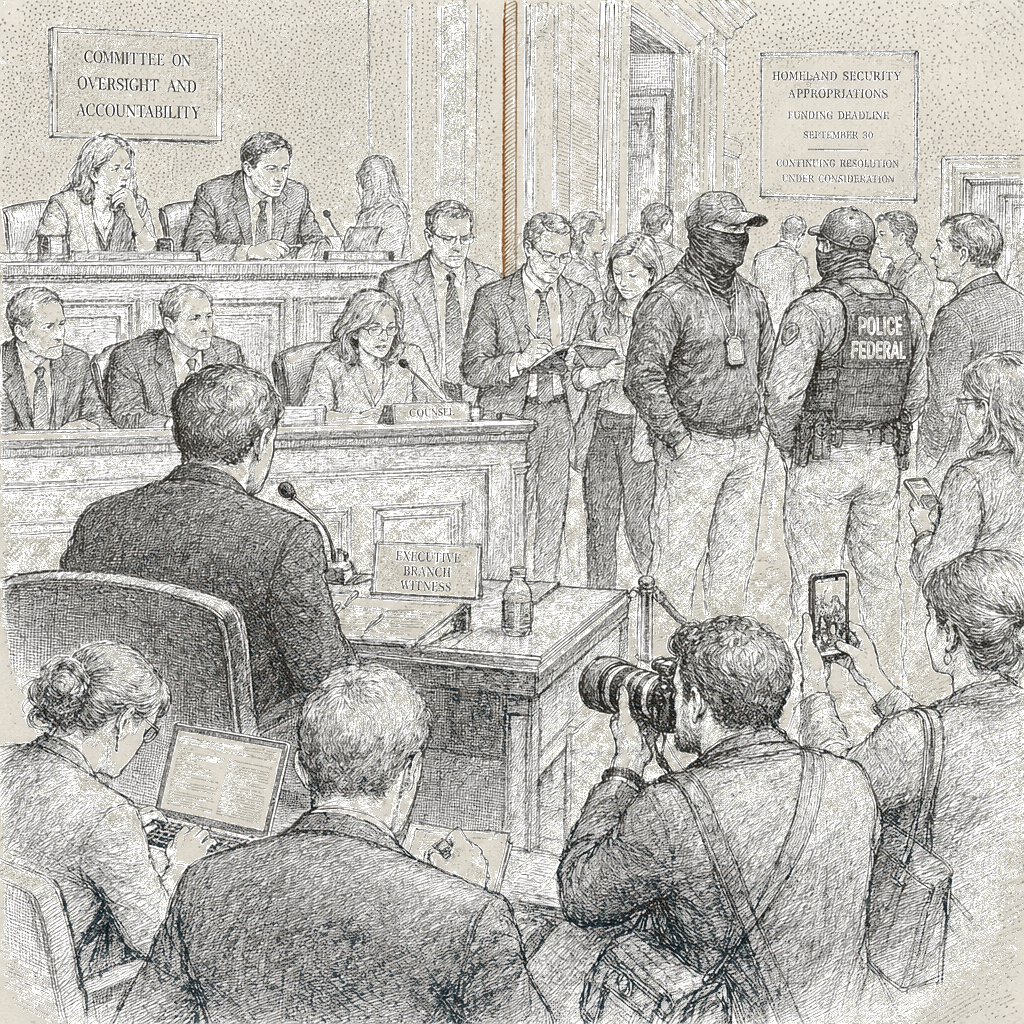
Beyond the car windows being smashed, people tackled on city streets — and in one case even a little child with a floppy bunny ears snowcap detained — the images of masked federal officers have become a flashpoint in the Trump administration’s immigration enforcement operations, a debate that is now spilling into congressional funding negotiations.
The fight centers on whether officers should be required to remove masks during ICE operations even as lawmakers face a partial agency shutdown threat. The funding deadline comes Friday at midnight, when Homeland Security is expected to face a partial shutdown if an agreement is not reached, and the mask question has emerged as a prominent issue in the negotiations.
Democrats have pressed “masks off” as part of their broader oversight demands. House Democratic Leader Hakeem Jeffries told reporters at the Capitol that unmasking federal agents is a “hard red line” in the talks ahead, and Democrats have also said officers should wear body cameras.
ICE, for its part, has defended the practice. On its website, the agency says its officers “wear masks to prevent doxing, which can (and has) placed them and their families at risk,” and that all ICE law enforcement officers carry badges and credentials and will identify themselves when required for public safety or legal necessity.
The dispute has also been fueled by a broader shift in how ICE enforcement has been carried out in recent months and how it has been documented publicly. The AP reported that masking appeared early in the first year of President Donald Trump’s immigration enforcement push, including a spring episode in which plain-clothed officers drawing up their masks surrounded and detained a Tufts University doctoral student near her Massachusetts home.
Beyond that earlier case, the images have repeated in multiple cities, and the AP tied the escalation of public attention to the shooting deaths of two American citizens at the hands of federal immigration officers during demonstrations against ICE raids in Minneapolis. According to the AP account, those deaths sparked widespread public protest and spurred lawmakers to respond as the masking became a recurring visual marker of enforcement operations.
Republicans have generally argued that current conditions make unmasking dangerous for officers, many of whom are new to the job. Sen. Thom Tillis of North Carolina said he could not agree with Democrats’ demand that officers unmask themselves, arguing that “there’s a lot of vicious people out there” who could threaten officers’ families, including children and spouses.
The debate also includes arguments about whether ICE is using a tactic more broadly than other law enforcement agencies. The AP reported that it appears no other policing agency regularly uses masking on a widespread basis, and that masks are more commonly used for special operations such as undercover work, crowd control or protest situations, or when there is inclement weather or individual health concerns.
Experts cited by the AP said masking in ICE operations could be “without precedent in modern American history.” The American Civil Liberties Union’s Naureen Shah said the idea of masked patrols seeking immigrants can leave people scared and confused about who they are encountering and that, in her view, the approach may be “calculated to terrify people.”
Shah said she does not believe communities “viscerally feel” this should become “a permanent fixture in our streets,” pointing to what she described as the risk that norms, trust and accountability between police and citizens could be shattered. The AP also reported that a provision requiring agents to clearly identify themselves was included in a defense authorization bill Trump signed into law toward the end of the first Trump administration after masked federal agents appeared in 2020 to quell protests in Portland and other cities.
Some officials are seeking a compromise. Justin Smith, executive director and CEO of the National Sheriffs’ Association and a former Colorado sheriff, said unmasking can raise concerns about officer identification and that “humans read each others’ faces — that’s how we communicate,” adding that when a large number of federal agents are involved and they cannot be identified by facial visibility, “it just tends to make people uncomfortable” and “brings up some questions.”
Smith suggested a middle ground in which officers could continue to wear masks while their badges or other identifying numbers remain prominently displayed. At the same time, advocates said unmasking alone may not be enough and pushed Congress to curb other ICE practices they say weaken legal safeguards.
Greg Chen, senior director of government affairs at the American Immigration Lawyers Association, said Congress’s funding role makes it important for lawmakers to push for reforms now, and he linked the issue to the large Homeland Security funding included in Trump’s tax cuts bill, which the AP said poured some $170 billion into the department. Advocates also pressed Congress to require judicial warrants for home entries rather than allowing administrative warrants in immigration operations, and they urged changes to end roving patrols, the practice of using a person’s race, language or job location to question legal status, sometimes referred to as “Kavanaugh stops” after Supreme Court Justice Brett Kavanaugh’s concurring opinion last summer.
Rep. Ayanna Pressley, D-Massachusetts, who returned from Minnesota, said the masked enforcement operation is felt as a heavy presence even by people not targeted as immigrants. She said it is “a very a heavy presence of surveillance and intimidation,” and added, “No one is exempt.”
The mask dispute, with Republicans stressing officer safety and Democrats framing the issue around public identification and oversight, is unfolding as Congress tries to complete Homeland Security funding before the shutdown deadline.