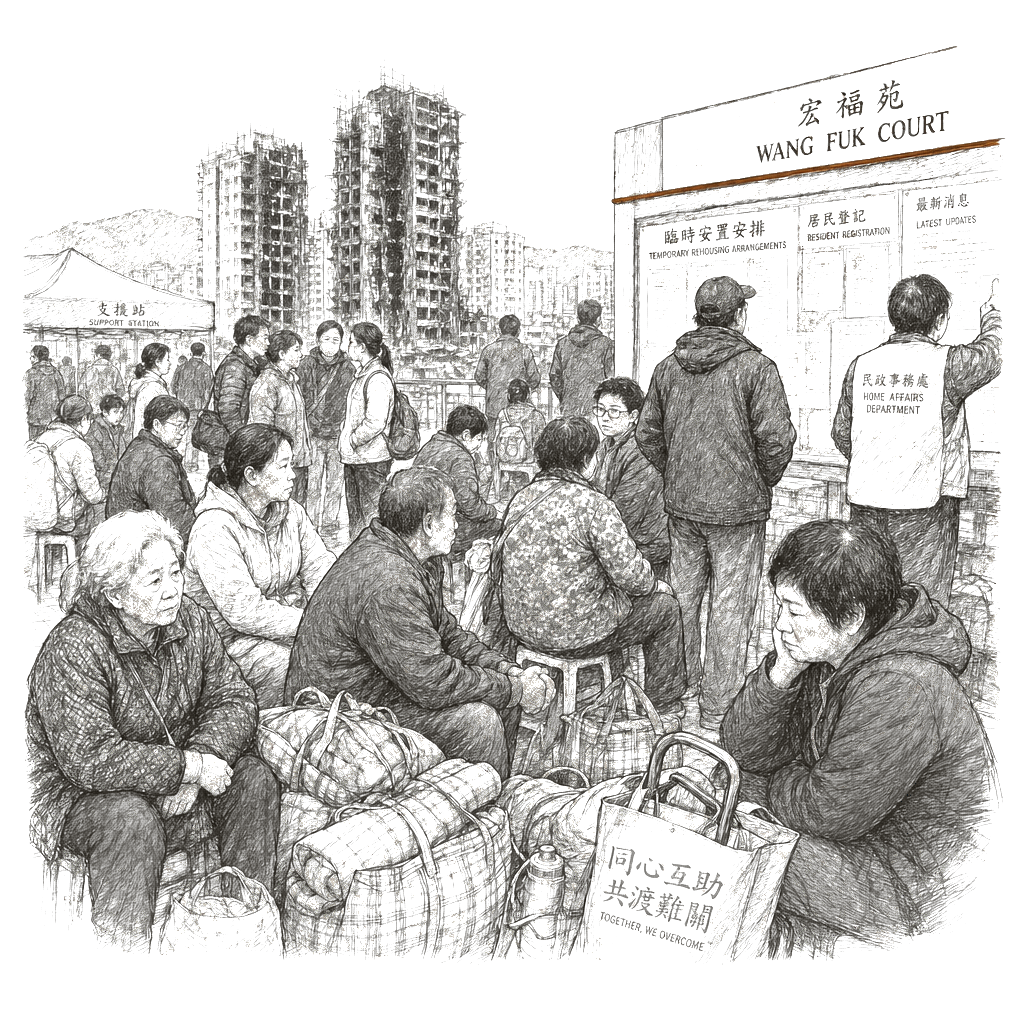
When Hong Kong was hit by a deadly fire at Wang Fuk Court last November, it left thousands without parts of their lives—neighbors, belongings and the place they called home. Months later, survivors interviewed by The Associated Press say the next step, long-term resettlement, remains unclear even as the Lunar New Year approaches on Feb. 17.
Several survivors described a process that has moved them into temporary housing while waiting for authorities to survey residents’ resettlement preferences and map out a permanent plan. The government has also offered rental grants to help homeowners cover short-term housing costs, according to the report.
The fire engulfed seven apartment buildings and killed 168 people on Nov. 26, 2025, according to the Associated Press report, which also said authorities blamed substandard scaffold netting and foam boards used in a maintenance project for the rapid spread of flames. While some arrests were made, the report said an independent committee is still investigating the cause.
Pearl Chow, 87, said she fled the apartment with documents including her title deed when the flames devoured the towers. Her grandson, Dorz Cheung, 33, rushed from his office to find her safe while the fire was still raging. They later found temporary shelter separately, and now both say they are still divided into temporary units around 100 square feet, each on different floors; Chow said she is satisfied, while Cheung said it is not home.
Cheung said, “Only a permanent residence can be a home,” and said he wants resettlement in Tai Po because he and his grandmother lived there for decades. Chow said she still returns regularly to Tai Po for church and grocery shopping despite the hourlong journey. The report cited 2021 census data showing that more than a third of the complex’s approximately 4,600 residents were aged 65 or above, underscoring the concerns about how long temporary arrangements might last.
Kit Chan, 74, and her husband, Keung Mak, 78, described a similar struggle with time and location after the fire. The report said they had lived together in a 460-square-foot apartment for more than 40 years and raised their family in a neighborhood where neighbors helped look after children. After the blaze, they moved into a studio unit at a youth hostel and Chan said she learned that other fire victims were being asked to leave the facility.
Chan told The Associated Press that she has not been asked to leave but worries about what comes next, saying it is “like being unable to get by in my final years.” She initially wanted a new home rebuilt on the fire site, but the government estimates rebuilding will take about a decade, the report said. Keung Mak said many residents are hoping to return at least to see how badly the complex was burned.
Other survivors said the challenge goes beyond housing square footage, extending to the social networks that once existed inside the complex. Isaac Tam, 23, said that during previous Lunar New Year celebrations, his family visited neighbors on their floor with gifts. After the fire, he said those familiar faces were scattered around the city, and his family moved into temporary homes that were smaller and farther from the city center, requiring money to renovate the units before moving in.
Tam said his family is considering options in another district that could be ready sooner than units in Tai Po, which he prefers because he grew up there. He said time is their priority given his grandfather’s age, adding, “I fear he can’t wait until we secure an apartment of about 400 square feet (about 37 square meters),” regardless of the district.
Phyllis Lo, 48, described a different kind of waiting: not only for answers about what went wrong, but for access to her own past. The Associated Press report said Lo’s mother called after she saw smoke outside Lo’s door as the fire began, and that during the call her mother asked Lo and her brother to live well. Lo said she rushed to her childhood home, called again minutes later, and the next morning police told her they had found her mother’s body.
Lo said she has been troubled by a lack of transparency, asking when she will be allowed to go see her burnt apartment and how authorities will use a reported $589 million relief fund. The report said the investigation is expected to last about nine months, and Lo said she hopes it will release what was found. She also said she wants her childhood home rebuilt at the fire site but considers the proposed timeline—about a decade—unreasonably long.
At a news conference on Tuesday, Hong Kong leader John Lee addressed families affected by the Wang Fuk Court fire and said the city is working on a resettlement plan. Lee said, “This is no easy time for families of Wang Fuk Court. The government will work tirelessly to finalize the plan as soon as possible,” and said a significant proportion of homeowners have indicated they would be willing to consider selling their ownership rights to the government, according to the report.
Jack Rozdilsky, a professor of disaster and emergency management at York University in Canada, told The Associated Press that mental health and trauma coping assistance will be key to a successful resettlement plan. Rozdilsky also said the community survey on resettlement is a good sign because a one-size-fits-all proposal would not satisfy every household and that rebuilding a sense of community may require preserving features that residents associated with daily life, such as shared gathering points or a bus stop.
“Very small things matter,” Rozdilsky said.