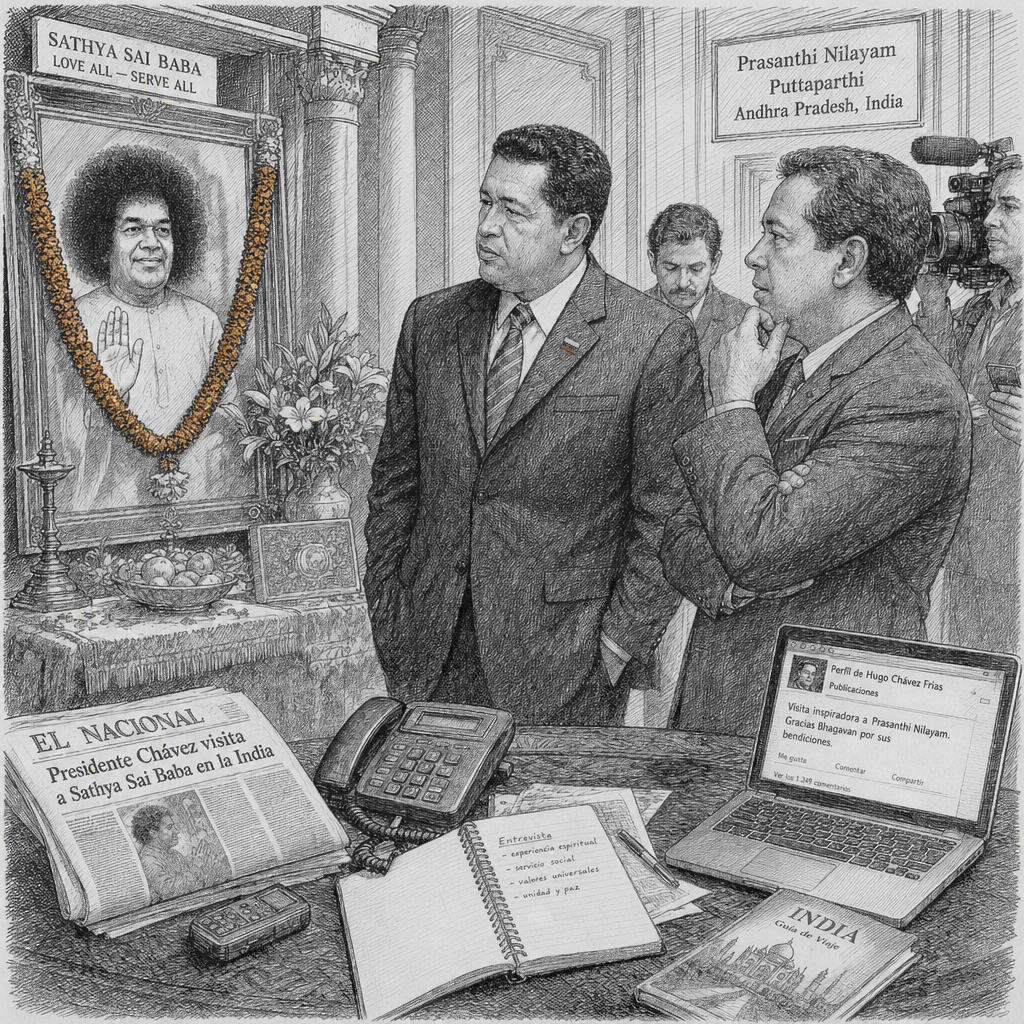
Venezuelan acting President Delcy Rodríguez and ousted President Nicolás Maduro have both described spiritual ties to Indian guru Sathya Sai Baba, whose death in 2011 ended a global movement that drew followers in India and abroad. Both leaders were raised Catholic in a country where, according to religious studies professor Andrew Chesnut, many people blend multiple religious and spiritual practices rather than practicing one tradition exclusively.
Rodríguez visited Sai Baba’s ashram in southern India as recently as 2024, and she has said in public remarks that she still feels the guru’s presence during periods of danger and uncertainty. She has also spoken about a “new moment” for “coexistence, mutual respect, and recognition of others” as Venezuela confronts political transition after Maduro’s capture.
The references to Sai Baba come as Maduro’s removal from power unfolded rapidly. U.S. forces captured Maduro and his wife, Cilia Flores, from their Caracas home on Jan. 3 and brought them to New York to face federal drug trafficking charges. After the capture, Maduro portrayed himself in spiritual terms during legal proceedings, calling himself “a man of God” while pleading not guilty.
Maduro’s public spirituality toward Sai Baba has been paired with Christian language in his political messaging. During his presidency, he frequently invoked Christ, the Holy Spirit and God, framing the government’s struggles as a spiritual battle for Venezuela’s “soul and sovereignty.” The AP reported that weeks before his Jan. 3 capture, Maduro marked Sai Baba’s centenary in a social media post, saying: “the wisdom of this great teacher will continue to illuminate us in the mission of building a homeland of love, peace and high spirituality.”
Rodríguez’s Sai Baba ties have also been documented through her visits to the organization’s facilities in India, including the guru’s headquarters in Puttaparthi in the southern state of Andhra Pradesh. During trips in 2023 and 2024, she was shown praying at the sanctum, the site devotees say is where Sai Baba is finally laid to rest. In statements and interviews, she has said the guru’s presence stayed with her while facing threats, describing a personal feeling of protection from “Baba” during danger.
In a 2023 interview with the organization’s official channel during a visit to India, Rodríguez said, “Many times, when I was in danger, I felt Baba with me, my family and also with my country,” and she added, “He is always with us, teaching us … and showing a path for peace and love.” AP reported that the Sai Baba organization’s efforts to reach for comment in Venezuela and India went unanswered.
The Sai Baba movement’s footprint in Venezuela long predates both Maduro and Rodríguez. The AP reported that the organization opened its first center in Caracas on Aug. 22, 1974, started by Arlette Meyer, a devotee who wrote books in Spanish about the guru. The AP said the center’s early activities included hymn-singing and study of Sai Baba’s teachings with a small group of members.
Today, the organization appears to be centered in Abejales in the western state of Táchira, where it runs a “Human Values School,” the AP reported. The town is the birthplace of Walter Márquez, who maintained ties with Sai Baba before and after serving as Venezuela’s ambassador to India. The AP said Márquez was honored by the Sai Baba organization in Venezuela late last year, and it cited some estimates putting the number of Sai Baba followers in Venezuela at about 200,000.
Chesnut, of Virginia Commonwealth University, said Venezuela’s religious life is “not monolithic,” with Catholicism still dominant but coexisting with evangelical Protestantism, Afro-Indigenous traditions and transnational religious figures. He argued that this syncretic environment helps explain how Maduro could present himself as a devotee of Sai Baba while also cultivating relationships with evangelical leaders whose theology differs. Chesnut said that encounters with figures like Sai Baba can carry “symbolic and performative weight” rather than directly driving policy decisions or shaping laws.
Sai Baba, born Ratnakaram Sathyanarayana Raju, became widely known in India and internationally in the 1970s and 1980s as his followers shared claims about miraculous abilities, including materializations of objects and healings. His teachings emphasized unity and service, and he encouraged followers to continue practicing their own religions while asserting that “God is one” and that all paths lead to the same truth. The AP reported that his messages included “Love All, Serve All” and “Help Ever, Hurt Never,” and it said the movement built nearly 2,000 nondenominational centers in 120 countries.
At the same time, Sai Baba faced intense criticism from some rationalists and scientists, and the AP said he also faced criminal allegations that included accusations of fraud, sexual abuse and murder, though he was never charged. Many of his followers rejected those claims as slander and propaganda. The AP reported that Dr. Samuel Sandweiss, a retired psychiatrist based in southern California, has visited the guru nearly 80 times since 1972, and said he has seen Sai Baba materialize items such as sacred ash known as vibhuti and golden rings.
With Maduro and Rodríguez citing Sai Baba in public comments during a period of political upheaval, the AP described their references as part of a broader religious and cultural blend that remains common in Venezuela—one where religious identity can be layered and where spiritual figures may function both as personal guides and as symbols in public life.