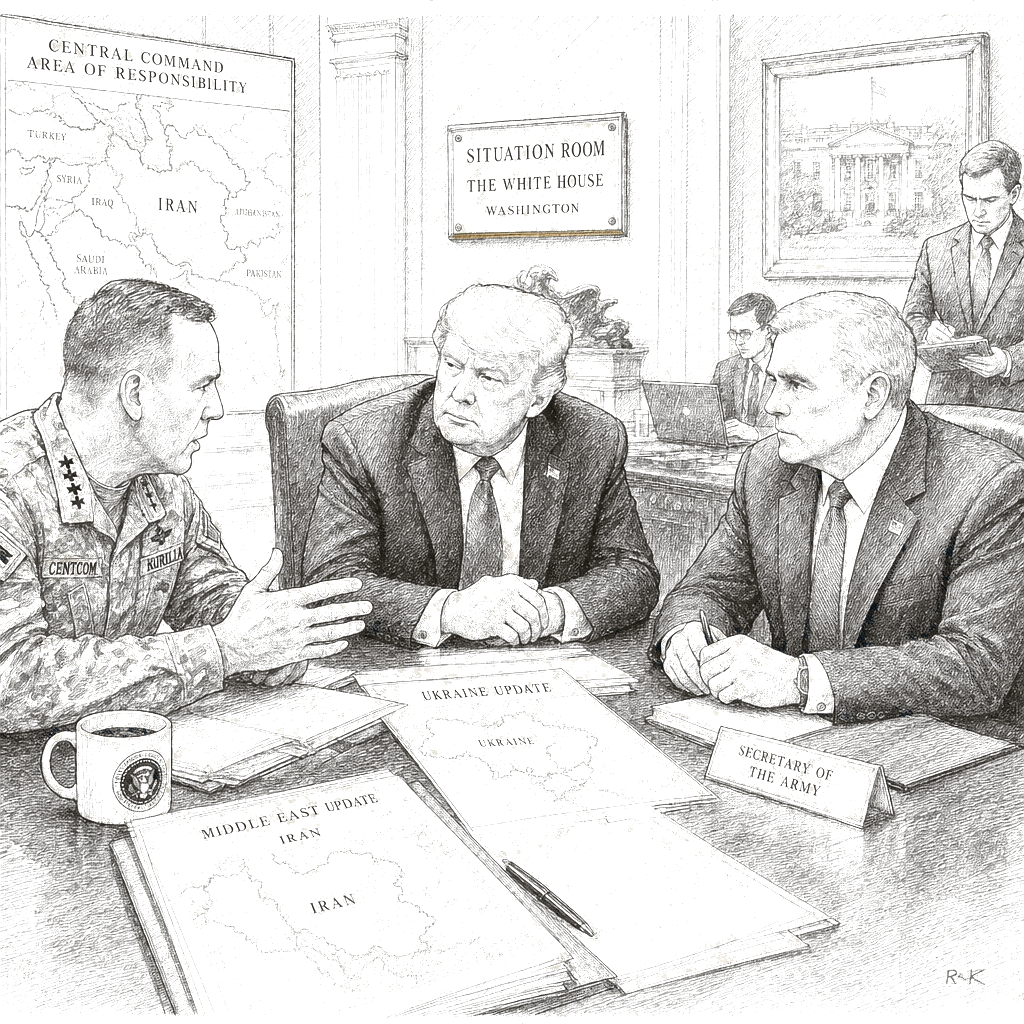
Trump brings military leaders into diplomacy on Iran and Ukraine
President Donald Trump has taken an unusual step for high-level diplomacy by placing senior U.S. military leaders into negotiations involving Iran’s nuclear program and efforts to end the Russia-Ukraine war, the Associated Press reported.
In the Iran track, Adm. Brad Cooper—head of U.S. Central Command—joined indirect U.S.-Iran talks in Oman for the first time, showing up in dress uniform during the sessions. The AP report said Trump’s decision to bring in Cooper reflected both the administration’s break from traditional diplomacy and the message that senior military leadership can convey, even as indirect talks proceed.
In the Ukraine track, the AP report said Army Secretary Dan Driscoll has been reprised as a key negotiator in talks aimed at ending the war. The report described Driscoll as using downtime between sessions to keep contact with Ukrainian officials and acting as a liaison with Trump administration figures, including special envoy Steve Witkoff and Jared Kushner, who have been involved in diplomacy on multiple fronts.
The report said that in addition to Cooper’s access to regional expertise, the choice of military leaders also serves as a signal about the options available to Washington. Elisa Ewers, a Middle East scholar at the Center for a New American Security who served in national security roles in the George W. Bush and Obama administrations, said placing active-duty military leaders in diplomatic roles shows how the Trump administration has “devalued skilled diplomats and the tools of diplomacy in favor of an overreliance on the military to try to solve foreign policy challenges.” She also said that “It often takes an enormous amount of time, investment and hard work to get to the point where you can say diplomacy has succeeded,” quoting a similar idiom that “not every nail needs a hammer.”
Other former officials and defense policy analysts pointed to precedent and to the different expertise required by technical negotiations. Eliot Cohen, who served as counselor of the State Department in the George W. Bush administration, said American generals were involved in arms control talks with the Soviet Union during the Cold War and added that Trump’s approach in bringing Driscoll was more unusual but still something “Presidents do this kind of thing.” Cohen said “There’s a long tradition of American presidents using unusual people as emissaries if they trust them and think they can deliver the message.”
As for Cooper’s role in Oman, Michael O’Hanlon of the Brookings Institution wrote that including the CENTCOM commander was “quite unusual and seems intended to send a message more than to add to the heft of the negotiating team for the talks themselves.” O’Hanlon cautioned that because the relationship between Washington and Tehran is already tense and bad, the move might not change outcomes unless Iran had “had a fundamental rethinking on their nuclear program.” Michael Singh, who previously served as senior director for the Middle East at the White House National Security Council, said Cooper’s presence was more about expertise than signaling, describing Witkoff and Kushner as generalists while Cooper has regional knowledge and access to military experts who can assess proposed concessions.
Trump and his advisers characterized the Oman diplomacy as an opportunity to lower tensions. The AP report said Trump described the talks as “very good” and said more were planned for early next week. The report also said Trump warned that if Iran did not reach a deal on its nuclear program, “the consequences are very steep,” and noted that Trump has repeatedly threatened to use force and has sent warships to the region during Tehran’s crackdown on nationwide protests.
In the Ukraine negotiations, the AP report said Driscoll was tapped in November after talks had stalled, using an already-planned trip to Ukraine to meet with President Volodymyr Zelenskyy and other senior officials. Since then, Driscoll has been part of multiple negotiation sessions, including in Abu Dhabi this week, where the report said his role has coalesced around keeping the dialogue going between sessions and providing a military perspective.
The AP report said Driscoll has experience as an armor officer, including service in Iraq from October 2009 to July 2010 and earning the rank of first lieutenant. In Abu Dhabi, he was joined by U.S. Gen. Alexus Grynkewich, commander in Europe of both U.S. and NATO forces, as part of efforts to reestablish high-level military-to-military dialogue between the United States and Russia for the first time in four years. The report cited a U.S. military statement saying it “will provide a consistent military-to-military contact as the parties continue to work towards a lasting peace.”